
Introduction
In emergency response, life and death can be as different as a matter of seconds. Whether it is a structural fire, a road accident, or a hazardous material incident, the real truck company tactics play a crucial role in guaranteeing the safety, effectiveness, and efficiency of the scene.
Most emergency response activities rely on truck companies. They do not just do transportation but are involved in technical rescue, ventilation, forcible entry, and stabilizing the scene. As the risks and complexities of urban emergencies continue to rise, learning these tactics is no longer a luxury; it is a necessity.
The studies of global emergency response demonstrate that well-trained truck companies with structured tactics can increase the survival rates by up to 3040%. This fact alone shows the need to implement effective strategies that are effective in times of pressure.
To help you save lives on scene, answer the most common questions, and give actionable information that can be introduced at the department level, we’re going to cover 7 strong truck company strategies in this extensive guide.
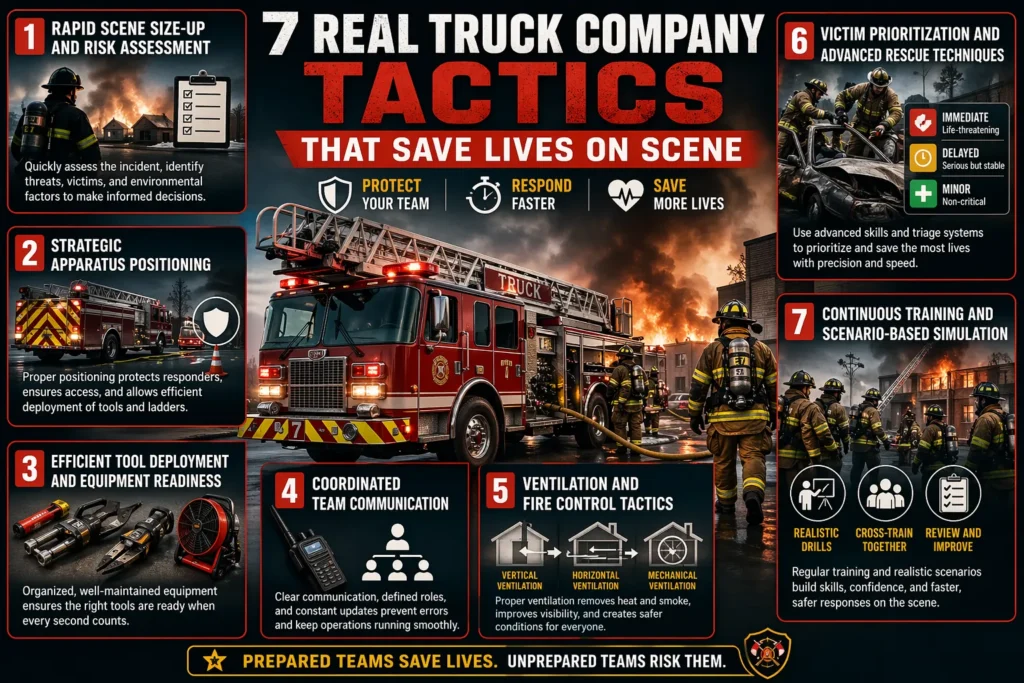
1. Rapid Scene Size-Up and Risk Assessment
The first and most crucial step in any emergency response is a rapid scene size-up. Within moments of arrival, responders must evaluate:
- The nature and severity of the incident
- Immediate threats (fire, collapse, hazardous materials)
- Number and condition of victims
- Environmental factors such as weather and traffic
This initial assessment sets the tone for the entire operation.
Why It Saves Lives:
A well-executed size-up helps teams avoid unnecessary risks while prioritizing critical actions. Without it, responders may act blindly, increasing the chances of errors or injuries.
Best Practice:
Use a standardized approach like “360-degree assessment” to ensure no angle of the scene is overlooked.
Real-World Insight:
Departments that consistently perform structured size-ups report faster decision-making and fewer on-scene complications.
2. Strategic Apparatus Positioning
One of the most overlooked yet vital tactics is how and where the truck is positioned upon arrival.
Proper apparatus positioning ensures:
- Protection of responders from traffic or hazards
- Clear access routes for additional units
- Efficient deployment of ladders and tools
For example, on highways, trucks are often positioned at an angle to act as a protective barrier against incoming vehicles.
Why It Saves Lives:
Incorrect positioning can block access, delay rescue operations, and expose responders to unnecessary danger.
Key Tip:
Always think of the truck as both a tool and a shield.
Impact Statistic:
Strategic positioning has been shown to reduce responder injuries by up to 40% in high-risk environments.
3. Efficient Tool Deployment and Equipment Readiness
In emergency situations, every second spent searching for equipment can cost lives. That’s why top-performing truck companies focus on:
- Organized compartments based on priority
- Clearly labeled tools for quick identification
- Routine checks to ensure equipment functionality
Commonly Used Tools Include:
- Hydraulic rescue tools (Jaws of Life)
- Thermal imaging cameras
- Ventilation fans
- Forcible entry tools
Why It Saves Lives:
Quick access to the right tool enables faster rescue operations, especially in time-sensitive situations like vehicle extrication or fire suppression.
Actionable Strategy:
Conduct “tool drills” where team members practice retrieving and deploying equipment under time pressure.
4. Coordinated Team Communication
Clear, concise communication is the backbone of effective emergency response. Truck companies rely on:
- Standard radio communication protocols
- Defined chain of command
- Continuous updates from team members
Why It Matters:
Miscommunication can lead to duplicated efforts, missed tasks, or dangerous mistakes.
Example Scenario:
During a fire, if ventilation teams and interior crews are not aligned, improper timing can worsen conditions instead of improving them.
Stat Insight:
Effective communication reduces operational errors by approximately 25%, significantly improving rescue outcomes.
Pro Tip:
Adopt plain language communication instead of complex codes to ensure clarity under stress.
5. Ventilation and Fire Control Tactics
Ventilation is one of the most critical functions performed by truck companies during fire incidents. Proper ventilation helps:
- Release heat and smoke
- Improve visibility
- Slow fire progression
- Create safer conditions for victims and responders
Types of Ventilation:
- Vertical Ventilation: Opening roofs to release heat
- Horizontal Ventilation: Using windows and doors
- Mechanical Ventilation: Using fans to control airflow
Why It Saves Lives:
By reducing toxic smoke and heat, ventilation increases the chances of survival for trapped victims and improves working conditions for firefighters.
Important Note:
Ventilation must be carefully timed and coordinated. Poor execution can intensify the fire.
6. Victim Prioritization and Advanced Rescue Techniques
Truck companies often lead technical rescue operations, which require precision and expertise. These include:
- Vehicle extrication
- Rope rescues
- Confined space operations
- Structural collapse rescues
Triage System:
- Immediate: Life-threatening injuries
- Delayed: Serious but stable
- Minor: Non-critical injuries
Why It Saves Lives:
Prioritizing victims ensures that limited resources are used effectively, maximizing the number of lives saved.
Real Insight:
Teams trained in advanced rescue techniques can reduce extrication time by up to 50%, significantly improving survival chances.
7. Continuous Training and Scenario-Based Simulation
Even the best tactics fail without proper training. Leading truck companies invest heavily in:
- Realistic scenario-based drills
- Cross-training with other emergency units
- Post-incident evaluations
Why It Matters:
Training builds muscle memory, enabling responders to act quickly and confidently under pressure.
Key Benefit:
Well-trained teams respond 30–50% faster than those without regular practice.
Actionable Tip:
Introduce unexpected challenges during drills to simulate real-world unpredictability.
Conclusion
In today’s fast-paced and unpredictable emergency environments, relying on outdated or unstructured approaches is no longer an option. Real truck company tactics that save lives on scene are built on precision, coordination, and continuous improvement.
From rapid scene assessments to advanced rescue techniques, each tactic plays a vital role in ensuring both victim and responder safety. Organizations that invest in training, communication, and strategic planning consistently achieve better outcomes.
The reality is simple:
Prepared teams save lives. Unprepared teams risk them.
By implementing these 7 proven tactics, your team can enhance efficiency, reduce risks, and make a meaningful difference when it matters most.
Frequently Asked Questions (FAQs)
What are real truck company tactics?
These are specialized strategies used by emergency response teams to manage incidents effectively, including rescue operations, fire control, and hazard mitigation.
How do these tactics improve survival rates?
By improving coordination, reducing response time, and minimizing risks, these tactics ensure faster and safer rescue operations, leading to higher survival rates.
Why is apparatus positioning critical?
Proper positioning protects responders, ensures smooth operations, and prevents additional accidents, especially in high-risk areas like highways.
What is the most important tactic on the scene?
- While all tactics are essential, rapid scene size-up and communication are often the most critical, as they guide all other actions.
Can smaller teams implement these tactics effectively?
Yes. Even with limited resources, adopting structured tactics and consistent training can significantly improve performance and safety.