
Introduction
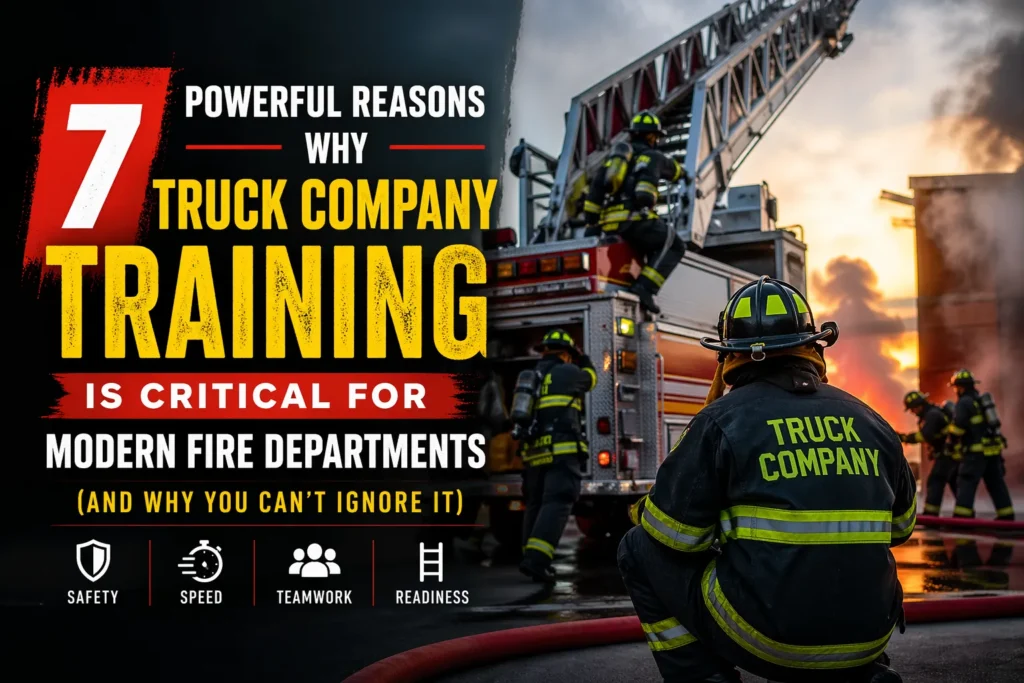
The modern dynamic world of emergency response presents more complex challenges than ever to fire departments. Since the high-rise fire, the truck companies’ functions have gone well beyond what was expected, from technical rescue to hazardous materials. However, one factor that many departments often underestimate is the regular, high-quality training of the truck company.
Even the state-of-the-art equipment and the most trained staff may not be able to achieve the desired results when the seconds count in the end. This is where the training of truck companies comes in, not only as important, but as a mission.
This blog will deconstruct the importance of training in truck companies to modern fire departments, address the most common questions, outline practical strategies, and deliver insights that may help departments increase operational efficiency, safety, and life-saving performance.
What Is Truck Company Training?
The training of truck companies is a special training that is offered to firefighters who are to work with the trucks, and this training includes:
Ventilation (horizontal and vertical)
- Forcible entry
- Search and rescue
- Ladder operations
- Overhaul and salvage
- Technical rescue support
Truck companies are allied but highly tactical, unlike engine companies, which are concerned with water supply and fire suppression, which has a direct effect on the survival rates and fire control.
Why Truck Company Training Matters More Than Ever
Rising Complexity of Fire Incidents
The contemporary buildings are made of synthetic materials that are easy to burn and produce toxic smoke. Modern fires have been known to attain flashover within less than five minutes of ignition, whereas in old buildings, the time taken is around 20 minutes.
Truck crews might not be able to without advanced training:
Without advanced training, truck crews may struggle to:
- Perform rapid ventilation
- Conduct efficient search operations
- Navigate complex layouts
Training makes it possible for firefighters to adjust quickly and respond decisively.
Faster, More Effective Rescue Operations
Truck companies are often responsible for primary search and victim rescue. Proper training improves:
- Search patterns and coordination
- Victim detection speed
- Survival outcomes
Professional truck crews can save lives through reduced rescue time, and this is directly proportional to the well-training of the truck crews.
Enhanced Fireground Coordination
Scenes of fire are hectic. Engine and truck company coordination is crucial.
Truck company training focuses on:
- Communication protocols
- Role clarity
- Timing of ventilation vs suppression
When done right, this coordination:
- Prevents fire spread
- Improves visibility
- Enhances safety for both victims and firefighters
Increased Firefighter Safety
Firefighting is inherently dangerous. However, a lack of training increases risk exponentially.
Truck company training helps firefighters:
- Identify structural collapse indicators
- Perform safe roof operations
- Avoid dangerous ventilation mistakes
It has been statistically proven that the training-based improvements may decrease the number of firefighter injuries by up to 30 percent in certain departments.
Mastery of Specialized Equipment
Truck companies use complex tools such as:
- Aerial ladders
- Hydraulic forcible entry tools
- Ventilation saws
Without proper training, these tools can become liabilities instead of assets.
Frequent practical training makes firefighters effective and safe in handling equipment in emergencies.
Adaptation to Urban Growth and High-Rise Risks
The world is becoming urbanized. The towering structures, narrow corridors, and multi-storey buildings necessitate modern laddering and rescue methods.
- Truck company training prepares crews for:
- High-angle rescues
- Confined space operations
- Multi-story ventilation strategies
This flexibility is a crucial aspect of contemporary city fire departments.
Improved Decision
In emergency scenarios, firefighters have seconds to make life-or-death decisions.
Training builds:
- Muscle memory
- Situational awareness
- Confidence
The more realistic the training, the better the performance on the fireground.
Key Strategies for Effective Truck Company Training
Scenario-Based Training
Simulate real-life incidents such as:
- Residential fires
- Commercial building fires
- Rescue operations
Realistic scenarios improve retention and performance.
Cross-Training with Engine Companies
Encourage joint training sessions to:
- Improve coordination
- Clarify roles
- Enhance teamwork
Use of Modern Technology
Incorporate:
- Virtual reality simulations
- Fireground simulation software
These tools provide safe yet realistic training environments.
Regular Skill Assessments
Evaluate performance through:
- Timed drills
- Practical exams
- Feedback sessions
This ensures continuous improvement.
Leadership Development
Train officers to:
- Make strategic decisions
- Lead teams effectively
- Adapt to changing conditions
Strong leadership is essential for successful operations.
Real-World Impact: A Quick Story
During a high-rise fire incident, a well-trained truck company executed perfect vertical ventilation within minutes. This action:
- Reduced smoke conditions
- Improved visibility
- Enabled faster rescue
As a result, multiple lives were saved.
In contrast, similar incidents without trained truck crews often result in delayed operations and higher casualties.
The Cost of Ignoring Training
Neglecting truck company training can lead to:
- Increased firefighter injuries
- Poor fireground performance
- Loss of life
- Equipment misuse
- Legal and financial consequences
The cost of training is far less than the cost of failure.
Conclusion
The training in truck companies is not a luxury anymore, but a necessary need of the contemporary fire departments. The demands of highly trained, flexible, and synchronized truck crews are on the increase as the complexity of fireground challenges increases.
The benefits of having proper training cannot be denied, whether it comes to the enhancement of firefighter safety or the enhancement of rescue operations. The departments that invest in training today will be in a better position to save lives, property, and work safely tomorrow.
Frequently Asked Questions
How often should truck company training be conducted?
Training is ideally to be done on a weekly or bi-weekly basis, where weekly drills and scenario-based exercises are to be carried out. The ability to be consistent is the main factor in keeping skills and readiness.
What are the most critical skills for truck companies?
The most essential skills include:
- Forcible entry
- Search and rescue
- Ventilation techniques
- Ladder operations
These skills form the backbone of effective truck company performance.
Can small fire departments benefit from truck company training?
Absolutely. Even smaller departments face complex emergencies. Training ensures:
- Better resource utilization
- Improved teamwork
- Higher survival rates
Training is not a choice; it is a necessity whether the department is large or small.
What is the biggest mistake departments make?
- One of the biggest mistakes is treating truck training as secondary to suppression training. In reality, both are equally important and must work together seamlessly.
How does training impact response time?
While training doesn’t directly change travel time, it:
- Reduces on-scene confusion
- Improves task execution speed
- Enhances coordination
This leads to faster overall incident resolution.