
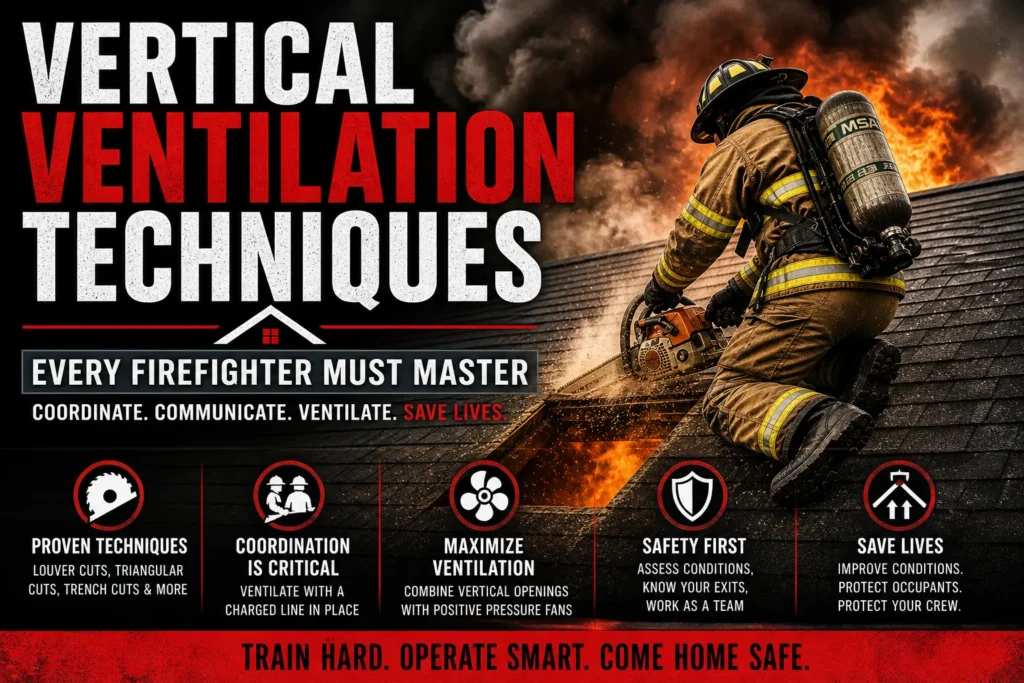
Introduction
When responding to a structure fire, time is of the essence. As smoke obscures vision and hot gases prepare to flash and burn anything in their path, firefighters are faced with one of the most important tactical decisions: how to ventilate the structure. Proper vertical ventilation can turn a fire attack into a flashover that can kill dozens of occupants and firefighters.
But this crucial skill is one of the most poorly understood and executed aspects of firefighting. Errors in vertical ventilation can instantly make conditions worse, lock in occupants, and even cause firefighters to fall through collapsing structures.
This article explains the basics, advanced methods, and strategies to perform vertical ventilation techniques, so you and your team can successfully perform this life-saving skill with accuracy, confidence, and safety every time.
What Is Vertical Ventilation and Why Does It Matter?
Vertical ventilation involves opening holes in the roof to allow heat, smoke, and other deadly gases to rise out of a structure. By allowing heat and smoke to rise, vertical ventilation is performed with the natural thermal column, as opposed to against it, and is one of the most effective ventilation techniques for structural firefighting.
The National Fire Protection Association (NFPA) estimates that most fire deaths in the United States are a result of smoke inhalation. Ventilation greatly increases the chance of survival for trapped victims and makes entry conditions safer for interior attack firefighters. When combined with hose advancement, vertical ventilation helps to extinguish the fire faster, reduces the potential for flashover, and shortens the duration of the incident.
The stakes could not be higher. Understanding this technique thoroughly is not optional — it is a professional obligation.
The Core Principle: Coordinated Ventilation
Before diving into specific techniques, every firefighter must internalize one non-negotiable principle: ventilation must always be coordinated with the interior attack crew.
Ventilating a roof without a charged hose line below it creates a deadly chimney effect, which can intensify a fire. The Underwriters Laboratories (UL) Firefighter Safety Research Institute has released groundbreaking data showing uncoordinated ventilation can double the size of a fire in just minutes. Always talk to Incident Command. Always check the hose line is ready to go.
Essential Vertical Ventilation Techniques Every Firefighter Should Know
The Louver Cut
The louver cut is the most basic vertical ventilation cut taught in fire academies worldwide. It’s a square or rectangular cut in the decking to create a controlled opening for smoke and heat to exhaust above the fire.
Execute the louver cut using these precise steps:
- Locate the fire from the ground and thermal images before ascending the roof.
- Probe the roof in front of you before each step with a pike pole or roof hook to ensure it is safe to step.
- Stand upwind, on a safe part of the roof, and keep an eye on your exit.
- Cut two parallel lines along the length of the required opening, and complete a rectangle by making two cross cuts.
- Use a roof hook or pike pole to push the cut section downward, creating the louver flap that opens into the attic space below.
- Check the smoke conditions immediately. Good ventilation results in a strong, constant flow of smoke through the opening, verifying the cut is above the fire.
The louver cut should be at least 4 feet x 4 feet, but larger sizes facilitate quicker heat release and better conditions for interior crews.
The Triangular Cut
The triangular cut is a good fast ventilation alternative when time is of the essence or roof access is restricted. It requires fewer and shorter saw cuts than the full louver and can be cut in less than a minute by a well-trained firefighter.
Deploy the triangular cut effectively in these specific situations:
- Peaked or steep roofs: The triangular cut can be made on steep roofs where positioning for a full louver is difficult and unsafe.
- Rapidly deteriorating interior conditions: When interior crews report sudden worsening visibility or heat, the triangular cut provides faster relief than a full louver.
- Limited crew availability: When only one firefighter can be committed to roof operations, the triangular cut’s reduced steps make solo execution more manageable.
- Supplemental openings: Use triangular cuts alongside a primary louver cut to increase total exhaust area when fire conditions demand it.
While it produces a smaller opening than a standard louver, the triangular cut buys critical time for interior crews when every second matters.
The Strip (Trench) Cut
The trench cut (also known as a strip cut) is a large-scale vertical ventilation cut designed to halt the spread of fire in an attic or cockloft. Instead of making vertical vents straight above the fire, crews cut a long strip (trench) in line with the fire’s travel, stopping the fire in the roof structure.
Deploy the trench cut in these high-risk scenarios:
- Large commercial buildings: Open cocklofts in commercial buildings provide long horizontal travel paths for fire. The trench cut prevents fire travel.
- Taxpayer buildings: “Strip” commercial structures are known to conduct fire spread at a dangerous rate, so trench cuts are often used in city fire departments.
- Row houses and attached dwellings: Fire spreading through connected cocklofts has the potential to attack multiple occupancies – a trench cut stops the spread and saves non-combustible structures.
- When a direct attack above the fire is not possible: If roof conditions directly above the fire are too compromised to operate safely, the trench cut allows crews to work on more stable sections while still controlling fire travel.
Before trench cutting, always check the direction of fire travel. Cutting on the wrong side will increase, not decrease, fire spread – a potentially devastating mistake.
Hydraulic Ventilation Combined with Vertical Openings
Hydraulic ventilation is often thought of as horizontal ventilation, but using positive-pressure fans in combination with a vertical opening above the fire greatly enhances smoke and heat removal rates. This tactic is increasingly popular in departments after groundbreaking UL studies.
Apply this combined tactic effectively by following these guidelines:
- Establish the vertical opening first: Create your roof cut and confirm it is drawing before positioning fans below — the opening must exist before pressurization is useful.
- Position the fan at a primary entry point: Place the positive pressure fan at the main entry door or a lower-level opening to create a directed, building-wide airflow path.
- Confirm a clear flow path: Smoke and heat must have an unobstructed route from the fan entry point upward and out through the roof opening. Doors and stairwells along this path should be managed accordingly.
- Monitor interior conditions continuously: Interior crews must report condition changes as pressurization begins, allowing Command to adjust fan placement or opening size as needed.
- Use for post-knockdown overhaul: This combined approach excels during overhaul operations, rapidly clearing residual smoke and dramatically improving visibility for damage assessment crews.
UL testing shows this combined approach results in quicker fire knockdown and better interior conditions than either approach alone.
Natural Vertical Ventilation Through Existing Openings
Vertical ventilation operations don’t always involve cutting. Where possible, firefighters should and can use existing roof openings to expedite ventilation. These include:
- Skylights: Skylights can be removed or broken to provide an instant exhaust opening. Open skylights before cutting openings if they are located above the fire.
- Scuttle hatches: These roof hatches are often found in commercial structures and can be opened rapidly to provide immediate relief without the need for cutting.
- HVAC penetrations: HVAC penetrations can be used as supplementary exhaust outlets, especially in commercial buildings where the large rooftop units create large existing holes.
Leveraging existing openings is the first line of attack because it saves time, maintains building stability, and helps combat crew fatigue. all key factors on the fireground.
Every firefighter operating on a roof must:
Sound continuously: Never stop sounding the roof with your hook. A solid sound indicates structural integrity; a hollow or springy feel demands immediate withdrawal.
Maintain egress awareness: Always know your two exit routes before you begin cutting. Never position yourself between your cut and your only escape path.
Read smoke conditions: Black, turbulent, high-velocity smoke pushing from eaves indicates extreme fire conditions below. Recognize when conditions are too dangerous to operate.
Work in pairs: Never operate alone on a roof. Your partner watches conditions, monitors your safety, and provides immediate assistance if needed.
Know your building construction type: Type III (ordinary) and Type V (wood frame) construction collapse most quickly in fire. Your understanding of the NFPA 220 building construction type affects roof safety.
Conclusion:
Vertical ventilation is both one of the most potent and one of the most deadly firefighting skills. When done properly, with coordination and tactical acumen, it saves lives. The lives of the victims trapped by the fire and the lives of firefighters relying on it to clear a path to the fire for attack.
Executed carelessly, it kills.
Those firefighters who achieve safe and effective vertical ventilation are not just fortunate; they are skilled, proficient, and tactically proficient. They have studied building construction. They have practiced their saw skills until they become automatic. They talk continuously and effectively to their Incident Commander and interior firefighters.
Commit to mastering these techniques now, in the training ground, so that when fire conditions demand your best performance, you deliver it without hesitation. Your crew is counting on you. The people inside that burning building are counting on you.
Train hard. Operate smart. Come home safe.
Frequently Asked Questions
How do I know if vertical ventilation is the right tactic for the situation?
Vertical ventilation is most appropriate when fire is confirmed in the attic or upper floors, when interior crews report deteriorating visibility conditions, or when horizontal ventilation alone proves insufficient. Always base your decision on a solid size-up and clear communication with interior crews.
What type of saw is best for roof operations?
The rotary saw with a carbide-tipped blade is still the most common, quick, and efficient saw for roof cutting. But many departments also use chainsaws for pitched roofs. Be familiar with all departmental equipment and practice using it.
Can vertical ventilation make conditions worse?
Yes, if done wrong. Vertical ventilation prior to the hose lines being charged and deployed, cutting on the wrong side, and creating inlets rather than outlets can all make things significantly worse. This is why good communication and training are critical.
How large should a ventilation opening be?
The minimum recommended opening size for a single-family dwelling is 4×4 feet. But bigger fires or fast-moving fires require larger openings. The rule of thumb: if in doubt, go big – more heat and smoke will be vented.