
INTRODUCTION
Forcible entry is one of the most important skills a firefighter can learn and the proper equipment will mean the difference between success and failure on the job. Firefighters are put at a disadvantage in emergency situations when doors are locked, barriers are reinforced, and hazards are unpredictable and require exact application of force. Without the proper equipment, the job will take longer, be more hazardous, and could put the people working and the people trapped at risk.
There are special challenges in the modern fireground. Buildings are built with tougher materials, sophisticated locks and fireproof doors which need special equipment for quick entry. Poorly maintained or inadequate tools may lead to delayed rescue, property loss and fire or collapse hazard. However, learning the proper tools increases speed, safety and overall effectiveness.
Firefighters need to know not just how to use the tools but when and how they will work and what tools not to use and why. Whether it’s the old-fashioned Halligan bar and flathead axe, hydraulic spreaders or rotary saws, they all have specific functions. Selection and use of appropriate materials and equipment will afford quick access, ensure property protection and safeguard the safety of firefighters and civilians.
This extensive guide will discuss the best tools available for forcible entry, along with their pros, cons, and ideal applications. Firefighters will also gain knowledge on operational techniques, step-by-step procedures, best practices, common mistakes and safety. Whether you’re a recruit or a seasoned professional, this guide offers practical advice to help you perform at your best and be prepared for any fireground situation.
QUICK ANSWER
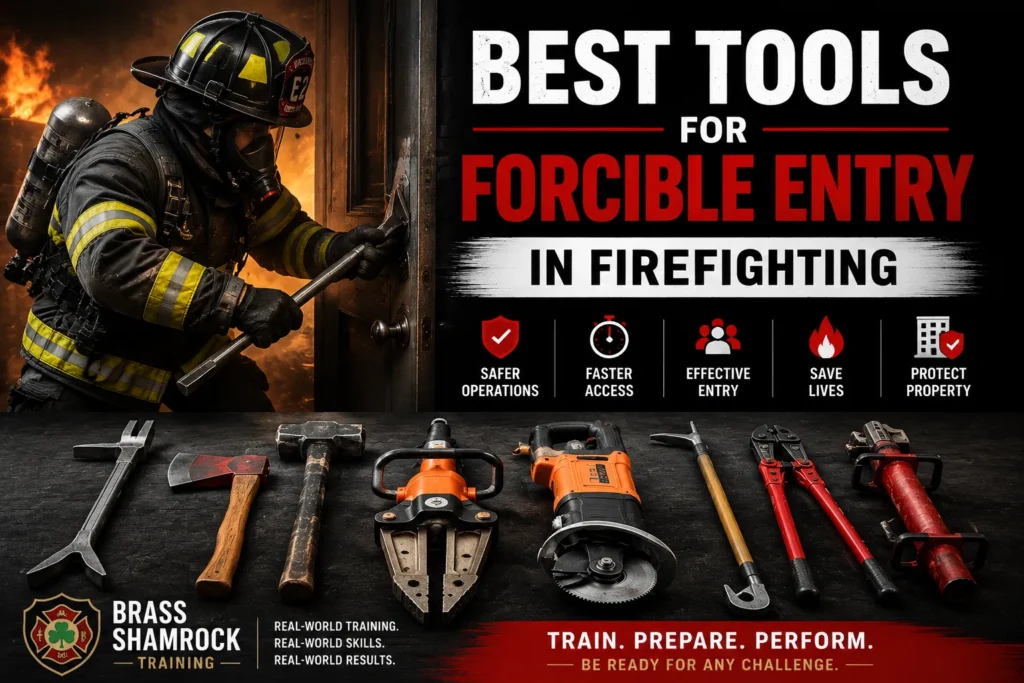
The best tools for forcible entry include Halligan bars, flathead axes, sledgehammers, hydraulic spreaders, rotary saws, pike poles, bolt cutters, and rams. Each tool is selected depending on the type of barrier, the fireground conditions and the tactical goals, and is selected to be ready, safe and efficient to operate.
WHAT IS TOOLS FOR FORCIBLE ENTRY IN FIREFIGHTING?
Definition: Hand and mechanical devices used to aid firefighters in forced entry through locked, blocked or reinforced barriers during emergencies.
Purpose: They provide quick access to rescue, fire suppression and ventilation, keeping firefighters safe, and maximizing operational efficiency.
History: Traditional tools like axes and Halligan bars have evolved alongside firefighting techniques. Modern innovations include hydraulic tools, rotary saws, and battery-powered breaching devices that address reinforced doors and complex locks.
Fireground Relevance: Every structure fire or rescue scenario may require forcible entry. Firefighters will evaluate doors, windows, walls and locks to determine which tools to use. Worn or misused equipment can impede access and affect safety.
Operational Importance: Understanding how to use the tools will increase the rate of victim rescue, fire suppression, and reduce property damage. Success depends on crew coordination and communication and on the use of the proper tools.
Practical Applications: Tools used in residential homes, commercial buildings, industrial facilities, vehicles and high-rise structures. Mastery helps firefighters deal with different barriers and structural designs with efficiency.
WHY THIS SKILL MATTERS ON TODAY’S FIREGROUND
- Firefighter Survival: Correct tools reduce exposure to fire, smoke, and collapse hazards.
- Victim Survivability: Quick access saves lives in time-critical rescues.
- Operational Efficiency: Proper tools minimize wasted effort and streamline crew tasks.
- Property Conservation: Controlled entry reduces unnecessary structural damage.
- Crew Accountability: Clear roles with tools improve team coordination.
- Tactical Effectiveness: Optimized tool use supports suppression, ventilation, and rescue strategies.
- Modern Building Challenges: Reinforced doors, fire-rated barriers, and metal gates demand updated tools.
- Time-Critical Operations: Every second saved by the right tools can prevent fatalities and reduce fire spread.
HOW IT WORKS
Process Overview:
- Size-up: Identify barrier type, locks, and potential hazards.
- Select Tools: Match the tool to the door, lock, or wall construction.
- Crew Positioning: Ensure proper stances and assign primary and backup roles.
- Apply Technique: Use controlled force with the selected tool.
- Confirm Entry: Verify the opening is safe and adequate.
- Tactical Deployment: Enter and advance hoses or rescue teams.
- Communication: Maintain verbal cues and accountability checks.
- Reassessment: Check structural integrity and plan subsequent operations.
ESSENTIAL EQUIPMENT AND TOOLS
Tool | Purpose | Advantages | Limitations | Best Use Case |
Halligan Bar | Pry, twist, or breach doors | Versatile, durable, multipurpose | Requires skill and training | Residential and commercial doors |
Flathead Axe | Striking and chopping | Durable, dual-purpose | Heavy fatigue over time | Wooden doors, lock plates |
Sledgehammer | Force application | High impact, simple | Can damage property if uncontrolled | Metal doors, barricaded entries |
Hydraulic Spreader | Open reinforced barriers | Fast, precise, mechanical advantage | Requires a power source | Vehicle doors, high-security commercial doors |
Rotary Saw | Cut through locks, walls, roofs | Rapid, precise | Noise, sparks, heat | Metal doors, composite locks, reinforced barriers |
Pike Pole | Pulling ceilings, removing obstacles | Extended reach, maneuverable | Limited on doors | Ventilation, debris removal |
Bolt Cutters | Cut padlocks, chains | Portable, simple | Limited to thinner metals | Gates, chain-secured entrances |
Ram Tool | Push or break doors | High impact, efficient | Heavy, requires backup | Locked commercial doors |
Tool Details:
- Halligan bars paired with axes form the classic “Irons” for precise entry.
- Hydraulic spreaders reduce physical strain on personnel while tackling high-security doors.
- Rotary saws are essential for metal or composite barriers.
- Bolt cutters and rams provide solutions for non-traditional obstructions.
CONCLUSION
Mastering the best tools for forcible entry is crucial for firefighter safety, operational efficiency, and successful rescue operations. By ensuring the appropriate tools are selected, regular maintenance and scenario-based training, crews will be able to respond promptly and safely to any barrier or structure.
When firefighters know the purpose, benefits, and drawbacks of each tool, whether it’s a Halligan bar, hydraulic spreader, or rotary saw, they can perform forcible entry with accuracy, which reduces delays, saves lives and property. These tools would be best applied in high-stress situations as a result of regular drills, crew coordination, and situational awareness.
Frequently Asked Questions
What are the essential tools for forcible entry in firefighting?
Basic tools such as halligan bars, flathead axes, sledgehammers, hydraulic spreaders, rotary saws, pike poles, bolt cutters and rams are required. Every tool is used in specific applications depending on the type of door, material of the barrier and tactical requirements.
How do I select the right tool for a specific entry?
Evaluate type of door, lock or barrier. Operate manual tools on wood or standard doors and mechanical/hydraulic tools for reinforced or metal barriers.
Can forcible entry be done safely with only hand tools?
Yes for simple doors, but not for reinforced, mechanical or powered tools are more effective in terms of speed and physical endurance.
How does proper tool selection improve firefighter safety?
Choosing the right tool decreases the amount of physical strain, hazards and risk of collapse, while also increasing access time.
Are there tools specific to commercial or industrial buildings?
Yes. Metal doors, chains or high-security barriers, such as those found in commercial or industrial buildings, frequently require the use of a hydraulic spreader, rams or rotary saws.