
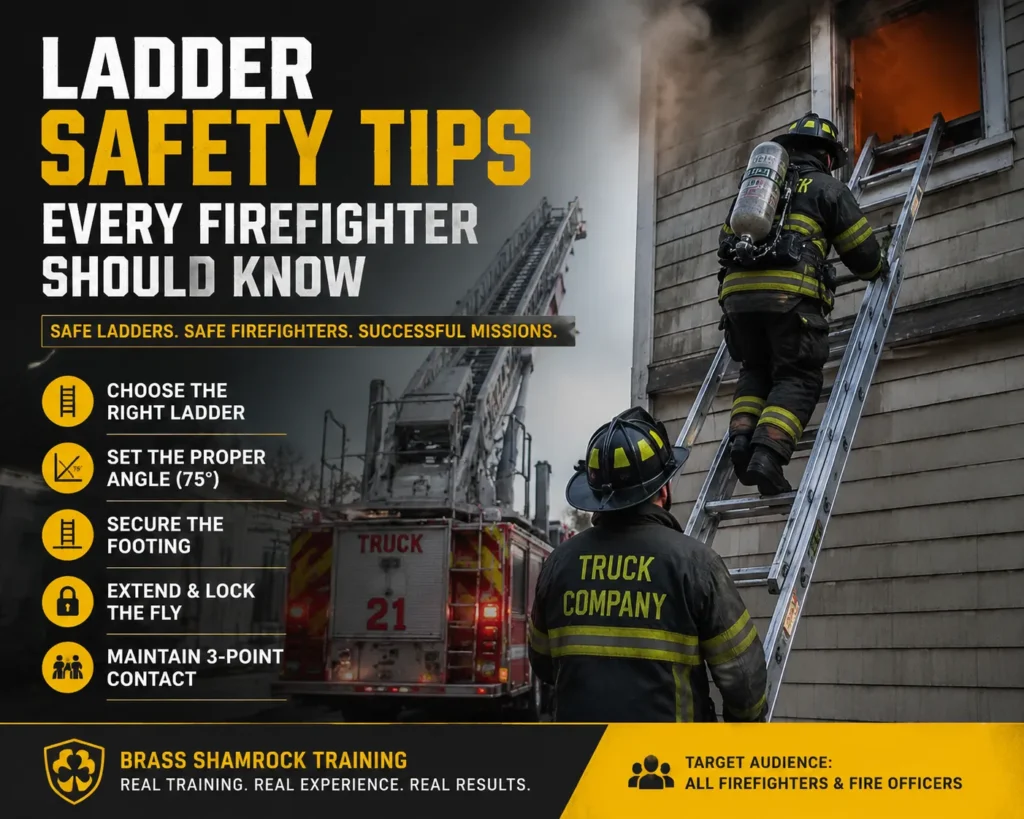

Brass Shamrock Training — Ground Ladders Academy Level
When the Ladder Fails, Everything Fails
The Scenario We All Know Too Well
It’s 0200 hours. Residential structure fire. Heavy smoke pushed from the second floor. The engine makes the front door with a line. Truck company swings to the Charlie side and throws a 24’ extension ladder for secondary egress and a possible victim search.
The ladder goes up. Height looks right. Dogs appear locked. Angle seems okay. The tip is square. Spurs are set. The tip firefighter climbs. But the heel firefighter doesn’t heel. Or the dogs weren’t actually locked. Or the fly wasn’t fully extended. And when the butt kicks out, the climber is three rungs from the sill. He falls ladder and all onto a concrete walkway.
This isn’t a theoretical “what if.” These failures happen every year across the country, and they’re almost never caused by equipment failure. They come from technique failures, complacency, lack of reps, or simply not understanding why each step of a ladder throw exists.
Ground and aerial laddering are essential truck-company skills and some of the most commonly shortcut operations on the fireground. We throw ladders in the heat, in the dark, in full gear, on uneven ground, and under time pressure. Every shortcut increases the chance of injury or death. Ladder safety isn’t a checklist. It’s a mindset. It’s a habit. It’s a discipline.
Ladder Failures Don’t Come from Extreme Situations
Most ladder-related injuries don’t happen during unusual or high‑risk operations. They happen during normal tasks performed without the necessary sets and reps to make the basics automatic. When firefighters don’t have enough repetition, they rely on conscious thought and conscious thought collapses under fireground stress.
The Failure Patterns We See Everywhere
Across hundreds of training evolutions, the same issues show up repeatedly:
- Butt set too close to the building, creating a steep, unstable angle.
- Fly section not locked before climbing.
- Heel abandoned the moment the climber starts up.
- Two firefighters lifting and throwing without communicating timing or direction.
- Ladder placed against weak surfaces instead of solid contact points.
- Career firefighters make the same mistakes as recruits because skills decay without consistent training.
These aren’t “rookie mistakes.” They’re human mistakes and they happen to anyone who doesn’t train ladders regularly.
Stress Makes Good Firefighters Do Dumb Things
Situational pressure increases cognitive load:
- Fatigue
- Night operations
- Heavy fire conditions
- Limited visibility
- Conflicting priorities
Under stress, firefighters revert to their strongest habits. If the habit isn’t solid, the operation isn’t safe. That’s why ladder safety must be drilled into muscle memory not reviewed occasionally.
Skill Decay Is Real
If a firefighter only throws ladders during annual certification, they are not proficient. Proper angle, proper heel, fly lock confirmation, climbing posture these skills fade fast without repetition. Ladder work must be practiced until it becomes instinctive. Only then will it hold up under fireground pressure.
Ladder Selection: Getting the Right Tool to the Right Place
Maintenance and Pre‑Use Inspection: The Step Before the Throw
A ladder that’s mechanically compromised is a hazard no technique can overcome. Pre‑use inspection is easy to skip and expensive to ignore.
Ground ladders must be checked for:
- Bent or cracked beams
- Damaged rungs
- Broken pawls
- Heat or flame damage
- Warpage or structural distortion
Ladders exposed to fire even those stored that passed through high radiant heat may be damaged in ways that aren’t obvious. Any ladder showing signs of heat or mechanical failure must be taken out of service immediately and inspected by a qualified person. NFPA 1911 outlines the inspection requirements, and these exceed what a morning apparatus check can accomplish. Crews should still perform a pre‑shift walk‑around:
- Check fly sections for binding
- Inspect for mechanical issues
- Verify halyard condition
- Conduct a basic range‑of‑motion test
If something is wrong, document it and report it. Quiet workarounds are not risking management; they’re gambling.
Choosing the Right Ladder
The wrong ladder creates hazards you can’t fix with good technique.
Height matters. If the ladder is too short, the firefighter will have to reach over the top rung to transition, and the ladder may not provide safe egress if conditions deteriorate.
Longer isn’t always better. Long ladders are harder to maneuver in tight spaces, more likely to be thrown at a bad angle, and place more physical strain on the crew.
A good rule of thumb: The ladder should extend 3–5 rungs above the roofline or sill.
Weight ratings matter too. NFPA 1931 sets minimum load requirements, but what matters most is knowing the rating of each ladder on your rig. A firefighter in full PPE and SCBA weighs significantly more than a firefighter in station gear, add a victim, and the load increases again. Never assume the rated capacity is a “suggestion.” Know your ladders. Know their limits.
The Angle Is Not a Preference, It’s Physics
A proper climbing angle is 75 degrees, or roughly 1 foot out for every 4 feet of working height.
This isn’t tradition it’s physics:
- Angles steeper than 75° shift the climber’s center of gravity behind the ladder, increasing the chance of a backward fall.
- Angles shallower than 65° increase compressive force on the butt and make kick‑out more likely.
- Shallow angles also make climbing harder and increase fatigue.
Quick Field Check
Stand at the butt, place your foot on the bottom rung, extend one arm straight out. If your hand touches a rung at shoulder height, the angle is close.
Common Angle Mistakes
The most frequent error: Butt placed too close to the building.
Crews in a hurry often throw ladders nearly vertical. The climber feels unstable but may not know why. Moving the butt 12–18 inches can completely fix the problem. In tight alleys or congested apparatus placements, the ideal angle may not be possible. In those cases:
- Adjust heeling technique
- Communicate the limitation to the climber
- Operate within known parameters
Professional ladder work is flexible, not rigid.
Heeling, Tying Off, and Securing the Base
Heeling is one of the most under‑trained parts of ladder operations and one of the first things abandoned on the fireground.
Heeling means:
- Foot planted at the butt
- Body weight applied downward and inward
- Continuous pressure throughout the climb
Heeling from the front of the ladder is preferred so the firefighter can observe and participate in the operation.
Tying Off
If the heel firefighter must leave the position, the ladder should be tied off but only if:
- The tie‑off is secure
- It doesn’t require constant attention
- Time and conditions allow it
Fast‑moving operations often don’t. If the heel firefighter must climb, the tip firefighter can maintain ladder control while they ascend.
Surface Conditions Matter
Wet pavement, ice, gravel, or soft soil can cause the butt to shift even with a heel. Crews should train on sub‑optimal surfaces so they can recognize when additional stabilization is needed.
Contact Points, Climbing Posture, and Load Distribution
Three points of contact always. Full PPE and SCBA shift a firefighter’s center of gravity backward and reduce fine motor control. That’s why climbing in gear must be the standard, not the exception.
Climbing Posture
- Weight centered between the rails
- Eyes forward, not down
- Arms slightly bent to absorb movement
- Controlled pace, especially on descent
Descending is where many injuries occur fatigue, smoke, and poor visibility make missed rungs more likely.
Fly Section Orientation and Extension Protocol
The fly section, pawl locks, and extension height all matter.
Fly Orientation
We teach:
- Throw fly‑in for climbing
- Roll to rescue when victim removal is required
Fly‑in creates a step in at the fly section transition, giving the climber a smoother, more stable ascent. Rolling to rescue creates a smoother descent path for victim removal.
Pawl Locks
Pawls must be locked before climbing, no exceptions.
Standard practice:
- Heel firefighter or officer verbally confirms “Pawls locked” before the climber touches the first rung.
Extension Height
The ladder should extend above the roofline or sill:
- Too little extension = unstable transitions
- Too much extension = unnecessary stress on the fly section
Communication Is Mandatory
The operator must communicate every adjustment, even small one. Rapid acceleration at the tip can injure firefighters.
Environmental Factors
Wind loading, icing, and slow evacuation from height all increase risk. Crews must train in less‑than‑ideal conditions, not just perfect weather.
Instructor Insight
The most dangerous moment isn’t full extension it’s repositioning under pressure when communication breaks down.
The Fireground Context: Decisions Under Pressure
Ladders aren’t used in isolation. They’re deployed in the chaos of fireground operations.
Common issues:
- Crews place ladders where they’re convenient, not where they’re ideal
- Ladders thrown onto unstable surfaces
- Poor visibility affecting angle judgment
- Collapse zones ignored
- Ground ladders interfering with hose advancement
- Ladder placement limiting water application
Training must reflect real conditions, not parking‑lot perfection.
Training Frequency and Skill Decay
Ladder skills fade fast.
Monthly or quarterly training is far more effective than annual certification. Training should include:
- Odd surfaces
- Confined spaces
- Full‑gear climbs
- Fatigue drills
- Integrated fireground tasks
- Heel techniques on varied terrain
Ladders are not the end goal; they support ventilation, rescue, and suppression. Training should reflect that. Officers should review near‑miss data from their own department and national sources (NFPA, NIOSH). Ladder‑related incidents are common enough to justify dedicated training segments. When your department needs realistic, fireground‑driven ladder training, advanced programs from Brass Shamrock Training exist to build true proficiency not just test‑ready skills.
Communication Protocols That Prevent Ladder Incidents
Most ladder accidents are communication failures.
Assumptions kill:
- The climber assumes the heel is held
- The heel assumes the fly is locked
- The officer assumes the crew knows the load limit
Effective crews use short, intentional confirmations:
- “Area clear.”
- “Heel set.”
- “Pawls locked.”
- “Climber on.”
- “Ladder moving.”
These aren’t radio transmissions, they don’t slow down the operation, they’re ingrained, ongoing checks. Officers must enforce communication discipline. When shortcuts are allowed in training, they become habits on the fireground.
Final Thoughts: The Ladder Is Only as Safe as the Crew Throwing It
Ladders are engineered to NFPA standards with generous safety margins but none of that matters if:
- The heel is empty
- The angle is wrong
- The fly isn’t locked
- The crew isn’t communicating
Ladder failures don’t just injure firefighters. They disrupt operations, drain resources, and can eliminate the very access point another crew depends on.
A ladder is a lifeline but only when the fundamentals are executed with discipline, repetition, and respect for the tool.
