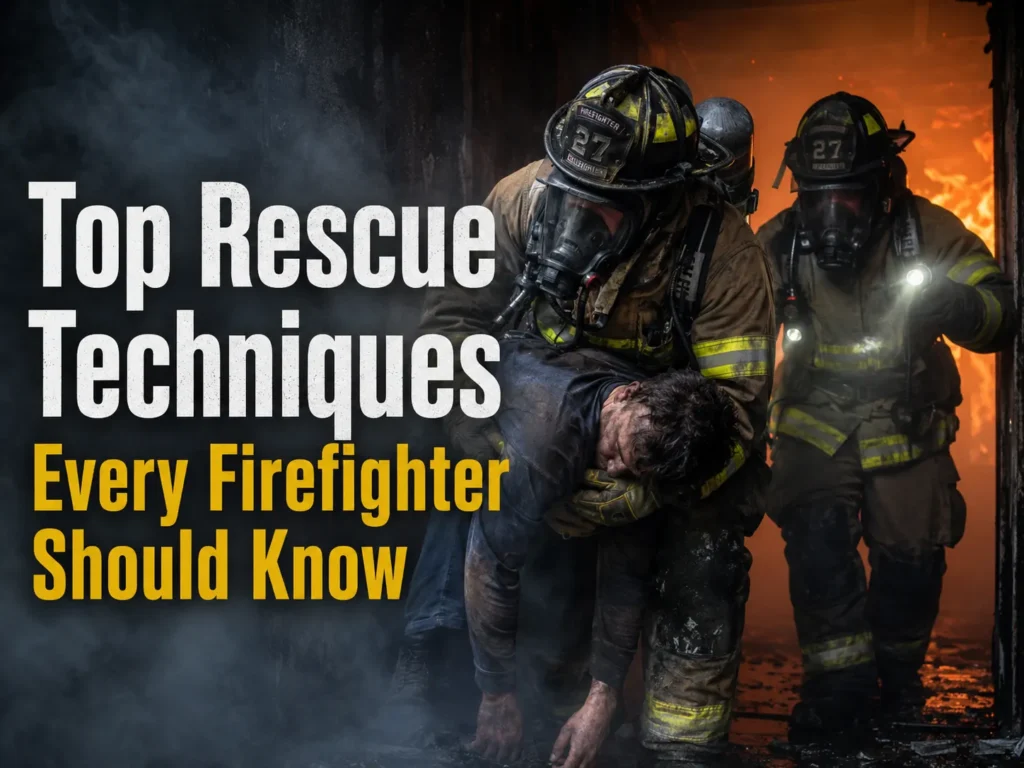
For most people, the image of firefighting involves firefighters using hoses to fight fires. The essence of the profession is, in fact, rescuing. Every call is to save lives, trapped civilians, or fellow firefighters in an emergency.
Firefighter rescue skills do not develop in the classroom. They result from realistic search-and-rescue training, multiple practice sessions, and learning to do things under stress. Even the most experienced firefighters can be overwhelmed by smoke, heat, limited visibility, and time pressure if they have not received training to prepare them for real-world conditions.
Here are some of the most critical skills every Firefighter should know to make him/her more effective on the fireground and more likely to survive.
Quick Answer
The rescue techniques every firefighter should know include primary search in zero visibility, victim location and removal, Vent-Enter-Search (VES), Rapid Intervention Crew (RIC) operations, and effective Mayday recognition and response. These critical firefighter rescue techniques require consistent hands-on training, realistic scenarios, and repeated practice to become second nature during emergency incidents.
Primary Search in Zero Visibility
The primary search is one of the most critical firefighter rescue skills in very poor visibility. One of the challenges of a structure fire is orientation; it can be lost within seconds of entering a fire because of the thick smoke.
Effective firefighters use effective search patterns; keep contact with the wall; keep in constant communication with crew; and remain cognizant of fire-changing conditions. Firefighters will build muscle memory from repeated search-and-rescue training, allowing them to concentrate on the victims rather than getting fixated on navigation.
Firefighters can become hesitant in the absence of zero visibility practice, and hesitation can prove to be a vital time log loss in a rescue.
Key skills include:
Maintaining orientation in heavy smoke
Following systematic search patterns
Effective team communication
Reading changing fire conditions
Fast victim identification
Victim Location and Removal Techniques
Finding a victim is only the beginning. The real challenge is removing them safely and quickly.
All firefighters should know several methods of victim removal, such as drags, carries, stairwell removal, and confined-space removal. Victims are rarely in an easy position to lift, and unconscious adults are much heavier and harder to move than the training mannequins.
Realistic loads/weights, full PPE, and awkward rescue scenarios prepare firefighters for real emergency rescue situations.
Important firefighter rescue skills include:
Victim assessment
Proper lifting mechanics
Victim packaging
Stairwell rescue
Window rescue
Confined space victim removal
The more realistic the training, the smoother these skills become during real incidents.
Vent-Enter-Search (VES)
Vent-Enter-Search (VES) is one of the most advanced search-and-rescue techniques used in residential fires.
This approach includes opening a window, entering through the opening, closing the door to isolate the room, searching the room for victims, and, as soon as possible, moving to the next room before the situation worsens.
VES requires teamwork, swiftness, confidence and great situational awareness. Firefighters need to be confident in entering unknown areas, while dealing with heat, smoke and the changing nature of the fire.
There should be repeated VES evolutions under proper smoke conditions, not just a demonstration.
Critical VES skills include:
Safe window entry
Room isolation
Victim search
Exit planning
Crew communication
Rapid Intervention Crew (RIC) Operations
Few situations are more stressful than rescuing one of your own.
Rapid Intervention Crew operations are a high priority for locating and extricating downed firefighters in Mayday operations. All firefighters need to know individual firefighter survival techniques and coordinated RIC rescue techniques.
The ability to improvise is not essential for successful RIC teams; preparation is. Quickly locate the firefighter, assess the air supply, clear any entanglements, package the victim, and complete the rescue under extreme conditions.
Effective RIC training for downed firefighters should always include:
Full protective gear
Limited visibility
Air management drills
Realistic obstacles
Time pressure
Team communication
Under stress, muscle memory consistently outperforms memorized procedures.
Mayday Recognition and Response
A mayday doesn’t start when the radio button is pressed.
Qualified firefighters can recognize warning signs before an emergency is called. Long before a mayday call, increased breathing, confusion, poor radio communications, loss of orientation and worsening fire conditions are likely to occur.
Strong firefighter mayday response training ensures that firefighter crews can recognize these early indicators and maintain an overall watch of the fireground.
Departments should regularly practice:
Declaring a mayday
Radio communication
Self-survival techniques
Firefighter emergency procedures
Coordinated rescue operations
Early recognition saves critical seconds that often determine survival.
Why Rescue Training Often Falls Short
Departments often invest a great deal of time in teaching rescuers how to do it, but little time practicing it realistically.
Just watching an instructor do a rescue is not enough to prepare firefighters for smoke, fatigue, low visibility, falling structures, and stressful decision-making.
High-quality firefighter rescue training should include:
Zero-visibility drills
Live-fire simulations where appropriate
Full PPE and SCBA use
Realistic victim weights
Timed rescue scenarios
Physical fatigue
Decision-making under pressure
These elements build confidence that carries directly onto the fireground.
Building Stronger Firefighter Rescue Skills
One of the great strengths of successful fire departments is the focus on continuous improvement. For academy members, rescue skills should never be static.
Departments that routinely review performance, add realistic scenarios and push experienced firefighters make better rescue teams, which can meet increasingly complex incidents.
Training should emphasize:
Fireground survival
Search and rescue operations
Firefighter accountability
Victim rescue techniques
Team coordination
Communication under stress
Situational awareness
Consistent practice transforms knowledge into instinct.
Final Thoughts
Every firefighter hopes they’ll never face a firefighter rescue or high-risk victim removal, but hope isn’t a strategy. Preparation is.
The rescue teams are not only brave but also highly trained. From a primary search to a VES operation, from a Rapid Intervention Crew to a Mayday, it takes hundreds of hours of realistic training to make it happen.
Investing in advanced firefighter rescue skills, search-and-rescue training, and continuous hands-on education improves firefighter safety, increases victim survival, and strengthens overall fireground performance. These rescue techniques aren’t optional—they’re fundamental skills that every firefighter should master before the next emergency call.
Frequently Asked Questions
What is the most important rescue technique every firefighter should learn?
The ability to conduct a primary search in zero visibility is ranked as the first skill taught in all firefighter rescue techniques, as almost all rescues start with locating victims safely and efficiently.
Why is realistic rescue training so important?
Realistic firefighter training is vital for building muscle memory, confidence, and decision-making skills that can only be gained through hands-on training.
What are RIC operations?
Rapid Intervention Crew (RIC) operations are special operations conducted by specially trained firefighters that provide a rapid response to the rescue of injured, trapped, or missing firefighters during emergency operations.
How often should firefighters practice rescue techniques?
Search-and-rescue training should be conducted regularly throughout the year in realistic scenarios that simulate a fireground.
What makes effective firefighter rescue training?
The ideal training is a realistic smoke environment, complete with PPE, live communication, timed scenarios, victim removal drills, firefighter survival skills and repeated hands-on training in realistic conditions to prepare firefighters for real emergencies.