Knowing the name of a tool isn’t the same as knowing how to use it under pressure. Every probie can identify a halligan bar in a classroom. Far fewer can actually set it correctly on a swollen door, in full gear, with smoke pushing and a clock running. That gap, between recognition and real proficiency, is where injuries happen and where time gets wasted that the fire is already using against the crew.
This list isn’t an inventory of gear your department probably already owns. It’s a breakdown of the tools that demand actual hands-on mastery, not familiarity, and why so much equipment training in this industry stops short at the point where real skill would actually begin. A tool sitting unused on the rig because nobody trained hard enough to trust it under pressure is dead weight with a price tag attached.
This is fireground reality. The tool doesn’t save anyone. The hands that know how to use it under chaos do.
Quick Answer
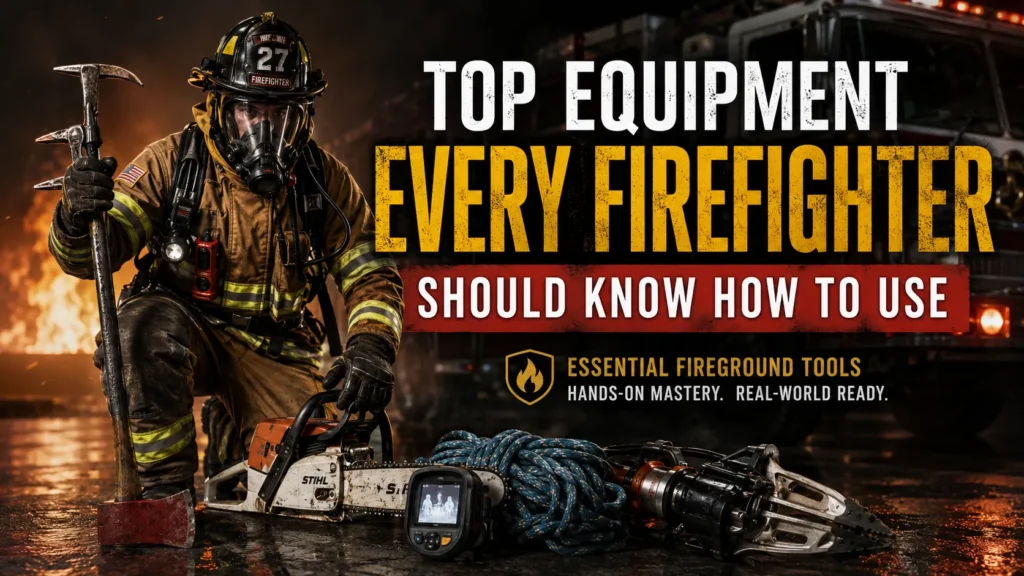
The equipment every firefighter should master through hands-on repetition includes the irons for forcible entry, rotary and chain saws for vertical ventilation and roof operations, hydraulic and pneumatic tools for heavy lift and stabilization, thermal imaging cameras for search, and search ropes and RIC tools for member rescue. Mastery means correct, fast execution under resistance and time pressure, not just familiarity from a demonstration.
The Irons: Halligan and Flathead Axe
The irons are the most fundamental forcible entry tool in this industry, and they’re also the most underdeveloped skill on most departments because training stops at the demonstration phase. A member who has watched the through-the-lock technique performed once and tried it on a cooperative training door hasn’t built the skill needed for a door that genuinely resists.
Real mastery of the irons comes from setting the halligan correctly against doors with security bars, multiple lock points, and swollen frames, repeatedly, until the body adjusts technique automatically based on what the door is doing rather than running a single memorized sequence. Forcible entry is a problem-solving skill applied through a tool, and the tool only performs as well as the hands using it. Competency beats courage here. A confident member with poor technique wastes time and energy; a real fire doesn’t give back.
Rotary and Chain Saws for Roof Operations
Vertical ventilation depends on a member’s ability to operate a saw decisively and correctly while standing on an unstable surface, often in low visibility, often under real-time pressure. This is one of the clearest places in the entire trade where simulation fails. A saw demonstrated on flat ground with no real roof underneath teaches nothing about the balance, positioning, and cut discipline required when the surface itself is the hazard.
Members need real reps on acquired structures, cutting actual roof assemblies, learning to read sag and sound before committing weight, and operating the saw with the kind of controlled aggression that vertical ventilation actually requires. A hesitant cut wastes time on a roof where time is the entire point of the operation. Violence of execution applies directly here: decisive, trained movement, not recklessness, but also not hesitation.
Hydraulic and Pneumatic Tools for Heavy Lift and Stabilization
Heavy lift and stabilization tools, struts, hydraulic rams, airbags, only work correctly when the operator understands load distribution and leverage under genuine weight. A member trained on a lightweight prop hasn’t built the physical calibration needed to recognize when a real load is improperly supported, and that gap shows up exactly when a vehicle or structural element needs to be stabilized for a trapped victim.
This equipment demands training against real weight and real awkward angles, not a scaled-down substitute that loses the exact feedback the body needs to learn correct setup. A department that trains heavy lift technique only on light training props is producing members who are confident with the tool and incompetent with the application, and that combination is dangerous specifically because it doesn’t look dangerous until the moment it matters.
Thermal Imaging Cameras for Search
A thermal imaging camera is only as useful as the member’s ability to interpret it correctly under stress, in zero visibility, while moving through an unfamiliar structure. Members who have only used the camera in a calm training environment with good visibility haven’t built the actual interpretive skill needed when the screen is the only reliable information source in a room full of smoke.
Train this tool the way it will actually be used, in real smoke conditions, under time compression, with the member also managing search technique and radio communication simultaneously. A camera in untrained hands creates false confidence. A camera in trained hands cuts search time dramatically and increases the odds of locating a victim before conditions deteriorate past survivability.
Search Ropes and RIC Tools
Search rope deployment and RIC tools demand muscle memory that has to function without conscious thought, because the moment these tools are actually needed is the moment a member is disoriented, under physical stress, and operating with degraded fine motor control from fear and exertion. A member who has to think through rope deployment step by step in that moment has already lost critical time.
RIC training built around genuine disorientation, full gear, and real-time pressure produces members who can locate, package, and remove a downed firefighter without hesitation. RIC training built around a calm walkthrough produces members who know the steps but can’t execute them when the steps actually matter. Fear plus lack of skill produces hesitation, and hesitation during a RIC operation directly threatens the life of the member already down.
The Mistake Every Department Makes With Equipment Training
The most common failure across this industry is treating equipment proficiency as a one-time certification instead of a perishable skill. A member who passed a forcible entry evaluation two years ago and hasn’t touched real resistance since has lost the calibration that made that certification meaningful in the first place.
Identify the members in your department who already handle tools with speed and confidence under pressure. Those heavy lifters should be running point on tool-heavy evolutions, not buried in a generic rotation that treats every member identically regardless of demonstrated skill. Equipment mastery isn’t evenly distributed across a roster, and training that ignores this wastes the department’s strongest operational asset.
Why This Matters More Than Most Departments Admit
Safety without capability is false security. A department can issue every piece of modern equipment available and still lose time, or lose a member, if the hands holding that equipment were never trained against real resistance. The tool isn’t the variable that matters. The training behind the hands using it is.
Equipment proficiency built through repetition under realistic conditions is what turns a halligan, a saw, a hydraulic ram, or a thermal camera from inventory into capability. The fireground will test exactly that distinction, and it won’t wait for anyone to catch up.
Frequently Asked Questions
What is the most underdeveloped equipment skill in most fire departments?
Proficiency with the irons, the halligan, and flathead axe is the most underdeveloped because most training stops at a single demonstration on a cooperative door instead of building real problem-solving skill against genuine resistance.
Why can't saw operation be trained on flat ground?
A saw demonstrated on flat ground teaches nothing about the balance, positioning, and cut discipline required when the surface itself, an actual roof, is the hazard. Real mastery requires reps on acquired structures.
Why do hydraulic and lifting tools fail even when the setup looks correct?
A setup trained on a lightweight prop doesn’t build the physical calibration needed to recognize an improperly supported load. The failure doesn’t show until real weight proves the calibration wrong.
What is the biggest mistake firefighters make with thermal imaging cameras?
Treating the camera as a simple answer machine instead of a tool requiring trained interpretation. Members who only practiced in calm, well-lit conditions haven’t built the skill to read it correctly in real smoke.
Why does RIC equipment need to become pure muscle memory?
Because RIC tools are needed in the exact moment a member is disoriented and under physical stress. Conscious thought through the steps costs seconds a downed firefighter doesn’t have.
Is equipment proficiency a one-time certification or an ongoing skill?
It’s a perishable skill, not a one-time certification. A member who passed an evaluation years ago and hasn’t trained against real resistance since has lost the calibration that made that certification meaningful.
