Skill decays. That’s not an opinion; it’s a fact every veteran officer has watched play out on a fireground when a member who trained hard a year ago suddenly can’t execute a technique they used to own. The hands forget. The timing slows. The decision-making that used to be automatic becomes hesitant again, and hesitation on a real call has a cost nobody wants to pay.
Most departments understand training matters. Far fewer understand that the wrong training, practiced constantly, builds false confidence instead of real skill. Watching a video on forcible entry technique once a quarter doesn’t maintain the ability to force a door that’s actually fighting back. Sitting through a PowerPoint on building construction doesn’t maintain the ability to read a roof under load with smoke pushing from a vent below. Repetition matters. Repetition under the wrong conditions matters for nothing.
This is the list of methods that actually hold a department’s edge sharp, along with the reasoning behind why each one works. This is fireground reality, not a training calendar filler.
Quick Answer
The training methods that build and maintain real fireground competence are resistance-based forcible entry drills, acquired structure evolutions for vertical ventilation and roof operations, time-compressed search and RIC scenarios, heavy lift and stabilization reps under realistic load, and live coordination drills between engine and truck functions. Each one depends on repetition against genuine resistance, not demonstration or simulation.
Forcible Entry Drills Against Real Resistance
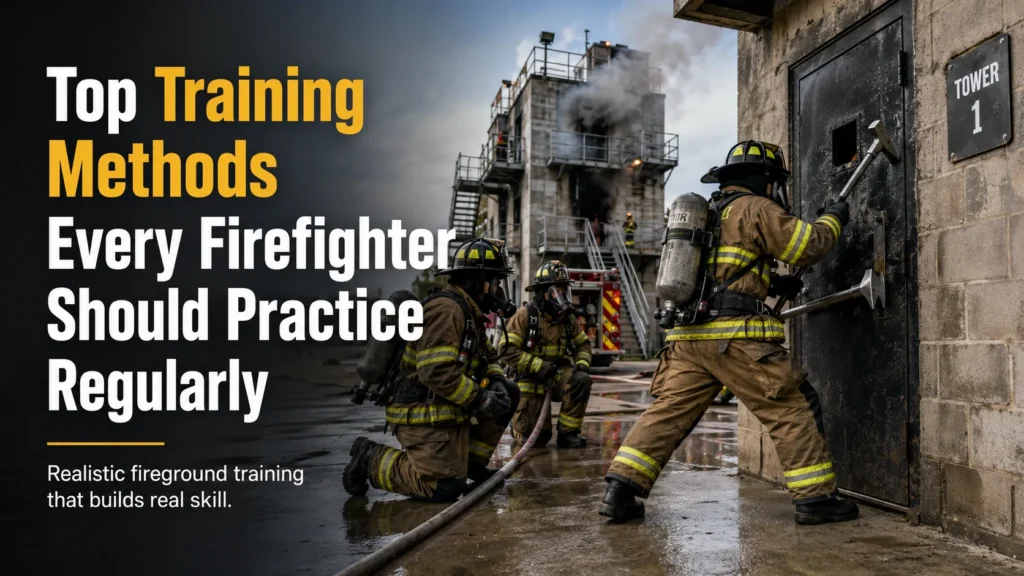
Forcible entry is a problem-solving skill, and problem-solving skill only develops against problems that actually resist solving. A door that swings open easily after one demonstrated technique teaches nothing about what happens when a member hits a security bar, a swollen frame, or a door with multiple lock points under time pressure.
The method that works is rotating members through doors set up with genuine resistance, repeatedly, until the body defaults to the next correct technique without requiring the brain to manufacture a plan from scratch under stress. Run it under a clock. Run it again after the member fails the first attempt. Competency beats courage here every time, and competency only comes from doing the work against resistance that fights back.
Departments that treat forcible entry as a one-time certification skill instead of a perishable one are setting members up to hesitate on the exact door that matters most.
Acquired Structure Evolutions for Roof and Vertical Ventilation
Reading a roof from a slide and reading a roof while standing on it are two entirely different skills, and only one of them transfers to a real incident. Acquired structures, buildings slated for demolition or controlled burn use, are the single best training resource a department can access for this because they replicate real construction behavior in ways a training prop never will.
Run vertical ventilation evolutions on real roof assemblies whenever access allows it. Train members to read sag, sound, and feel before committing weight to a section. This can’t be simulated on flat ground or learned from a diagram. Building construction knowledge that lives only in a classroom is theory, and theory doesn’t hold a roof up.
Time-Compressed Search and RIC Scenarios
Search technique under calm, well-lit, low-pressure conditions is a different skill than search technique under zero visibility with a clock running and a member already in trouble. The gap between those two experiences is exactly where casualties happen, because a firefighter trained only in the calm version has no internal reference point for the chaotic one.
Run search evolutions with real-time compression. Add physical exertion before the search begins so members are working against fatigue, the way they actually will be on scene after stretching a line or forcing entry. RIC drills need the same treatment: full gear, genuine disorientation, and a clock that doesn’t pause for comfort. Fear plus lack of skill produces hesitation, and the only way to remove that equation is repetition under the actual conditions that produce fear in the first place.
Heavy Lift and Stabilization Reps Under Real Load
Heavy lift and stabilization is a technical skill that depends entirely on correct application of leverage and load distribution, and that correctness only gets verified by practicing against real weight. A member who has only seen stabilization technique demonstrated on a lightweight training prop hasn’t built the actual physical calibration needed to recognize when a real load is improperly supported.
Train this with genuine weight, genuine awkward angles, and enough repetition that the correct setup becomes automatic. This is one of the clearest examples in the entire industry of a skill that simulations and low-resistance drills can’t replicate, because the physics involved don’t scale down to a lighter substitute without losing the exact feedback the body needs to learn from.
Coordination Drills Between Engine and Truck Functions
Individual skill execution isn’t enough if divisions aren’t moving in sync. Run drills that force communication and timing between roof division and interior crews, between truck operations and engine operations, under the same time pressure that exists on a real incident. A vent opened without coordination changes fire behavior in ways that put the interior crew at risk, and that failure point gets exposed in training far more safely than it does on a live incident.
These coordination drills also surface who in the department naturally operates with speed and good judgment under chaos. Identify those high performers and put them in positions where their initiative gets maximized instead of buried in a generic rotation. Every department already has heavy lifters on the roster. Training that doesn’t identify and elevate them is wasting the department’s best asset.
Why Frequency Matters as Much as Method
Skill is perishable. Forcible entry technique, search patterns, and heavy lift procedures all degrade without continued repetition, and a department that trains hard once a year and assumes the skill holds for the next twelve months is gambling with response capability. The methods above need to run on a consistent cycle, not as a single annual event treated as a checkbox.
Safety without capability is false security. A department can run every safety briefing on schedule and still lose a member if the underlying skill was never trained against real resistance, or was trained once and never maintained. Build a training calendar around these methods, run them consistently, and the gap between a department that performs under pressure and one that hesitates closes fast.
The fireground doesn’t test what a department knows. It tests what a department’s hands can already do without thinking, and that ability only exists because it was built the hard way, under resistance, before the real call ever came in.
Frequently Asked Questions
Why does forcible entry training need real resistance instead of a cooperative door?
A door that opens easily after a single demonstration teaches only a single memorized sequence. Real resistance, such as security bars, swollen frames, or multiple lock points, forces the body to build genuine problem-solving skill that holds up under pressure.
Why are acquired structures better than training props for vertical ventilation?
Acquired structures replicate real construction behavior, sag, sound, and feel under load, in ways a flat training prop or classroom diagram never can. Reading a roof while standing on it is a different skill than reading about it.
What makes time-compressed search and RIC scenarios more effective than calm walkthroughs?
Calm, well-lit search training gives a firefighter no internal reference point for zero visibility under genuine time pressure. Adding physical exertion and disorientation before the drill closes the exact gap where casualties happen.
Why can't heavy lift and stabilization be trained on lightweight props?
The physics of leverage and load distribution don’t scale down. Training on a lighter substitute fails to build the physical calibration needed to recognize an improperly supported real load before it shifts.
Why are coordination drills between engine and truck functions necessary?
Individual skill isn’t enough if divisions move out of sync. A vent opened without coordination changes fire behavior and puts the interior crew at risk, a failure best exposed in training rather than on a live incident.
How often should departments run these training methods to maintain skill?
These methods need to run on a consistent cycle, not as a single annual event. Skills like forcible entry techniques and heavy-lift procedures are perishable and degrade without continued repetition under real resistance.
