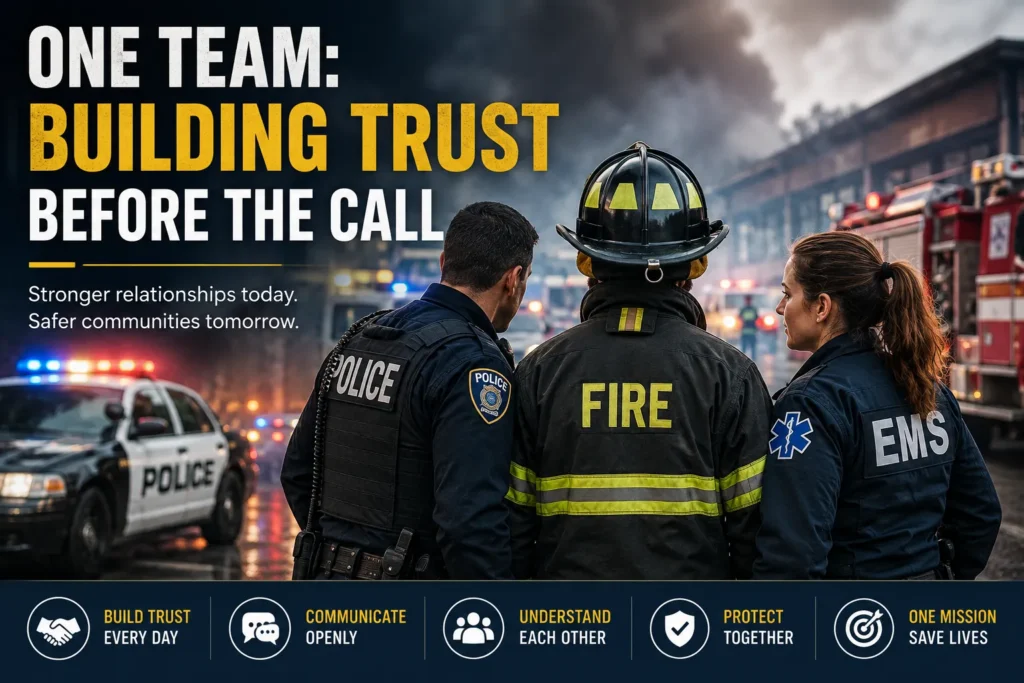
When an active shooter, natural disaster, or other large-scale emergency strikes a community, the public does not see separate police, fire, and emergency medical services. They see first responders. They expect us to work together, solve the problem, and save lives.
For many years, however, police, fire, and EMS responded to major incidents largely as independent organizations. Each discipline carried out its specific responsibilities, often with limited coordination with the others. Police addressed the threat. Firefighters managed fires and hazardous conditions. EMS personnel treated the injured.
Although everyone worked toward the same general objective, the response was frequently divided into organizational silos. Those divisions created gaps in communication, command, access, and patient care. In retrospect, some victims may have died while lifesaving resources remained nearby but were unable to reach them.
Becoming One Team requires more than placing police officers, firefighters, and paramedics in the same room for an occasional training exercise. It requires insight, mutual understanding, humility, patience, and persistence. Those qualities are necessary just to begin the process. Embedding the One Team philosophy into the culture of emergency response requires another full measure of each.
At the incident level, the One Team philosophy is put into practice through Unified Command. Unified Command brings agencies with jurisdictional authority or functional responsibility together to establish common objectives, agree on strategies, coordinate resources, and operate from a single incident action plan. It does not diminish the authority or responsibilities of any participating agency. Instead, it aligns those agencies around one mission.
Unified Command is not simply a box on an organizational chart. It is a disciplined process of making decisions together.
Lessons Written in Tragedy
Early in my career, I watched the North Hollywood shootout unfold on television in the patrol briefing room with my squad mates. Two heavily armed gunmen held officers from one of the largest and most capable law enforcement agencies in the country at bay.
Individual acts of courage ultimately brought the confrontation to an end, and care was provided to the wounded officers and community members. In the years that followed, the responders who experienced that day shared their lessons in classrooms and at conferences. Their experiences contributed significantly to our understanding of emergency operations under fire.
Then came Columbine High School.
Columbine exposed serious gaps not only in law enforcement tactics but also in our ability to provide timely medical care to victims inside an unsecured or partially secured environment. Police officers were focused on locating and stopping the threat. Fire and EMS personnel were prepared to treat patients, but traditional practices kept them outside the danger area.
Everyone was doing what they had been trained to do. The problem was that we had been trained separately.
Over the following years, police and fire tactics began to change as agencies studied critical incidents across the country. We learned from each tragedy, revised policies, purchased equipment, and conducted additional training. Yet even after a decade of progress, incidents such as the 2012 theater shooting in Aurora, Colorado, and the shooting at Clackamas Town Center in Oregon demonstrated that command structures could still separate public-safety disciplines when cooperation was most urgently needed.
Training had changed, but culture had not changed enough.
Collaboration Begins Before the Emergency
A few years earlier, I had completed an assignment with a federal task force and worked with several police and fire departments in California on responses to hypothetical terrorist attacks. Those exercises demonstrated that emergency responders could work well together during major events.
More importantly, we discovered that cooperation should not be reserved for extraordinary incidents.
The strongest relationships were built during routine calls: domestic violence incidents, neighborhood searches, barricaded suspects, structure fires, traffic collisions, and other emergencies occurring every day in our communities. These lower-level joint responses opened the door to better communication, a greater understanding of organizational priorities, and, most importantly, trust.
Trust cannot be exchanged for the first time while rounds are being fired, buildings are burning, or injured people are waiting for rescue. It must already exist.
Police officers must understand what firefighters and paramedics need to operate safely. Fire and EMS personnel must understand how law enforcement evaluates a threat and creates protected areas for rescue and treatment. Leaders from every discipline must understand one another’s capabilities, limitations, terminology, equipment, and decision-making processes.
This understanding takes patience. It also requires humility. Each profession must be willing to admit that it does not have every answer and cannot successfully manage a complex incident alone.
Unified Command depends on those relationships. Agencies cannot be expected to make effective joint decisions during a crisis when their leaders have never trained together, do not understand one another’s priorities, and have not established a foundation of trust.
The command post is not where relationships begin. It is where established relationships are put to work.
Working together under the One Team concept during routine, day-to-day operations improves decision-making when a crisis occurs. Responders who regularly communicate, solve problems, and manage incidents together develop a shared understanding of one another’s capabilities, priorities, and expectations. When lives are on the line, they do not have to spend valuable time establishing relationships or determining how to work together. Familiarity reduces hesitation, strengthens situational awareness, and allows leaders to make coordinated decisions more quickly.
Time matters during any emergency, but it is especially critical during an active-threat incident, mass-casualty event, or rapidly developing disaster. Delays in sharing information, establishing common objectives, or committing resources can have life-or-death consequences. Unified Command provides the structure for joint decision-making, but trust allows that structure to function at the speed the incident demands.
Trust is the key. It gives leaders confidence that their partners understand the mission, will communicate honestly, and will carry out their responsibilities while protecting the entire team. That trust is not created during the crisis. It is earned through daily cooperation and strengthened on every call.
Learning to Speak the Same Language
The Incident Command System has provided a framework for combined emergency responses for decades. However, police and fire organizations have often applied that framework differently, sometimes to the detriment of both.
Fire incidents generally develop and progress differently from violent law enforcement incidents. A structure fire may unfold at a somewhat predictable rate and continue for an extended period. A violent encounter can begin, change, and end within seconds. Information may be incomplete, suspect locations may be uncertain, and officers may be forced to make immediate decisions with little opportunity for formal planning.
Neither approach is inherently better. Each developed in response to the operational realities of its profession. The challenge was learning how to translate those approaches so police, fire, and EMS could function together.
Unified Command provides the structure for that translation. Law enforcement, fire, and EMS leaders jointly identify the problems confronting the community, establish incident priorities, develop common objectives, and agree on strategies. Each agency then applies its expertise and directs its own personnel within that shared framework.
This distinction is important. Unified Command does not mean that firefighters suddenly report to a police commander or that police officers are placed under the operational control of a fire chief. Unity of command remains intact: Each responder reports to one designated supervisor. At the same time, agency leaders work together through Unified Command to provide coordinated direction for the entire incident.
One Team does not mean one agency takes over. It means every agency contributes to one coordinated response.
The late Phoenix Fire Chief Alan Brunacini’s Eight Functions of Command became a Rosetta Stone for the organizations with which I was working. The fire service was exceptionally skilled at establishing command, conducting a size-up, developing an incident action plan, managing communications, organizing resources, and continually reviewing conditions. These concepts gave us a practical and recognizable structure through which we could teach patrol sergeants and watch commanders.
As law enforcement supervisors became more familiar with the fire service’s command practices, they began working with engine companies and battalion chiefs in ways they had never done before.
Agencies established mutual radio frequencies. Patrol sergeants began staging fire and EMS resources a few blocks away during violent domestic calls rather than leaving them uninformed at a distant station. Battalion chiefs worked beside watch commanders to log, track, and manage resources during neighborhood searches for armed suspects.
Fire officers gained a clearer understanding of law enforcement threat assessments and tactical priorities. Police supervisors developed a greater appreciation for fireground accountability, resource management, staging, and safety.
We were no longer simply working next to one another. We were beginning to work with one another.
From Separate Command Posts to Unified Command
A common incident location does not automatically create Unified Command. Placing a police watch commander, battalion chief, and EMS supervisor in the same parking lot is only the beginning.
Effective Unified Command requires those leaders to develop a shared understanding of the incident. They must agree on priorities, identify common objectives, select coordinated strategies, and communicate those decisions to the personnel operating under them.
During an active-shooter incident, for example, law enforcement may identify stopping the threat as the immediate tactical priority. Fire and EMS may identify rapid access to wounded victims, casualty collection, treatment, and transportation as critical medical priorities. Those priorities are not mutually exclusive. Unified Command brings them together.
Shared objectives may include locating and stopping the threat, establishing protected corridors, deploying rescue task forces, removing victims from areas of risk, managing fire or hazardous conditions, and coordinating patient transportation. Each discipline retains its expertise, but all disciplines work from the same operational picture and toward the same outcomes.
Unified Command also requires honest discussion of risk. Law enforcement may not be able to declare an entire scene secure, but it may be able to establish areas that are sufficiently protected for fire and EMS operations. Fire leaders must be prepared to explain what their personnel need to operate in those areas. EMS leaders must communicate patient-care and transportation requirements. Together, the command team must balance responder safety against the urgent needs of victims.
That conversation is difficult to have for the first time in the middle of a crisis. It must be practiced before the call.
Beyond ASHER
Unified Command should not be viewed solely as part of the fire service’s Active Shooter/Hostile Event Response, or ASHER, protocols. ASHER programs provide an essential framework for preparing for, responding to, and recovering from active-shooter and hostile events. They have also helped advance rescue task force operations, protected medical response, rapid victim access, and the early establishment of Unified Command.
Those capabilities are important, but the One Team concept is broader than any single threat, standard, or response model.
The same relationships, communication practices, and joint decision-making processes are needed during wildfires, earthquakes, floods, hazardous-materials incidents, civil unrest, mass-casualty events, explosions, large-scale searches, and other complex emergencies. These incidents involve different hazards and tactical priorities, but they create the same fundamental need: Responsible agencies must quickly develop a common operating picture, establish shared objectives, coordinate resources, and act with unity of effort.
ASHER protocols are an important application of Unified Command, but they should not be the only setting in which police, fire, and EMS practice working as One Team. If Unified Command is reserved for active-shooter training or written into a plan that is rarely exercised, responders may still struggle when a different type of crisis occurs.
A fast-moving wildfire may require law enforcement to manage evacuations and access control while fire personnel conduct suppression operations and EMS establishes medical support. A flood may require public-safety agencies to coordinate rescues, road closures, evacuations, sheltering, public information, and infrastructure protection. Civil unrest may involve law enforcement threats, fire suppression, emergency medical care, public works, transportation, and hospital coordination occurring at the same time.
No single discipline can manage those incidents effectively from an isolated command post.
The habits required for Unified Command must therefore be developed during routine incidents and reinforced across the full range of community emergencies. Police, fire, EMS, emergency management, public works, hospitals, utilities, and other partners should be prepared to communicate, share information, resolve competing priorities, and make coordinated decisions whenever an incident crosses organizational or jurisdictional boundaries.
This broader approach strengthens every response. When partner agencies regularly communicate and solve problems together, the command structure becomes familiar before the circumstances become extraordinary. Leaders understand whom to contact, where to meet, what information their partners need, and how decisions will be communicated to the field.
The objective is not merely to improve ASHER operations. It is to create an everyday culture in which joint decision-making, shared situational awareness, and coordinated action are the normal response to complex incidents.
The One Team principle therefore extends beyond rescue task forces, protected corridors, and casualty collection points. Those capabilities remain vital, but they represent only one part of a larger commitment.
Unified Command is not an active-shooter tactic. It is a leadership and coordination model for any complex incident that no single agency can manage alone.
Progress Requires Patience
Not every response went perfectly.
Some battalion chiefs worked more effectively with their law enforcement partners than others. The same was true of police supervisors operating at fire and medical incidents. Longstanding habits did not disappear after one class or tabletop exercise. Terminology sometimes created confusion. Personalities occasionally collided. Organizational boundaries did not suddenly vanish.
But the principle of One Team, One Response, began to gain traction.
Leadership recognized progress and authorized additional training. Strong relationships were reinforced, and weaker links were given opportunities to improve. Mistakes became learning opportunities rather than excuses to retreat into separate organizational corners.
That patience was essential. Building an integrated response capability is not a single training event or policy revision. It is a continuing process of listening, practicing, evaluating, and improving.
The same is true of Unified Command. Leaders do not become effective members of a Unified Command merely by completing an Incident Command System course. They must practice establishing command together, identifying appropriate agency representatives, agreeing on objectives, resolving competing priorities, sharing information, and communicating unified direction to the field.
Trust grows when responders consistently do what they say they will do. It grows when a police supervisor considers the safety of firefighters and paramedics part of the law enforcement mission. It grows when a fire officer accepts a measured level of risk to reach victims or protect a community while working within a law enforcement security plan.
Most of all, trust grows through shared experience.
When One Team Was Tested
A few years later, our efforts were tested.
A gunman drove to a local golf course and opened fire. Police officers arrived quickly and began searching for him. The suspect had returned to his home a few blocks away, where we learned that he had killed members of his family before causing the house to explode with natural gas.
The explosion set several neighboring homes on fire. At the same time, we could not account for the gunman’s location.
Under a traditional response model, firefighters might have been held outside the area until police could guarantee that the threat had been eliminated. Police officers, meanwhile, would have continued searching as the fire spread from home to home.
Instead, the trust developed during the preceding years gave leaders another option.
Police and fire leaders evaluated the threat, the advancing fire, the resources available, and the consequences of inaction. They established shared priorities and coordinated the deployment of their personnel. Even if the term Unified Command was not emphasized at that moment, its principles were clearly at work: joint decision-making, shared objectives, coordinated strategies, and respect for each agency’s authority and responsibilities.
Firefighters put on ballistic protection and moved into the neighborhood with police officers. Law enforcement personnel provided security while fire crews worked to limit the spread of the fire. Each discipline understood the risks, priorities, and capabilities of the other.
Fire and EMS personnel could not save the victims who had already been killed that day, but firefighters were able to protect neighboring homes and prevent the incident from causing even greater devastation.
That response was not improvised at the command post. It was the result of relationships built long before the call.
Can One Team Be Replicated?
Over the years, I have spoken with people who expressed doubt about the One Team concept.
Some dismissed the idea by saying that police officers and firefighters were like cats and dogs and would never truly work together. Others believed the circumstances in Southern California were unique and that the relationships and practices we developed could not be replicated elsewhere.
Time would give me an opportunity to test that belief.
I eventually left Southern California and began working for an organization in the Northwest. For the past two years, I have worked within a system that held firmly to its organizational silos and often treated written plans as the complete solution to crisis response.
Written plans are important, but a plan alone does not create cooperation. It cannot build trust, clarify misunderstandings, or teach people how to work through uncertainty together. A document may describe what organizations should do, but only relationships and repeated joint training can prepare responders to carry out those expectations under pressure.
The same limitation applies to a Unified Command plan. A policy may state that Unified Command will be established, but it cannot guarantee that leaders will know where to meet, how to communicate, who has decision-making authority, or how disagreements will be resolved. Those capabilities must be developed through training and reinforced during routine operations.
Changing this mindset requires patience and persistence.
Rather than trying to dismantle every organizational barrier at once, we gradually began leaning into the One Team principle. Much of the heavy lifting was already done and we just needed to start making connections. We developed allies within the law enforcement, fire, and EMS organizations. We found leaders and responders who understood that cooperation was not a threat to their professional identity but an opportunity to improve service to the community.
Slowly, the ball began to move.
Law enforcement personnel are now training with the fire department on active-shooter response and the following day, fire personnel will train with law enforcement on rescue task force operations and the medical aspects of crisis response. Additional training dates for both disciplines are expected to follow.
These exercises represent more than entries on a training calendar. They are opportunities for responders to learn how their partners think, communicate, make decisions, and manage risk. They also give command-level personnel an opportunity to practice Unified Command by developing common objectives, coordinating tactical priorities, sharing information, and directing resources through one integrated incident organization.
The immediate training topic may be an active-shooter response, but the relationships and command practices developed during that training will carry into many other emergencies. The objective is not to create a team that functions together only during an ASHER incident. It is to build an operational culture that supports coordinated action whenever the community faces a complex crisis.
These efforts are proof that the One Team concept is not limited to one region, one department, or one group of leaders.
It can be replicated, but it cannot simply be copied. Each community must build its own relationships, identify its own barriers, and create a shared response model suited to its resources and risks. The principles remain the same: communication, cooperation, patience, humility, and trust.
The Fire Service’s Role in One Team
The fire service brings far more to a violent incident than hoses, ladders, and medical bags. Firefighters and fire officers bring a disciplined command structure, resource accountability, risk management, patient movement, logistical capability, and a culture of coordinated action.
Those strengths are invaluable during active-threat incidents, civil unrest, natural disasters, explosions, and other complex emergencies.
Fire officers also bring essential knowledge to Unified Command. They understand fire behavior, hazardous conditions, structural stability, rescue capabilities, personnel accountability, water supply, medical operations, and resource needs. Without that perspective at the command level, incident objectives may fail to address critical hazards or may assign tasks without fully considering the capabilities and limitations of fire and EMS resources.
The fire service must therefore have a seat at the table early. Fire leaders should not remain at a separate command post waiting for law enforcement or another agency to provide instructions. They should be integrated into Unified Command whenever an incident involves shared jurisdictional authority or functional responsibility.
That participation must extend beyond ASHER operations. Fire leaders should be prepared to contribute to Unified Command during any event in which fire-service resources, community hazards, rescue responsibilities, medical operations, evacuations, or infrastructure concerns are part of the incident.
At the same time, the fire service must recognize that operating as One Team may require us to reconsider traditional definitions of a secure scene. Absolute safety may not be immediately achievable. There may be moments when firefighters and paramedics must operate in areas that are protected but not completely free from danger.
That does not mean accepting unnecessary risk. It means evaluating risk collectively, using appropriate protective equipment, coordinating closely with law enforcement, and balancing responder safety against the urgent needs of victims and the community.
Fire service leaders must be part of the planning before an incident occurs. They must participate in joint training, understand law enforcement tactics, develop rescue task force capabilities, establish interoperable communications, and build personal relationships with their police and EMS counterparts.
They must also prepare to function effectively within Unified Command. That includes knowing how to articulate fire and EMS priorities, assess risk, contribute to common objectives, commit appropriate resources, and communicate command decisions throughout the fire service chain of command.
We cannot expect firefighters to enter a challenging environment with people they have never trained beside, using radio channels they have never practiced on, under a command structure they do not understand.
One Mission, One Community
The public does not care which agency patch we wear. A wounded victim does not care whether the person reaching them is a police officer, firefighter, or paramedic. A family watching flames move toward its home does not care which organization is responsible for a particular geographic area or tactical assignment.
They need us to solve the problem together.
One Team does not mean abandoning our individual responsibilities or professional expertise. It means combining those capabilities under a shared mission. Police officers continue to address threats. Firefighters continue to control fires and hazardous conditions. EMS personnel continue to provide lifesaving care. But we do these things with common objectives, shared situational awareness, coordinated strategies, and genuine concern for the safety and success of every responder.
Unified Command gives that cooperation an operational structure. It allows responsible agencies to jointly manage an incident without surrendering their individual authority, responsibility, or accountability. It replaces competing command posts and disconnected plans with a common set of objectives, one coordinated strategy, and unified direction for personnel in the field.
That structure is essential during an active-shooter or hostile event, but its value reaches far beyond ASHER protocols. Any incident that crosses organizational, functional, or jurisdictional boundaries may require the same unity of effort.
The foundation is communication. The process requires cooperation, humility, patience, and persistence. Unified Command provides the structure. The result is trust and coordinated action.
Making the One Team concept a priority does not mean cultural change will happen quickly. Longstanding habits, organizational identities, and operational silos will not disappear because of one policy, one meeting, or one successful training exercise. Meaningful change takes time. It requires consistent leadership and a steady commitment to making cooperation part of the everyday culture of every organization involved.
Leaders must continue to create opportunities for responders to train together, communicate openly, and build relationships before a crisis occurs. They must reinforce the behaviors that strengthen the team and address the practices that pull organizations apart.
Successes should be recognized and celebrated. Shortcomings should be studied without blame and used to improve the next response. Every exercise, routine call, and critical incident offers another opportunity to build trust, strengthen Unified Command, and improve the team.
Policies are important. Equipment is important. Training is essential. But during the most difficult moments our communities will ever face, trust is what allows responders to make decisions together and move forward with one purpose.
We owe our communities more than three capable agencies arriving at the same incident.
We owe them one mission, one coordinated command, and One Team.
