


The Five Prioritized Responsibilities That Changed My Career
“Clarity doesn’t happen by accident. It comes from understanding your role and responsibilities and establishing a system, with proven priorities to fulfill them.”
In Part One, I asked what it really means to be a professional firefighter. My answer was simple: professionalism is not a label we claim; it is a standard we prove every hour, on duty and off. That raises the next question for every firefighter, from probationary members to seasoned company and chief officers: How do I know whether I am doing the job well, and how can I measure it?
Like many firefighters, I wanted to do the job the right way. For years, I tried to organize everything at once and found myself divided among dozens of responsibilities:
- Fire Technology & Education (associate’s & bachelor’s degrees),
- Emergency operations,
- Physical fitness,
- Station duties – equipment maintenance,
- and of course, family life. Which should be at the top of the list.
The list kept growing, and each step up in rank added new expectations. The problem was not motivation. It was the absence of structure, systems, a foundation, and a game plan — the clarity of how and why. Once I accepted that I would never know or do everything, the best approach became clearer: identify what truly mattered now.
Searching for a Better Way
Play to win the game, rather than playing not to lose.
This philosophy forced me to stop chasing every new idea and start building a system, while still adhering to the basic principles of saving lives, mitigating threats, and preventing further harm. I found myself collecting information from everyone around me and from every class. Every lesson had value, but the lessons often felt like individual puzzle pieces without the picture on the box. Then something happened that changed the way I viewed roles and responsibilities forever.
While completing my bachelor’s degree, Assistant Chief Robert Ramirez of the Los Angeles Fire Department (Ret.) introduced our class to a defined set of responsibilities for company officers. The framework aligned with the expectations described in NFPA 1021, Standard for Fire Officer Professional Qualifications, while Chief Ramirez refined it into five practical priorities for company officers. Over time, I realized those priorities applied to every firefighter. Promotion expands each responsibility; it does not replace it.
Over the next twenty-plus years, I tested these five priorities in every environment I could imagine: on the job, in the classroom, while coaching football, while mentoring firefighters, and while developing future company officers. I began to see the responsibilities as an interconnected gear system. Movement in one area influenced the others. Training became the center gear because it powered competent performance in every other part of the profession. The simplicity of the system created clarity, and it rarely failed me. It became a living operating system for how I prioritized the work.
The five priorities gave me that structure. They did not make the work easier, but they made it clearer. They helped me sort competing demands, evaluate my own readiness, and build a system that connected daily habits to the mission our communities expect us to fulfill.
Roles & Responsibilities / Expectations of a Company Officer
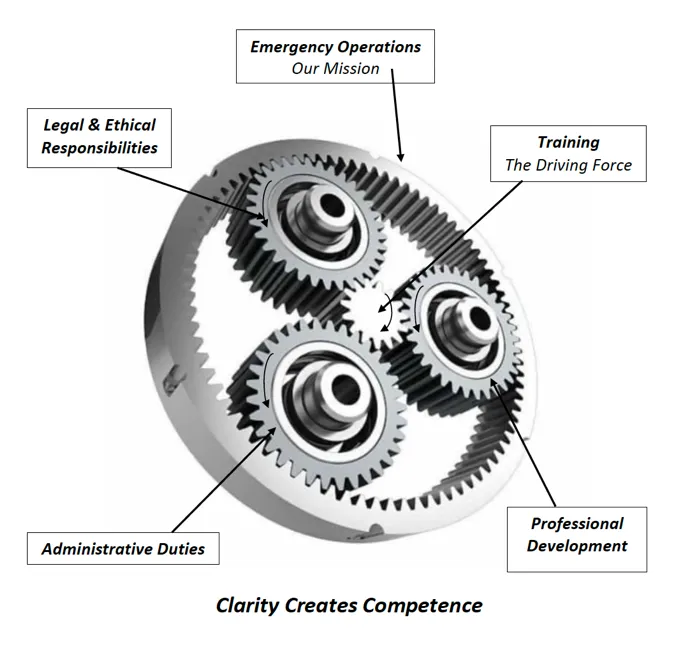
Priority #1: Perform Competent Emergency Operations
This is why we exist. It isn’t simply one of the 5 priorities – it is the mission that encompasses all others. It’s what our public expects. They don’t care about the other four. They matter, but they all support one primary duty: to perform competent emergency operations. The expectation is that we arrive prepared to save lives, solve or mitigate problems and prevent further harm. No matter the call, our communities expect us to perform with confidence, skill, speed and sound judgment.
Competence does not begin during the emergency. It is earned long before the tones go off. Every drill, class, after-action review, and difficult conversation about performance contributes to this responsibility. When firefighters lose sight of competent emergency operations, every other priority begins to drift. I see this priority as the outer ring that holds the other four together. Our oath tells us why we serve; a system helps us fulfill that promise consistently.
Priority #2: Understand Your Legal and Ethical Responsibilities
Many firefighters think of legal responsibilities only when discussing lawsuits or discipline. That’s far too narrow. Legal responsibilities, liability, and ethical decision-making influence nearly every decision we make.
This priority must follow the first one. If we do not perform emergency operations competently, or if we lack clarity about an officer’s legal obligations, painful consequences can follow. In a litigious world, that is not a slope any firefighter or officer wants to start down. Beyond emergency operations, legal and ethical responsibility also shows up in questions like these:
- How do we properly document incidents?
- How do we supervise/evaluate firefighters fairly?
- How do we respond when ethical decisions become difficult?
… and many more
Every one of those examples deserves its own conversation. Understanding our legal responsibilities isn’t about operating out of fear. It’s about having clarity of the position and honoring the duty we’ve accepted (the good, bad and ugly).
Priority #3: Make Training the Center of Everything
If I were asked which of these five responsibilities has the greatest influence on the other four, my answer would be immediate: Training.
I often describe training as the center gear in a set of interconnected gears. When that gear turns properly, every other gear begins moving with it.
- Training develops competence.
- Training reduces liability.
- Training prepares future leaders.
- Training improves organizational performance.
Without consistent, repetitive and purposeful training for low frequency, high risk events, other responsibilities eventually stall. Training should not be infrequent or informal. High-stress incidents impair memory and critical decision-making, which is why emergency procedures must be practiced before they are needed. Departments that routinely train through real-life simulations build the muscle memory necessary to function effectively when it matters. Without that repetition, even experienced officers can struggle during rapidly evolving emergencies.
Priority #4: Invest in Personal and Personnel Professional Development
Players don’t care how much you know until they know how much you care. The same holds true in the fire service. As firefighters gain experience, they naturally become teachers and coaches, whether they intend to or not. Someone is always watching and learning what to do and what not to do.
Professional development goes far beyond preparing yourself or someone else for a promotional examination. Its real purpose is to clarify and prepare people for the job, not just the exam. The exam is only a formality if the work has already been done. Development also helps firefighters discover their strengths, identify weaknesses before they become failures, review their career goals, and answer the question, “Where do you want to be five years from now, and as your coach, how can I help you get there?” Then we prove that commitment by following through.
One of the most rewarding moments in a fire officer’s career isn’t making captain. It’s watching someone you mentored and coached become an exceptional leader. That’s succession planning, and it begins long before someone wears bugles.
Priority #5: Embrace Administrative Responsibilities
Let’s be honest, administrative work rarely receives the same enthusiasm as live-fire training.
Yet every experienced company officer understands its importance. Administrative responsibilities include, but not limited to:
- Having clarity and understanding in the organization’s Rules and Regulations, Standard Operating Procedures and/or Guidelines,
- Risk Management & Personnel Issues (HR Department – City Attorney),
- Equipment Specifications & Purchase, Budgets (Finance Department),
- Communication (Staff Reports, Memos, Citizen Complaints)
These (and more) responsibilities aren’t distractions from emergency operations; they support emergency operations and legal compliance. The better organized a company is, the more prepared it becomes when the unexpected occurs. Administrative excellence creates operational excellence.
Why I’ve Trusted This System for More Than Thirty Years
While adapting to these priorities, I remembered the spring of my junior year in high school, when a new coaching staff arrived from the Los Angeles area. I still believe that coaching staff helped shape the direction of my life. They taught us how to play the game through personal and team discipline. We learned why we did what we did. They clarified the mission, the strategy, and the tactics. They held us accountable and pushed us to overdevelop the hard skills required to compete at a higher level. We were coached to trust the system, and that system came with established priorities. That experience became a true paradigm shift, one many people can recognize in their own lives.
This framework has stayed with me because it creates clarity at every rank. Whenever I felt overwhelmed, I returned to these five priorities. When we trained, for example, we parked closest to the exit so we remained positioned and available to respond. We were on duty to perform competent emergency operations, period. That is what our citizens expected. Whenever I mentored a firefighter, developed academy curriculum, or evaluated company performance, these responsibilities gave me direction. Instead of asking, “Where do I start?” I already had the answer. The system made priorities visible and created focus.
More Than a Checklist
It’s important to understand that these five priorities aren’t a checklist you complete. They form a continuous cycle, like the gears of a clock, always moving. Training improves emergency operations. Professional development strengthens training. Ethical leadership influences every decision. Administrative excellence supports the mission. Each responsibility reinforces the others and creates accountability. Together, they create a better culture where professionalism isn’t simply discussed it becomes the standard and solidifies our principles of saving lives, mitigating the problems and preventing further harm.
Looking Ahead
Over the years, I’ve shared this framework with all firefighters, coaches, instructors, recruits, and even professionals in other fields! Almost immediately, the question follows. “Where do I begin?”
The answer surprises many people; you begin with influence. Every firefighter, regardless of position, is already teaching someone.
- Your words teach,
- Your habits teach,
- Your preparation teaches,
- Your example lasts forever.
Whether you realize it or not, you’re already coaching the next generation of firefighters. Systems build competence. People build the culture.
In Part Three, we will explore why leadership begins long before promotion, how mentorship shapes organizational culture, and why every firefighter has a responsibility to develop those who will one day take their place. The greatest legacy you leave in the fire service will not be the fires you fought. It will be the firefighters you helped develop. Never forget where you came from, always give back to the profession that gave so much to you, and consider how you want to be remembered.
