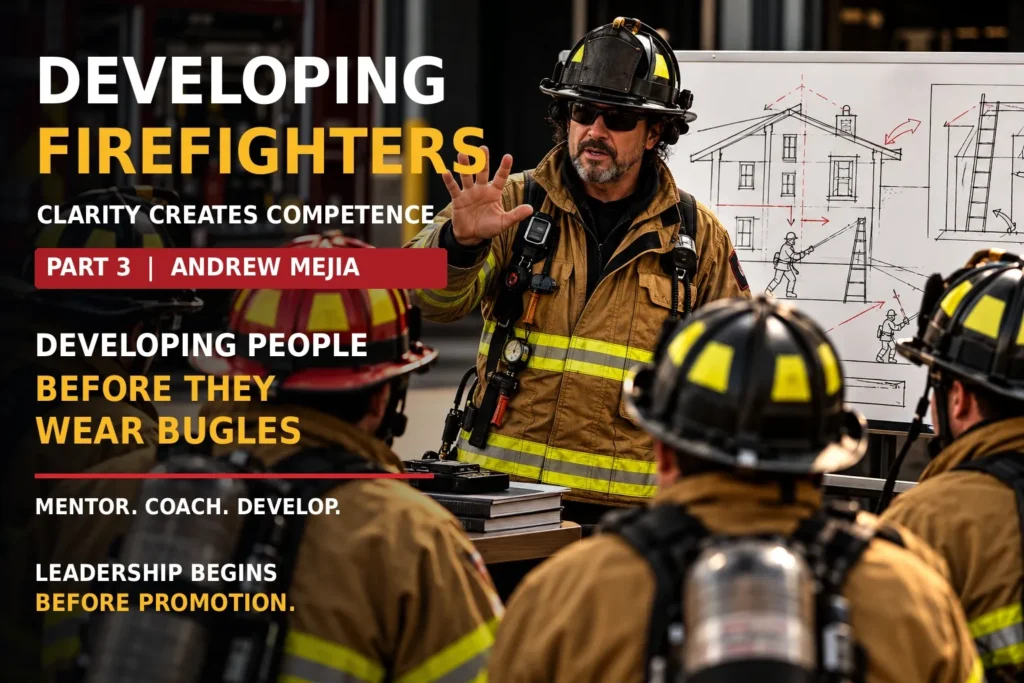
Developing People Before They Wear Bugles
“The day someone starts watching you is the day you become a leader.”
In Part Two, I introduced the 5 Expected Responsibilities that became the foundation for my career. Over the years they gave me clarity when I faced competing priorities, difficult decisions, or the responsibility of developing others. But a framework can only point people in the right provide direction; it cannot create commitment on its own. Policies, training records, and organizational charts establish expectations. People bring those expectations to life. For example:
- Policies don’t mentor firefighters.
- Training records don’t inspire firefighters.
- Organizational charts don’t develop leaders.
- Systems don’t build culture, people do.
How do you develop people to have clarity in those responsibilities?
This article focuses on the people side of clarity: how firefighters begin developing others before formal promotion, how officers and coaches use training to shape culture, and how intentional development turns daily conversations, drills, and expectations into long term professional growth.
One principle has guided my approach to leadership and mentoring: Every firefighter deserves to have someone who intentionally develops them.
Throughout my career, I came to believe that training and coaching are at the heart of a company officer’s responsibilities. The five responsibilities provide a framework for what officers should focus on, but firefighters do not develop themselves. People develop people. For an officer, that is where initial leadership begins: Intentional Development. To me, intentional development means understanding a person’s strengths, values, and aspirations, then creating professional opportunities that align with occupational standards and the organization’s mission and goals.
Unfortunately, many firefighters never see themselves as developers of people because they mistakenly believe leadership begins with promotion. I don’t believe that. One of the greatest misconceptions in the fire service is that influence comes with rank. It does not. Influence comes from behavior: how you prepare, how you treat people, how you communicate, and how you respond to adversity. Long before someone wears bugles, they are already influencing the people around them by the example they set.
Whether you have been on the job six months or twenty years, someone is watching. They are watching how seriously you take the profession, how you train, how you handle challenges, and how you respond when things get difficult. You may not realize it, but you are always leading by example. The only question is: What example are you setting?
As mentioned in the previous articles, you must know and understand your people. Crew members (or players) do not care how much you know until they realize how much you care about them. That does not mean trying to be everyone’s buddy; I have seen many officers damage their credibility with that mindset. People “allow” you to become their coach, mentor, captain, or instructor because they decide whether they trust you, or not.
Think about the person who most influenced your life. Chances are a face immediately came to mind. You trusted them. You believed them. Importantly, you allowed them to influence your thinking and development. That’s the responsibility and privilege every coach, mentor, and company officer should hope to earn.
For many years, I had the privilege and responsibility of serving both as a company officer and as an assistant football coach at different levels. People often asked me which role was more difficult. My answer was always the same: they were not that different in terms of development. A fire officer prepares firefighters to perform in life-and-death situations. A coach prepares players to perform under pressure on game day.
Both required:
- High levels of preparation (practice until you can’t get it wrong).
- Teaching people how to perform under pressure.
- Accountability and trust.
Great coaches don’t simply produce better players. They develop better people. The same is true of effective company officers. Leadership isn’t something we occasionally demonstrate. It’s something we consistently model.
Every Firefighter has Four Roles
One conversation with a former crew member has stayed with me for years. He approached me because another firefighter had asked if he would mentor him. His response surprised me: “I don’t think I’m qualified. That’s the captain’s job.” I understood where he was coming from. Many firefighters assume mentoring belongs only to officers. But because he was my second-in- command, an engineer, and a developing future company officer, I offered him a different perspective. The moment someone asks you for guidance, they have already identified something in you they respect and trust (sound familiar). That request should not be viewed as a burden. It is a compliment that says something important about you.
Over time I came to believe every firefighter, especially every fire officer, simultaneously fills four roles: student teacher, coach, and supervisor.
- You are always a student: Always on probation (continue learning and remain humble).
- You are always a teacher: Share what you know.
- You are always a coach: Help others improve.
- You are always a supervisor: Hold people accountable to standards.
Those roles do not begin with promotion. Like the oath you pledged when you were hired, they begin with commitment.
Training Is More Than a Scheduled Activity
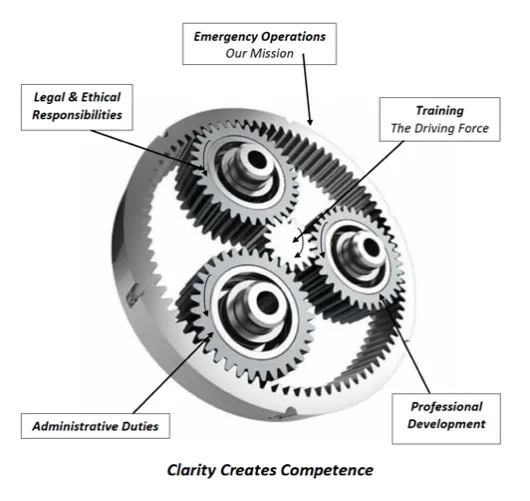
In the previous article I described training as the center gear that drives every other responsibility. The more I thought about that image, the more I realized why. Training isn’t just where we learn skills. It’s one of the primary places where culture is reinforced, modeled, and passed from one generation of firefighters to the next.
A close friend, Chief Ed Hadfield wrote: “A culture determines what firefighters do when no one is watching. It dictates whether crews accept mediocrity or relentlessly pursue mastery.” As an officer or coach, you are not simply teaching techniques or tactics. You are practicing stewardship, developing professionals and building leaders. That idea aligns with Jon Becker’s observation in Culture First that culture is created by what leaders tolerate, reinforce, and model every day.” Every training session teaches more than just tasks or tactics. It reinforces:
- What right looks like.
- What professionalism looks like.
- What preparation looks like.
- What teamwork, leadership and excellence look like.
It is the responsibility of every company officer – and every coach – to create an environment where people can succeed. An environment where firefighters are encouraged to ask questions, make mistakes during training, challenge themselves, and continuously improve. Some officers simply complete the drill and move on. Others use it to develop people. The difference isn’t the lesson plan. It’s the purpose behind it.
We’ve all said this for years, “it’s all about the little things – the little things affect the big things.” For those of us that have coached any sport… you know what this means. Ever watch a football practice? The intensity is so thick you can cut it with a knife. Every practice is choreographed and scripted earlier in the day. Every movement, every step is scrutinized. Any mistakes are immediately corrected.
As in football, coaches obsess over the smallest details because small details often determine success under pressure. A sloppy huddle, poor communication, or a lack of focus sends a message to the individual and to the team. Fire training is no different. Every drill communicates expectations. Those expectations must always point back to our mission: save lives, mitigate problems and prevent further harm.
Getting to Know Your Crew
Before we can effectively develop firefighters, we must first understand them. One of the first lessons I learned as a football coach was simple: You have to know your players.
Not just their position or strengths. You need to know what motivates them, where they struggle, what goals they have, and how they learn. The same principle applies inside the firehouse. One of the company officer’s most important responsibilities is understanding the people they lead. Every firefighter is different. Some need:
- Confidence,
- Accountability,
- Technical knowledge,
- Encouragement,
- Direction,
- Challenge,
- Someone who believes in them.
Leadership isn’t treating everyone the same. It’s helping everyone become the best version of themselves while maintaining the same professional standards for everyone. That takes time. It requires listening more than talking. It requires genuine interest in people and a commitment to helping them succeed.
Development Doesn’t Happen by Accident
One practice that proved invaluable throughout my career was creating a Professional Development Folder for each firefighter. This was not a disciplinary file; anything punitive belonged somewhere else. The folder represented accomplishments and future opportunities. Inside were resumes, certifications, career profiles, goals, and other reminders of where each firefighter had been and where they wanted to go.
Some firefighters wanted to become engineers, others wanted to promote to captain. Some simply wanted to become exceptional firefighters. The rank mattered less than the commitment to continuous improvement. Those folders reminded us that careers aren’t built one promotion at a time. They’re built one conversation, one class, one drill, and one shift at a time. Development is never finished. The folders worked. They became individual, crew, and department playbooks for growth.
Teach the Job, Not Just the Test
One concern I hear regularly involves promotional examinations. People ask what books to read, what classes to attend and what study guides to purchase. Those materials and classes matter, but I have always believed the deeper answer is this: teach people the job! If firefighters truly understand (have clarity) their responsibilities, why we do what we do, how we do it, and how each decision affects the organization and the public, they naturally become stronger promotional candidates.
Remember:
- Depth of knowledge creates confidence.
- Confidence creates better leaders.
- Promotions become a byproduct of competence, not the primary objective.
The goal has never been to create good test takers. The goal is to develop professionals.
Leadership Is an Investment
One of the greatest compliments a firefighter can receive is not an award or a promotion. It’s hearing someone say, “You helped shape my career.” That doesn’t happen through speeches, a one-time Power Point class, or these four articles. It happens through deep organizational investment, which means:
- Taking time to explain.
- Taking time to demonstrate.
- Taking time to listen.
- Taking time to challenge.
One of the most influential and winningest high school head coaches I ever worked with, Ed Burke of Torrey Pines High School in San Diego, once told me, “Coach Mejia, if your players or firefighters, seem confused by what you’re teaching them, it is probably because you’re trying to take them to a level they cannot see. Slow down. Draw pictures if you need to. It is your job, as a coach, teacher, captain, or father, to create an environment where they can succeed.” Those are words I will take to the grave. This concept is best stated by – Xun Kuang:
“ …Tell them and they’ll forget. Show them, they may remember.
Involve them and they’ll understand…”
Looking Ahead
As rewarding as leadership can be, it also presents one of the greatest challenges in our profession. Company officers stand at the intersection of organizational expectations, crew development, operational readiness, and public trust. They are expected to represent the organization while serving the people beside them every shift. That responsibility begins with a skill this is often overlooked: creating clear expectations.
- Creating clarity,
- Establishing expectations,
- Accepting responsibilities,
- Personal and professional accountability.
In the final article of this series, we will explore why expectations may be the most powerful leadership tool a company officer possesses and why the simple phrase “Prove It” became one of the guiding principles of my career. The fire service has a monopoly: our citizens have no alternatives, and we have no competition. That reality should raise the standard, not lower it. We must hold each other accountable for maintaining competency, professionalism, and the continued development of hard skills. Professionalism is not measured by what we intend or promise to do. It is measured by what we consistently deliver.
