
INTRODUCTION
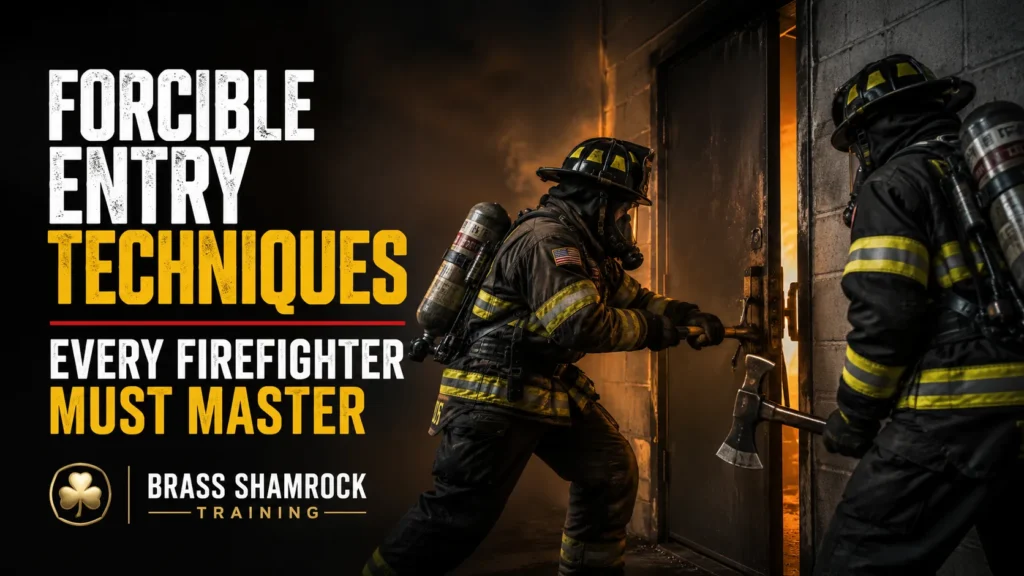
One of the most important skills a firefighter can learn is forcible entry. As seconds count during high-stakes emergencies, being able to quickly, safely, and efficiently gain access to a structure can be the difference between life and death for victims and firefighters alike. All firefighters, from the newest volunteer to the most experienced career firefighter, need to know the principles, tools, and techniques involved with an effective forcible entry.
Challenges have changed on today’s modern fireground. New buildings are built using sturdier materials, doors are made more robust, and precision is crucial in time-sensitive scenarios. A failed or delayed entry may jeopardize firefighter safety, may reduce victim survivability, and may result in property loss. During forced entry, there can be errors that lead to injury, structural failure, or the spread of fire if suppression is delayed.
Firefighters must be able to use forcible entry skills to meet all challenges, including facing a residential front door, a commercial barrier, or a reinforced fire escape. Using the proper technique increases the efficiency of operations, promotes crew accountability, and helps to maintain a level of situational awareness in complex environments. It is not only about getting in, but it is also about understanding the “why” and “how” of a method working in certain contexts, how to collaborate with other team members, and when to choose a tool or technique given tactical objectives.
In this complete manual, firefighters will discover all the fundamentals of forcible entry. Whether you’re interested in the history and purpose of these techniques or in modern tools, step-by-step procedures, real-world scenarios, or training drills, this article provides fire service professionals with actionable knowledge. These skills are essential for any firefighter and are crucial to their preparation, safety, and effectiveness in the field.
SECTION 7: QUICK ANSWER
Forcible entry techniques are organized procedures that a fire company will use to access buildings or compartments in an emergency situation. These include the use of the right tools, evaluation of the nature of the door or barrier, teamwork, and applying the correct force in a controlled manner while keeping everyone safe. On the fireground, Mastery provides rapid access, enhances victim survivability, and increases efficiency.
SECTION 8: WHAT IS FORCIBLE ENTRY TECHNIQUES MUST EVERY FIREFIGHTER MASTER?
Definition:
Forcible entry is a systematic method for a firefighter to enter a locked or obstructed structure, room, or vehicle. Manual methods, for example, using a Halligan bar and striking tools, and mechanical methods using special equipment.
Purpose:
Forcible entry is a means to allow firefighters to conduct rescue, fire suppression, and ventilation operations safely and efficiently. It allows for quick access without causing excessive damage and keeping the situation under control.
History:
In the past, forcible entry developed from simple firefighting tools like axes and hooks to modern tools such as Halligan bars, hydraulic tools, and breaching devices. These skills have been standardized by training to increase speed, safety, and crew coordination.
Fireground Relevance:
The act of forcibly entering a building is part of nearly all structure fires and emergency rescue operations. Doors, windows, gates, and barriers are constructed and designed to make it difficult to gain entry, and firefighters must determine the type of materials, locking device, and structural hazard before using force to enter.
Operational Importance:
The selection of the proper technique is one of the most important factors that determines how quickly a firefighter enters a building, how safe he or she is, and how effective he or she is in the tactical decisions made while in the building. A lack of execution can involve firefighters in a fire, slow down rescue operations, or hinder suppression operations.
Practical Applications:
Techniques are used in residential homes, high-rise buildings, commercial vehicles, and industrial complexes. Firefighters should learn several techniques: door, window, wall, or roof, and be able to change techniques based on the construction and fire of a building.
SECTION 9: WHY THIS SKILL MATTERS ON TODAY’S FIREGROUND
- Firefighter Survival: Entering rapidly and efficiently minimizes exposure to hazards and therefore, can make it safer to work on a fireground.
- Victim Survivability: Quick access to trapped occupants is critical; delays can be fatal.
- Operational Efficiency: Streamlined entry prevents wasted effort, allowing crews to focus on fire attack and search operations.
- Property Conservation: Controlled forcible entry reduces unnecessary structural damage.
- Crew Accountability: Clear entry protocols improve communication and team safety.
- Tactical Effectiveness: Firefighters will learn correct techniques to perform coordinated suppression, ventilation, and rescue.
- Modern Building Challenges: Reinforced doors, fire-rated barriers, and complex locking systems demand up-to-date skills.
- Time-Critical Operations: Each second matters; mastery means each second is acted upon.
SECTION 10: HOW IT WORKS
Process Overview:
Forcible entry is a sequence of assessment, tool selection, and methodical application.
Operational Steps:
- Size up: Determine the type of door, construction, locking, and hazards.
- Select method: Manual (axes, Halligan) vs. mechanical (hydraulic tools, rotary saws).
- Position team: Keep the team in a good position and keep the crew aligned.
- Apply technique: Use controlled force; do not cause unnecessary damage.
- Confirm access: Ensure entry is clear for firefighter and victim movement.
- Communicate: Maintain verbal cues and accountability check-ins.
- Reassess: Review structure for structural integrity and fire spread before continuing.
Tactical Considerations:
- Prioritize doors that provide access to life hazards.
- Minimize fire and smoke spread during entry.
- Integrate forcible entry with ventilation, hose line deployment, and search operations.
SECTION 11: ESSENTIAL EQUIPMENT AND TOOLS
Tool | Purpose | Advantages | Limitations | Best Use Case |
Halligan Bar | Pry, twist, or breach doors | Versatile, durable | Requires skill | Residential/commercial doors |
Flathead Axe | Striking and chopping | Durable, multipurpose | Heavy | Wooden doors, lock plates |
Sledgehammer | Force application | High impact | Can cause structural damage | Metal doors, barricaded entries |
Hydraulic Spreader | Open reinforced barriers | Efficient, fast | Requires a power source | Vehicle doors, high-security barriers |
Rotary Saw | Cut through locks, walls, roofs | Fast, precise | Generates heat and noise | Metal doors, composite locks |
Pike Pole | Pulling ceilings, removing obstacles | Extends reach | Less effective on doors | Ventilation, debris clearing |
Bolt Cutters | Cut padlocks, chains | Portable, simple | Limited to thin metals | Gates, chain-secured doors |
Ram Tool | Push or break doors | High impact | Heavy, requires backup | Locked commercial doors |
Explanation:
Tools are chosen depending on the type of door, locking system, fire scenarios, and the size of the crew. An example of this is Halligan bars and a flathead axe, which, when used together, can provide an efficient and safe technique for entering the door.
SECTION 12: STEP-BY-STEP OPERATIONAL GUIDE
Step 1: Scene Size-Up
- Objective: Identify entry point type and hazard potential.
- Actions: Examine doors/windows; check for locks or barricades.
- Safety: Avoid exposing crew to fire or collapse risks.
- Communication: Relay findings to the officer and team.
- Common Mistakes: Rushing entry without assessment.
- Tip: Look for secondary exit points or weak structures.
Step 2: Tool Selection
- Objective: Choose the most effective tool for the barrier.
- Actions: Consider door material, lock type, and fire spread risk.
- Safety: Ensure tools are in good working order.
- Communication: Announce the chosen method to the crew.
- Tip: Backup tools should be ready.
Step 3: Crew Positioning
- Objective: Ensure maximum force with minimal injury risk.
- Actions: Align body mechanics, assign roles (primary/backup).
- Safety: Maintain proper stance, PPE usage.
- Tip: Confirm everyone is clear of swinging doors or debris.
Step 4: Force Application
- Objective: Breach the barrier efficiently.
- Actions: Pry, strike, or cut based on the method.
- Safety: Controlled force to prevent kickback or collapse.
- Tip: Combine Halligan and axe for precision.
Step 5: Access Confirmation
- Objective: Verify the opening is sufficient for entry.
- Actions: Test door swing, remove obstacles.
- Safety: Watch for fire spread or smoke surge.
- Tip: Clear debris immediately.
Step 6: Tactical Entry
- Objective: Enter safely and deploy hoses or rescue lines.
- Actions: Maintain a low profile, follow pre-determined path.
- Safety: Watch the ceiling, floor, and walls for collapse signs.
- Tip: Always maintain contact with your partner.
Step 7: Victim Access and Search
- Objective: Ensure victim safety and rescue readiness.
- Actions: Perform a quick search, guide victims out.
- Safety: Air management and communication critical.
- Tip: Prioritize rapid assessment of high-risk areas.
Step 8: Post-Entry Evaluation
- Objective: Assess structural integrity, tool damage, and technique efficiency.
- Actions: Debrief, report tool status, plan next entry.
- Tip: Continuous improvement through review.
CONCLUSION
Forcible entry is an important ability for all firefighters. The benefits of mastery are quick access, increased victim survivability, and crew safety. Using the right tool at the right time, with the proper strategy and crew coordination, minimizes risks and maximizes efficiency on the fireground. Building confidence and operational readiness through continuous training, scenario practice, and best practices such as those provided at Brass Shamrock Training. Commit to improving these skills – one second saved can save a life.
Frequently Asked Questions
How do I choose the right tool for forcible entry?
The type of barrier (wood, metal, reinforced), the locking mechanism, and the need for access are important, as well as the size of the crew. For routine doors, use a manual tool, and for reinforced or heavy barriers, use a hydraulic or mechanical tool.
What safety precautions are essential during forcible entry?
Always wear full PPE (SCBA). Ensure situational awareness, ensure correct positioning of the crew, and determine structural integrity before exerting force. Communication and back-up staff are essential.
How does building construction affect forcible entry?
Many modern doors, windows, and walls are reinforced with steel, laminated glass, and fire-rated barriers. Applying correct entry methods safely requires firefighters to consider the type of material, integrity of the walls, and door mechanisms.
Can forcible entry be performed alone?
It’s technically feasible, but it’s not recommended. For safety, coordination, and accountability, two-person teams are required for fireground operations.
How can mistakes in forcible entry impact operations?
Errors can cause delays, make fire spread faster, cause structural failure, or cause injury to firefighters. Training is a way to reduce these risks and increase efficiency when there is pressure.