
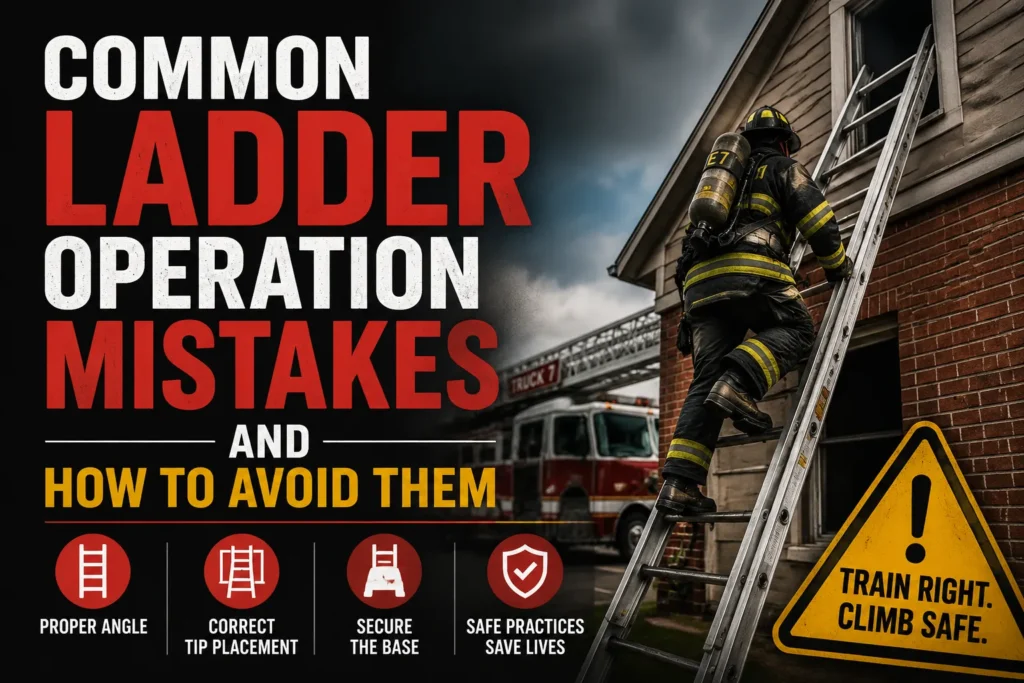
A firefighter arrives at the 3rd floor window and swings a leg over the sill and feels the ladder move under his foot. Only does 1 inch. Nevertheless, that inch is sufficient to cause his tummy to turn around and remind him that the ladder he climbed never was fastened at the bottom. That day, he makes it down safely. Not all firefighters do.
Some of the most used items in the fire service are also some of the most misused, such as ground ladders and aerial devices. Teams spend a lot of time training on hose lines, forcible entry and search patterns, but ladder is sometimes taken for granted and not trained on in recruit school, or at all. That’s what causes firefighters to think they are in trouble.
Ladders do not qualify as passive equipment. They are tools that are dynamic and require proper angle, properly placed feet, and proper size-up and tip placement. Poorly positioned ladders can collapse, slide, or not reach the object of their ascend at the moment a crew member needs it most during a rescue, ventilation, or egress operation.
The article examines the common pitfalls that repeatedly appear on the fireground and training evolutions, and the corrective measures that help to put shaky ladder work on repeat. This is a piece of information that is helpful for new firefighters as they’re developing a foundation and for the seasoned truck company operator who wants to brush up on his or her skills.
Why Ladder Proficiency Still Separates Good Crews From Great Ones
There are three important functions ladders have in the fireground: Firefighter access, victim rescue and secondary egress. If one of those functions fails due to not using the ladders correctly, the consequences begin building rapidly. A load-ladder in wrong position can buckle. If one is not close enough to the building, it may leave a firefighter with a long reach stretching precariously at the end of the line. An ill-fitting foot can slip out from under a climbing member at any moment.
On the surface, the operation of ladders appears straightforward; many departments under-train in ladders. As a result bad habits enter in and remain undiscovered until they are caught up in a genuine incident. The same few mistakes are seen by instructors at every size of department, by career and volunteer alike in their delivery of evolutions for truck academy.
Mistake One: Misjudging the Climbing Angle
A ground ladder is at its best when its slope is approximately 75° which is usually determined by the following “rule of thumb”: A firefighter extends an arm straight out at shoulder height and is just able to reach the rung. An angle that is too steep will cause the ladder to tip backwards from the building. If the angle is too shallow however, the base has to take an undue amount of outward stress, which increases the likelihood of the feet slipping out.
This error is most likely to occur when a crew is rushing in practice. While speed is important during a fire, throwing a ladder too quickly without verifying the angle makes it a hazard for anyone who climbs on the ladder later, and for the first firefighter to climb the ladder.
The fix: Automate, don’t opt-in, the checking of angles. In all raises, even while doing drill work, have a firefighter speak out loud the angle check. Low stress builds the habit, and then it’s maintained during the high stress.
Mistake Two: Poor Tip Placement
The length of the ladder is not the only important factor; how high it is placed is equally important. A tip in the centre of a window opening obstructs escape and rescue. Tips placed on the window sill, or any window pane supported by a window frame, may not be safe under the weight of a climbing firefighter.
Tip placement is even more crucial when accessing the roof. The tip should also be several feet above the roofline to provide a visual point for firefighters to gauge height and provide a handhold when moving from ladder to roof. A complementing tip that’s flush or just below the roof edge provides no visual hint in poor light and creates an awkward, unbalanced transition.
The fix: Don’t think about placing tips, just do it. If the window opening, the tip should rest at or just below the sill on the side (not in the middle) to allow easy access in and out. When conditions are favorable, extend tip 3 to 5 rungs above roofline when working on roofs.
Mistake Three: Failing to Properly Foot or Secure the Ladder
When a firefighter is on the footing ladder, they prevent the base kicking out when using the ladder or when raising it; they can also do this mechanically. One of the most preventable reasons for ladder failure on the fireground is to skip this step or take it half-heartedly.
This error is frequently made when staff are short and need to hurry to get a ladder up and proceed with the next job. Sadly, this is a short term that takes away an essential safety margin when situations are most frequently not straightforward, such as when on uneven ground, soft soil or icy surfaces.
The fix: When staffing is suitable, foot the ladder during the raise and tie it off or secure it when elevated, either by straps, halyard ties or roof hooks, depending upon the type of ladder. In a situation where staffing is extremely limited, choose a stable footing surface and double check the angle and base placement carefully before transferring weight to the ladder.
Mistake Four: Choosing the Wrong Ladder for the Task
Not all ladders are suitable for every situation. Multiple lengths of ground ladders and various aerial devices are carried by departments for this reason because fireground conditions are very varied. People tend to take whatever ladder they can find without considering how far they’ll have to climb. This can lead to a ladder that isn’t long enough or equally as bad, one that’s too long and requires more effort to operate in confined areas.
A 24-foot ladder, for example, sent to a window on the third floor is only as effective as that window is high, and if the operator makes a mistake, the job is delayed because he has to send a 35-foot ladder. Similarly, the use of a long extension ladder in a small side yard makes the job slower and makes it easier to come into contact with overhead power lines.
The fix: Make selecting ladders part of the size-up. Provide officers and firefighters with training to approximate a building height and reach distance within a few seconds, and then match the ladder to the job before they pitch on a raise. Departments that drill this skill on a frequent basis get much quicker and more accurate at picking a ladder when they’re pushed for time.
Mistake Five: Neglecting Continuous Overhead and Hazard Awareness
Ladder operations are not undertaken in isolation. There are several factors to consider when raising a ladder, including overhead power lines, unstable parapet walls, falling debris, and changing fire conditions. One typical problem is conducting a good size up prior to the raise and then losing awareness during the evolution.
Conditions change. The wall which seemed firm at the beginning of an incident can collapse two minutes later. Ladders may only reveal the existence of a power line when the ladder is in rotation to reach the position.
The fix: Don’t just check the box for hazard awareness, it is an ongoing process. Have an established set of eyes, usually the officer or a designated safety, firefighter, to watch the structure and surroundings during the entire ladder operation, not just the preoperation.
Mistake Six: Inadequate Communication During the Raise
Communication is essential to ladder raises, especially for flat raises and beam raises with multiple firefighters. If one firefighter calls a command while the rest of the crew is not paying attention or not repeating it at the same time, the raise is uneven, putting strain on the crew and the risk of falling off the ladder, losing control of the butt spurs, etc.
This is most likely to occur when crews are made up of firefighters from different departments or in mixed-experience crews, or during mutual aid response operations. Even seasoned firefighters can lose the rhythm, if they don’t have a common set of verbal orders.
The fix: Make a verbal cue for any raise and practice them until they are second nature. The use of a commonly used command language is great for departments that are involved in repeated mutual aid situations where it will help keep the ladder operations flowing no matter what crews are involved.
Training Methods That Build Real Ladder Competency
While classroom review is appropriate, ladder skills are developed through repetition in realistic situations. Raises on uneven terrain, raises in full PPE and SCBA, raises under simulated time pressure, and raises in night time or reduced visibility are all part of an effective training program.
Also, scenario-based drills that involve both a ladder operation and a secondary task (e.g., a forcible entry evolution immediately after the raise) are more representative of the demands of a fire ground. Isolated repetitive exercises promote muscle memory, while layered drills promote judgment that firefighters need in a situation where things are going against them.
Departments that really want their company to be proficient often change ladder evolutions to a regular training session instead of only requiring a one-time in the recruit school. If you don’t use a skill, you lose it, and this is true of ladder work.
Leadership’s Role in Preventing Ladder Mistakes
Officers are the ones who do the drilling.Officers do the drilling and set the tone. By actively engaging in ladder drills, officers should ask questions during size-up, and hold crews accountable for angle checks and footing procedures and the standards will transfer to actual incidents.
But at the same time, if ladder work is approached as a routine exercise, it reflects that attitude on the fireground as well. Good ladder work requires a sense of purpose and a relaxed approach, even when it’s part of the pressure to move quickly.
Final Thoughts
Ladder operations reward discipline and punish shortcuts. The mistakes outlined here rarely show up because firefighters lack knowledge. They show up because pressure, fatigue, or thin staffing pushes crews to skip steps that feel optional until the moment they are not.
Above all, the departments that consistently get ladder work right are the ones that keep training on it long after recruit school ends. Brass Shamrock Training builds these principles into truck academy evolutions and spotting and positioning courses specifically because ladder competency is foundational to so many other fireground operations, from vertical ventilation to victim rescue. Firefighters who treat every raise as deliberate practice, rather than routine, are the ones who perform reliably when it counts most.
Frequently Asked Questions
What is the correct climbing angle for a ground ladder?
The recommended climbing angle is approximately 75 degrees, commonly checked using the arm’s-length rule, where a firefighter standing at the base can just touch the rung at shoulder height with a fully extended arm.
Why is footing a ladder so important?
Footing prevents the base of the ladder from kicking out or sliding during the raise and while firefighters are climbing, particularly on unstable, wet, or uneven surfaces.
How far should a ladder extend above a roofline?
For roof access, the tip should typically extend three to five rungs above the roof edge, providing a clear visual reference and a secure handhold during the transition.
What is the most common cause of ladder failure on the fireground?
Improper angle and inadequate footing are the two most frequently cited factors contributing to ladder instability and failure during fireground operations.