Walk onto any drill ground, and you can tell
Spend an hour at any fire department training ground in the country, and within minutes, you can tell whether the crew is actually training or just going through the motions. The cues are subtle but unmistakable. Are the officers participating, or watching from a distance? Are firefighters timing themselves? When mistakes happen, are they corrected on the spot or politely ignored? Is the debrief honest, or is it five minutes of “good job, everybody”?
Training effectiveness is the single largest variable separating departments that perform on the fireground from departments that struggle. Two departments can log the same number of training hours each year and still produce wildly different outcomes, because hours logged are not the same as competence built. The fire service has known this for decades. Even so, the gap between effective and ineffective training programs remains one of the most consistent weaknesses in our profession.
This article is written for fire chiefs, training officers, company officers, and firefighters who want to move past the comforting illusion of “we trained on that already” and into the harder, more honest work of building training that actually transfers to the fireground. The goal isn’t more training hours. The goal is better firefighters.
Quick Answer: How Can Fire Departments Improve Training Effectiveness?
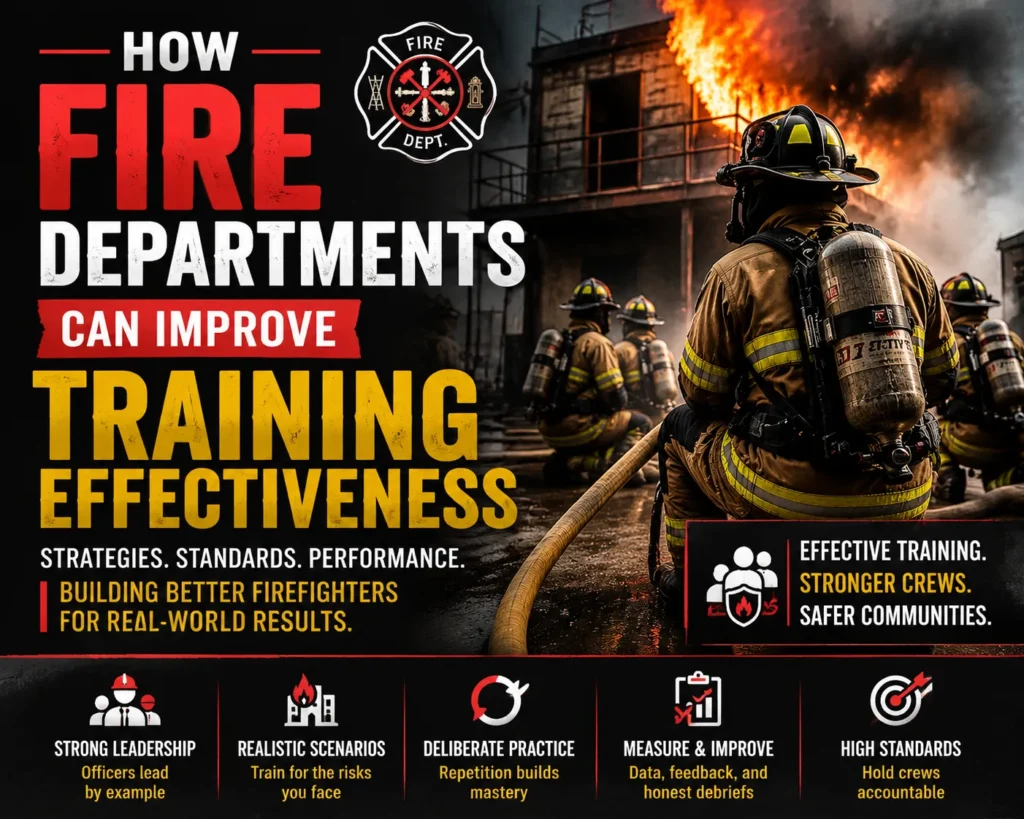
Fire departments improve training effectiveness by:
- Building a culture where officers train alongside their crews
- Designing realistic, scenario-based drills tied to local risks
- Prioritizing deliberate repetition of fundamentals over variety theater
- Measuring performance with timing, video review, and after-action debriefs
- Holding crews accountable to defined performance standards
- Investing in quality training props, acquired structures, and outside instruction
- Integrating decision-making and communication into every skill drill
- Documenting training honestly and reviewing results across the year
- Separating officer development from firefighter development
- Creating a culture where mistakes during training are welcomed, not hidden
Ultimately, effectiveness isn’t about hours logged. It’s about whether the training changes what firefighters do on the fireground.
The Difference Between Training and Performing
The most common failure in fire department training isn’t a lack of effort. It’s mistaking activity for learning. Crews show up, run a familiar drill, complete it cleanly, and leave feeling productive. Nothing was challenged. Nothing was uncovered. Nothing was improved. The crew already knew how to do what they just rehearsed. That’s performing. It’s not training.
Training, in the operational sense, is the deliberate stressing of a skill or decision until weakness is exposed and addressed. If a drill never produces a mistake, it’s too easy. If a debrief never identifies something to fix, it’s too shallow. If a firefighter leaves a session feeling exactly as comfortable as when they arrived, the session probably failed.
This distinction matters because real fires don’t reward familiarity. They punish it. The fireground is unpredictable, dangerous, and indifferent to a department’s training records. The only thing it respects is competence, and competence is built by training that stretches firefighters beyond what they already do well.
What Training Effectiveness Actually Means
Training effectiveness is the degree to which training changes fireground performance. You don’t measure it by attendance, by hours, or by the cleanliness of the drill ground. You measure it by whether firefighters perform faster, more safely, and more decisively during real incidents than before.
This definition matters because it forces departments to ask a different question. Instead of “Did we train this quarter?” the question becomes “Did our crews get better this quarter?” The first question is easy to answer with a roster. The second requires honesty, measurement, and a willingness to confront uncomfortable truths.
Effective training programs are built around three principles: specificity, fidelity, and transfer. Specificity means training the exact tasks crews perform on the fireground. Fidelity means replicating the conditions, including PPE, time pressure, communication load, and environmental stress, as closely as possible. Transfer means designing training so the skill survives the trip from the training ground to a 3 a.m. structure fire. Consequently, departments that build training around these three principles consistently outperform departments that rely on volume alone.
The Five Foundations of an Effective Training Program
1. Leadership That Trains, Not Just Schedules
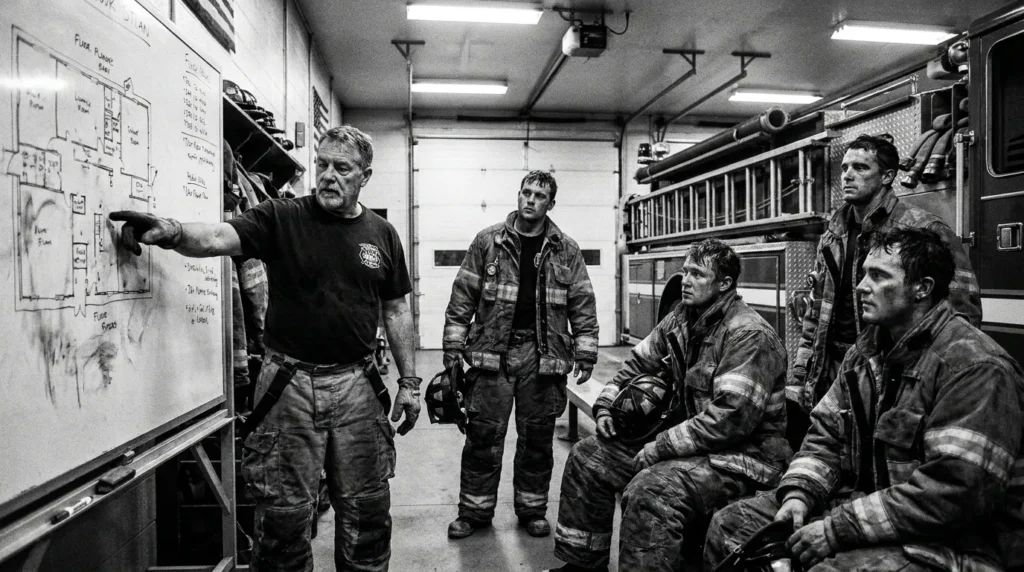
The single largest predictor of training effectiveness is officer participation. When chiefs, captains, and lieutenants put their gear on and force the door alongside their crews, the entire program rises. On the other hand, when leadership treats training as something firefighters do while officers watch, standards collapse. Crews mirror their leaders. There’s no shortcut around this.
2. Scenarios Built From Local Risks
Generic training produces generic firefighters. The most effective programs analyze their response area, looking at occupancies, construction types, water supply realities, and target hazards, and then build scenarios around the calls they’re most likely to run. For example, a department in a high-rise district trains differently from a department covering balloon-frame Victorians. Both can be excellent. Neither succeeds by copying the other.
3. Deliberate Repetition of the Fundamentals
The fire service has a chronic appetite for novelty. New tools, new tactics, new acronyms. Meanwhile, the fundamentals like stretching a line, throwing a ladder, forcing a door, and conducting a primary search are where most fireground performance is won or lost. Effective programs return to fundamentals constantly, not because they’re basic, but because they’re decisive. Mastery is built through repetition, not exposure.
4. Honest Measurement
What gets measured improves. Effective programs track time skills, record performance, evaluate against benchmarks, and review results across months and years. Subjective impressions like “the crew looked sharp today” are useful as a starting point but inadequate as a standard. In contrast, stopwatches, video review, and structured debriefs turn impressions into data, and data into improvement.
5. A Culture That Welcomes Mistakes
Training programs fail when firefighters feel they have to perform rather than learn. If errors are mocked, punished, or quietly remembered, crews will hide weakness instead of fixing it. The strongest departments build cultures where mistakes during training are treated as the entire point. After all, the fireground is no place to discover a deficiency. The training ground is.
Designing Training That Transfers to the Fireground
The biggest gap in most training programs is the distance between drill ground and fireground. A skill learned in shorts and sneakers doesn’t survive the trip to a working fire. The fix is to deliberately close that gap by raising the realism of training.
In practice, this means training in full structural PPE whenever the skill warrants it. It means putting firefighters in the air when the scenario calls for it. It means adding the conditions that complicate real operations, like radio traffic, low light, time pressure, and simultaneous tasks. A search drill with no smoke, no radio chatter, and no time limit teaches very little. A search drill with charged air bottles, blacked-out facepieces, simulated mayday traffic, and a stopwatch teaches a great deal.
Training transfer also depends on training the right crews together. Firefighters and officers who routinely respond together should routinely train together. The wordless communication that defines an excellent truck company or engine company can’t be built between strangers. It’s built by repetition with the same partners over months and years.
How to Measure Whether Training Is Actually Working
Measurement is the part of training most departments skip, and the part that separates good programs from great ones.
Effective measurement includes timing key skills against published benchmarks, video review for technique and decision-making, structured after-action reviews after every significant drill, and annual skills evaluations recorded and tracked over time. The point isn’t to grade firefighters punitively. The point is to identify where the program is producing results and where it isn’t.
Departments that measure honestly discover patterns. For example, the engine company might be excellent at stretching but slow at flowing water. The truck company might force doors well, but lose time at the ventilation hole. A particular shift might consistently outperform the others, and the reasons are worth studying. None of these insights are available to a department that measures only by hours logged.
The best metric of all is fireground performance itself. Departments that conduct meaningful post-incident reviews, not blame sessions but genuine analyses, create a feedback loop between operations and training. The fires teach lessons. The lessons reshape the drills. The drills change the next fire. That’s what a learning organization looks like.
Where Most Departments Fall Short
The most common failures of fire department training programs follow a predictable pattern. Officers schedule training but don’t participate. Drills repeat the same scenarios so often that they become rituals. PPE gets left in the rig because it’s hot or inconvenient. Debriefs get skipped or reduced to platitudes. Measurement is absent. Outside instruction is treated as a luxury rather than a necessity. Officer development is neglected because everyone assumes the rank itself is sufficient education. Recordkeeping is done for the auditor, not for the department.
None of these failures is mysterious. They’re well documented in fire service literature, NIOSH reports, and after-action reviews of line-of-duty deaths. What separates departments that fix these problems from departments that don’t is rarely budget. Instead, it’s leadership willing to confront the gap between what the department says about its training and what the training actually produces.
What the Best Departments Do Differently
Departments that consistently produce excellent fireground performance share recognizable habits. They train weekly, not monthly. They build progressions that take new firefighters from fundamentals to mastery over defined timelines. They invite outside instructors regularly because they understand that internal echo chambers eventually flatten skill. They train officers separately on tactical decision-making, command, and crew management, not just operational skills. They run multi-company drills that force coordination between engine, truck, and rescue. They share training across mutual-aid lines, so the crews working together at fires already know each other. They invest in quality props and dedicated training facilities. They keep training boring in its consistency and demanding in its standards.
None of this requires a metropolitan budget. Small and volunteer departments have built outstanding programs on modest resources by focusing on the fundamentals, partnering with neighboring agencies, and committing leadership time. The constraint is rarely money. It’s almost always a priority.
A Practical Framework for a Year of Effective Training
A simple framework that fits most departments looks like this: weekly company-level skill drills covering rotating fundamentals, monthly scenario-based multi-company drills, quarterly skills evaluations against published benchmarks, semi-annual outside instruction in a focused discipline, and an annual after-action review covering the year’s incidents and how training should evolve in response.
The exact mix varies by department size, call volume, and risks. What doesn’t vary is the architecture: a steady drumbeat of fundamentals, periodic scenario integration, honest evaluation, and outside perspective. As a result, departments that maintain this rhythm for several years produce noticeably stronger firefighters than departments that train reactively or sporadically.
Specialized programs delivered by outside instructors play an important role in this framework. Curated, scenario-driven instruction in disciplines like forcible entry, vertical ventilation, search and RIC, building construction, and heavy lift and stabilization, such as the courses offered by Brass Shamrock Training, can accelerate skill development and inject fresh perspective into programs that have become internally insulated. Outside instruction doesn’t replace in-house training. It sharpens it.
Closing Thought
Training effectiveness isn’t a program. It’s a discipline. It’s the daily choice to demand more from a drill than rote completion, to debrief honestly when comfort says otherwise, to time the skill when impression would do, to put the gear on when the air is hot, and to participate as a leader when watching would be easier.
Departments that make these choices consistently produce firefighters who perform on the fireground at a level that surprises everyone except the people who trained them. On the other hand, departments that don’t make these choices produce firefighters who learn the hard lessons in the worst classroom in the profession: a real fire with real lives at stake.
The path forward isn’t complicated. It’s just demanding. Train the fundamentals. Measure honestly. Bring leadership to the drill ground. Welcome the mistakes. Invest in outside perspective. Build the calendar, hold the standard, and let the results compound over years.
For departments committed to elevating their training programs, focused hands-on instruction in disciplines like Forcible Entry, Truck Academy, Search and RIC, Vertical Ventilation, Building Construction, and Heavy Lift and Stabilization, offered through Brass Shamrock Training, can serve as a force multiplier alongside strong internal programs. The fire service rewards departments that take training seriously. The work is the work. Do it well, and the fireground takes care of itself.
Frequently Asked Questions
What is fire department training effectiveness?
It’s the degree to which training measurably improves fireground performance, crew safety, and decision-making. It isn’t measured by hours logged.
How often should fire departments train?
Career departments should train weekly at the company level. Volunteer departments should target at least bi-weekly company drills, supplemented by monthly multi-company scenarios.
What is the biggest cause of ineffective firefighter training?
Officers are scheduling training but not participating, combined with an absence of measurement. The two failures usually appear together.
How can small or volunteer departments build effective training programs?
By focusing on fundamentals, partnering with neighboring departments, investing in basic training props, and inviting outside instructors periodically. Resources matter less than priority.
What is scenario-based training?
It’s training that recreates the conditions of a real incident, including PPE, time pressure, communication load, and environmental stress, so skills are practiced the way they’ll actually be used.
Why is leadership participation in training important?
Officers set the standard. When leadership trains alongside crews, the entire program rises in quality and seriousness. When officers only watch, standards collapse.
How do you measure training effectiveness?
Through timed benchmarks, video review, structured after-action reviews, annual skills evaluations, and honest post-incident analysis that ties fireground performance back to training.
Should fire departments hire outside instructors?
Yes. Outside instruction prevents internal echo chambers, brings new techniques and perspectives, and benchmarks departmental performance against the broader profession.
What is the role of after-action reviews?
After-action reviews identify what worked, what failed, and what needs to change. They’re the feedback loop that connects training to operations.
How can training officers improve training quality?
By building progressions, measuring outcomes, debriefing honestly, varying scenarios, requiring PPE, including officers, and resisting the temptation to default to familiar drills.
Is more training always better?
No. Repetitive low-quality training reinforces bad habits. Fewer, well-designed, well-debriefed drills produce better firefighters than more drills run on autopilot.
How long does it take to build an effective training program?
Cultural change typically takes 12 to 24 months of consistent effort. However, skill improvement begins much sooner, within weeks for departments that commit to the work.