Ask ten fire officers about their “training program” and you’ll get ten different answers usually wrapped in ten different excuses. “We drill when we can.” “We checked off this quarter’s boxes.” “Vector is at 100%.”
Meanwhile, rig checks, station chores, inspections, and everything else chip away at the clock. What you’re left with is a hose evolution here, a ladder throws there, maybe a video on a slow night. It feels like training, it logs training hours, but it’s not a program it’s a collection of random reps with no direction, no progression, and no path to excellence.
Here’s the difference that counts. A series of drills that develops individual skills. A program that gradually, systematically, and measurably develops capacity. That skill set becomes evident on the fireground with a faster-moving, clearer-communicating, better-decision-making crew that trains with structure rather than simply checking boxes.
The cost of getting it wrong is steep. Skills fade fast when they aren’t reinforced. Put companies together that have never trained side‑by‑side and you’ll watch coordination fall apart in real time. Train without understanding the real risks in your district, and you leave firefighters unprepared for the calls they’re actually going to face. These failures don’t announce themselves; they show up quietly, in a smoke‑charged hallway, or a steep roof, when there’s no time left to fix them.
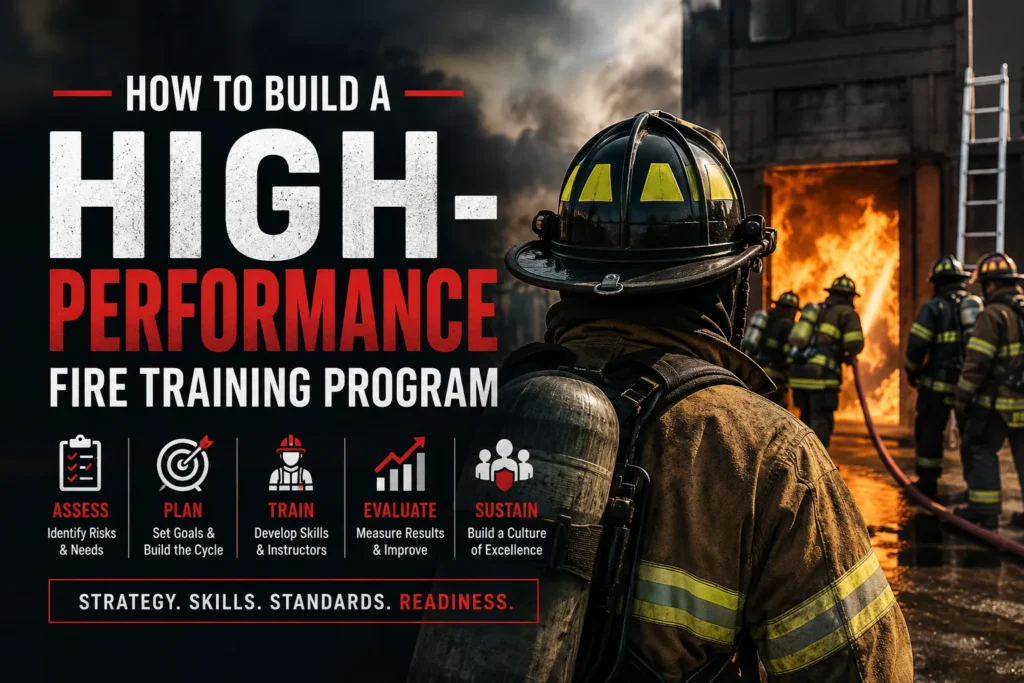
Start by outlining the steps you can take to create a high-performance fire training program from scratch, including how to determine what your department really needs, establish realistic goals, create a plan for a long-term training cycle, train your instructors, get an honest evaluation of the results, and create a culture that keeps it all together. This process applies to any department regardless of size.
Quick Answer
The first step in creating a high-performance fire training program is a risk-based needs assessment of your district and crews, followed by establishment of clear competency goals for actual fireground performance. Create a training cycle that includes repeating core training, developing qualified trainers, measuring outcomes against verifiable standards, and fostering an environment that recognizes and supports training and sets the example at the top of the organization. The purpose is to build measurable readiness.
What Separates a Program from Random Drills
A program is a deliberate, structured path that builds and maintains real skill. Random drills are just reps in the moment. Both matter but only when they support each other and drive toward the same end state. When they’re aligned, crews grow. When either piece is missing, readiness collapses.
Every solid training program rests on three pillars: intention, structure, and accountability. You establish what you’re building, why you’re building it, and how you’ll measure whether it actually worked. When those pieces are missing, departments fall into the same loop: same evolutions, same skills, same gaps busy but not better. The reps look productive, but they don’t move the needle on fireground performance.
A real program is built around the calls your people actually have to answer, not whatever happens to be convenient or what checks a box. That distinction is the line between “we trained” and “we got better,” and everything that follows is built on that mindset.
Start With a Risk-Based Needs Assessment
Before you schedule a single evolution, you need to know what your department must be able to do. This begins with an honest look at two things: your district and your people.
First, assess your district’s risk profile. What do you actually respond to? A department covering lightweight-construction subdivisions, an aging downtown, an interstate corridor, and an industrial area faces four very different problem sets. Your building profiles, target hazards, call volume, and incident history all point toward the competencies your crews must own.
Next, assess your people. Where does individual and crew performance stand right now? Be specific. “We’re slow on forcible entry” is a starting point; “our crews average too long on inward-swinging residential doors with secondary locks” is an objective you can train toward. Honest gap analysis, through evolutions, evaluations, and after-action reviews, reveals where the program should focus.
The product of this assessment is a prioritized list of competencies. Consequently, you stop training out of habit and start training out of need.
Set Objectives That Mean Something
Vague goals produce vague results. “Get better at search” isn’t an objective; it’s a wish. A strong training objective is specific, observable, and tied to fireground performance.
Effective objectives generally share a few traits:
- They’re measurable. You can tell whether the crew met the standard or didn’t.
- They’re realistic. They reflect your staffing, apparatus, and resources, not someone else’s.
- They’re tied to outcomes. Each one connects to a real fireground task that affects survival or effectiveness.
For example, instead of “improve RIC skills,” a high-performance program sets something like: “Each company will locate, package, and begin removal of a downed firefighter within a defined time standard, using assigned equipment, under low-visibility conditions.” That objective tells everyone exactly what competence looks like and gives you something concrete to evaluate.
Structure the Training Cycle
Skills decay. This single reality should shape how you structure training more than anything else. A firefighter who masters a perishable skill once and never revisits it will not own that skill when it counts. Therefore, a high-performance program runs on a recurring cycle rather than a one-time push.
A practical approach distributes core competencies across a calendar so that critical, perishable skills recur frequently while broader topics rotate over a longer period. Forcible Entry, Search, RIC, ground ladders, and apparatus positioning all need regular reinforcement. Building construction, specialized rescue, and less frequent operations can cycle on a longer rotation, provided they don’t disappear entirely.
Equally important, the cycle should layer complexity over time. Crews first build individual competence in a skill, then integrate it into company operations, and finally combine it into realistic, multi-company scenarios. To illustrate, a search progression might move from solo room searches to a coordinated company search with a hose line to a full scenario involving search, ventilation, and an RIC standby operating together. Each stage prepares the crew for the next.
This layered, repeating structure is what turns isolated abilities into integrated fireground performance.
Develop Your Instructors
The potential of a program is only as strong as its people. Unfortunately, many departments pass responsibility for training to whoever is available and/or senior, and that person may not be the best person for the assignment. Personal skills do not necessarily translate into skill in instructing.
High-quality instructors must be able to demonstrate the skill with a high level of proficiency and have a depth of knowledge on the skill being instructed. They describe the ‘how’ of a technique, identify the ‘why’ behind a firefighter’s difficulty, modify their technique, and establish a realistic context that enhances the training effect. They are, above all, competent, not chosen by rank, popularity, or position.
This is why it is more beneficial to invest in developing the instructors. These are the skills that Brass Shamrock Training focuses on: Instructor-level, focused, hands-on learning in subjects such as Forcible Entry, Truck Operations, Search and RIC, and Ventilation, bringing a core of capable trainers that drive up the performance of those they train. Knowledgeable and experienced instructors make all the difference. People who believe in the See one-Do one-Teach one method will lead their department into trouble.
Make Training Realistic
Realism is the link between practice and performance. The more closely training conditions replicate actual incidents, the more likely the skills will be transferred to the street. This principle ought to be carried out in all evolutions you design.
Train in conditions as close as possible to actual response: Realistic layouts, limited visibility, full PPE and SCBA, assigned apparatus, and time pressure. Where possible, acquired structures provide excellent opportunities to practice forcible entry, search, and ventilation skills, as well as recognition of buildings and construction. Without them, realism can be added through scenario design, blacked-out masks, and operational time standards.
But realism should never come at the expense of safety! The goal isn’t risk; it’s realistic conditions. Safe conditions, specific training goals, and skilled trainers with established safety protocols allow crews to train hard while mitigating risks. When done properly, demanding training and firefighter safety go hand-in-hand and don’t compete.
Evaluate Honestly and Measure Progress
If you can’t measure it, you can’t improve it. Evaluation is what separates a program that grows from one that merely repeats. Yet this is exactly where many departments fall short, mistaking activity, hours logged, drills completed, for actual capability.
High-performance programs measure outcomes, not just attendance. They use time standards on perishable skills, structured evolution evaluations, and rigorous after-action reviews to determine whether crews are actually meeting objectives. When performance falls short, that finding feeds directly back into the next training cycle.
This creates a continuous loop: assess, train, evaluate, adjust. Because of that feedback structure, the program improves itself over time instead of stagnating. Just as important, honest evaluation builds trust. Firefighters take training seriously when they see it measured seriously and tied to real performance rather than box-checking.
Build a Culture That Sustains It
You can design a flawless program on paper and still watch it fail if the culture won’t carry it. Culture is what determines whether training survives busy shifts, budget pressure, and the inevitable temptation to coast.
Leadership sets that culture. When officers train alongside their crews, prioritize drills even when the schedule is tight, and treat training as central to the job rather than an interruption, firefighters follow. On the other hand, when leadership treats training as optional, no policy will save the program.
A healthy training culture also normalizes a few key attitudes:
- Mistakes in training are learning opportunities, not occasions for embarrassment. Crews that fear looking bad stop pushing their limits and stop improving.
- Everyone trains, regardless of rank or experience. The most seasoned firefighters set the tone by continuing to drill the fundamentals.
- Training connects directly to survival. When crews understand that today’s reps determine whether everyone goes home, buy-in follows naturally.
Ultimately, culture is the multiplier that makes every other element of the program work.
