Introduction
Forcible entry looks easy until you’ve tried it. Anyone can swing an axe. Very few can swing one cleanly while wearing full PPE, breathing off an SCBA, watching smoke roll out of a doorway, with a charged hose line stacked up behind them. The distance between knowing how to force a door and actually getting one open during the worst call of your career comes down to one thing. It’s realistic, repeatable, hands-on training.
That’s exactly what a good training prop gives you. A well-built forcible entry prop turns a parking lot into a classroom, and a Saturday drill into the kind of rehearsal that actually shows up on the fireground. Without props, departments end up working from theory, cardboard mockups, and the occasional acquired structure. With them, every firefighter on the crew can put thousands of reps into the same fundamentals until the technique disappears into muscle memory. That’s exactly what you want when the tones drop.
This guide walks through what forcible entry training props are, why they matter, how they work, which ones every truck company should know, and how to use them to build the kind of competence that holds up under real conditions. Whether you’re a new firefighter, a volunteer chief, or a seasoned training officer, you’ll come away with a clear blueprint for sharper, faster, safer forcible entry.
Quick Answer: How Do Training Props Improve Forcible Entry Skills?
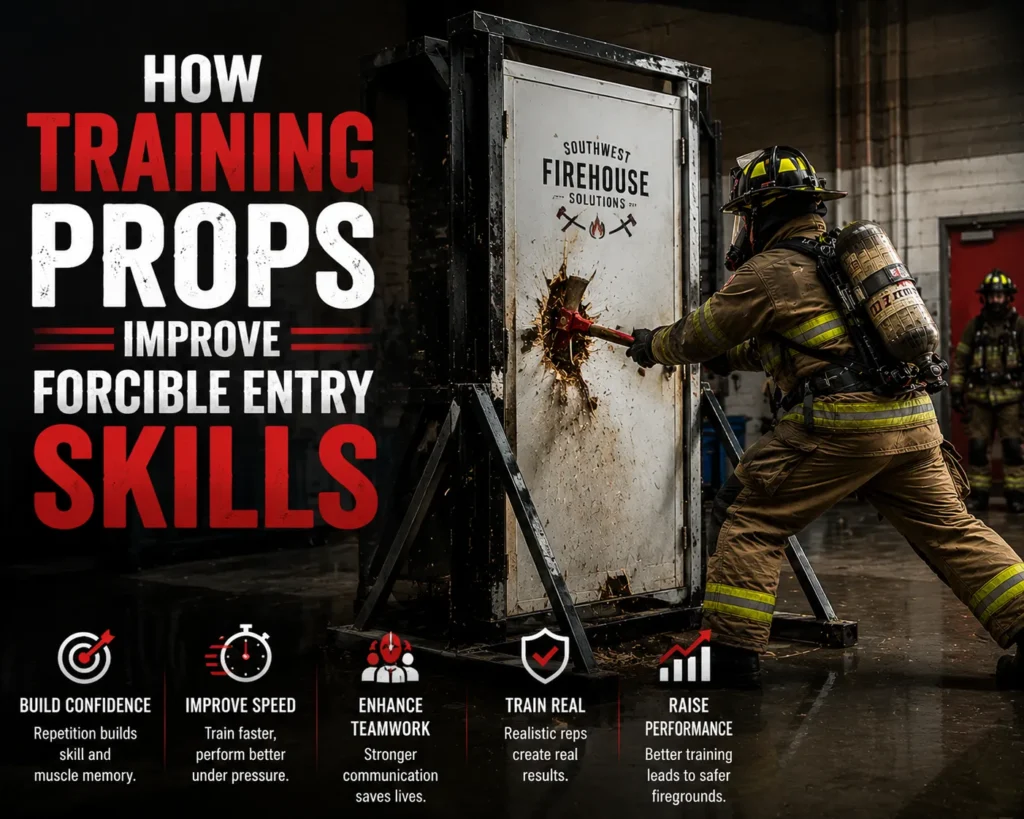
Training props improve forcible entry skills by letting firefighters perform hundreds of realistic, resettable repetitions in a safe, controlled setting. They build muscle memory, sharpen tool mechanics, expose flaws in technique, develop crew coordination, and condition firefighters to handle fireground stress. Because props simulate real doors, locks, hinges, and resistance without destroying property, they support progressive skill development from fundamentals all the way through scenario-based mastery. As a result, departments that train on quality props consistently force doors faster, safer, and with fewer injuries than departments relying on theory or the occasional acquired structure.
What Are Forcible Entry Training Props and How Do They Improve Firefighter Skills?
Forcible entry training props are purpose-built devices that simulate the doors, locks, hinges, gates, and barriers firefighters run into on the fireground. They’re built to be forced, reset, and forced again, often hundreds of times in a single session. The most common ones include inward-swing residential door simulators, outward-swing commercial door simulators, through-the-lock cylinder props, padlock cutting stations, drop-bar simulators, and adjustable-resistance mechanisms that mimic the feel of different door constructions.
Their purpose is simple. They replace luck with competence. A firefighter who has forced a prop 500 times under varying conditions isn’t guessing on the fireground. They’re running a sequence their body already knows. Props matter because real doors are unforgiving teachers. They cost money to replace, they only force once, and the price of getting it wrong on a fireground is measured in lives.
Why This Skill Matters
The ability to train forcible entry on demand changes everything about how ready a department actually is.
Life safety. Victims trapped behind a locked door start losing breathable air the moment fire ignites. A crew that can defeat a door in 12 seconds instead of 45 has just bought a victim a real chance at survival. That kind of speed comes from prop training. There’s nowhere else it comes from.
Firefighter survival. Forcible entry failures put firefighters in danger. A tool that slips. A misstrike that injures a partner. A door that swings closed behind an advancing hose team. These are training failures long before they become fireground failures. Props expose those weaknesses before the alarm ever drops.
Property conservation. A firefighter who has worked a prop with precision will force a real door the same way: surgically, not violently. The result is intact jambs, salvageable doors, and a department the public trusts.
Operational effectiveness. When the irons team performs, the whole fireground performs. The hose line advances on schedule. Search teams get in when expected. Ventilation lines up with suppression. Props are what build the timing that makes a coordinated operation possible.
How Forcible Entry Training Props Work
Most modern props use a resettable locking mechanism, usually spring-loaded or hydraulic, that mimics the resistance of a real locked door without destroying the prop each time. The firefighter performs a full conventional or through-the-lock force, the lock releases, and the instructor resets the mechanism in seconds for the next rep.
The progression generally moves from light-resistance settings for new firefighters learning the fundamentals up to heavy-resistance settings that simulate hardened commercial doors. More advanced props bring in features like adjustable jamb angles, multiple lock positions, dummy hinges for hinge-side attacks, and cylinder mounts for through-the-lock work. Some props simulate drop bars, security gates, padlocks, and high-security commercial locking mechanisms. The best training environments line up several props in sequence so firefighters can move from one forcing problem to the next, building decision-making alongside technique.
Essential Equipment and Tools
Equipment | Purpose | When Used |
Inward-Swing Residential Prop | Simulates standard single-family residential doors | Foundational conventional force training |
Outward-Swing Commercial Prop | Simulates rear residential and commercial doors | Hinge-side and through-the-lock training |
Resettable Mechanical Lock Prop | Spring-loaded mechanism allowing rapid resets | High-repetition technique drills |
Hydraulic Resistance Prop | Adjustable hydraulic resistance simulating hardened doors | Advanced force and crew training |
Through-the-Lock Cylinder Prop | Mounted lock cylinders for K-tool and A-tool practice | Through-the-lock proficiency |
Padlock Cutting Station | Various padlock types for cutting and breaching | Saw work and bolt cutter drills |
Drop-Bar / Security Gate Prop | Simulates commercial security gates with bars | Commercial occupancy training |
Wall Breach Prop | Simulates interior wall construction | RIC and firefighter survival drills |
Vehicle Door Prop | Simulates car door forcible entry | Law enforcement and extrication overlap |
Forcible Entry Training Tools (Irons, Saws, Hydraulics) | Real tools used against the props | Every training session |
Step-by-Step Guide to Effective Prop-Based Forcible Entry Training
Step 1: Tool Familiarization Without a Prop
Objective: Build comfort with weight, balance, and grip before applying tools to a door.
Actions: Each firefighter handles the halligan, flathead axe, K-tool, and any specialty tools. They practice the swing, the marry, and the grip changes.
Safety considerations: Clear training area, controlled swings, proper eye protection.
Common errors: Skipping this step and jumping straight to the prop, which leaves firefighters fumbling with unfamiliar tools.
Step 2: Slow, Static Prop Work
Objective: Drill clean mechanics at low speed.
Actions: Walk through gap-set-force in slow motion. The instructor coaches body position, tool angle, and strike accuracy.
Safety considerations: Communication between the forcer and the striker on every movement.
Common errors: Pushing for speed before the technique is clean.
Step 3: Repetition at Working Speed
Objective: Build muscle memory through volume. Actions: Firefighters cycle through the prop with rapid resets, completing 20 to 50 forces per session. Safety considerations: Rotate partners to prevent fatigue-related injuries. Common errors: Letting form degrade as fatigue sets in.
Step 4: Variable Resistance and Configuration
Objective: Train decision-making, not just mechanics.
Actions: Adjust the prop between reps. Change the lock position, increase the resistance, or switch the swing direction.
Safety considerations: Brief the crew before any changes so they size up the new setup rather than reacting blindly.
Common errors: Running the same settings every time, which produces one-dimensional competence.
Step 5: PPE and On-Air Training
Objective: Replicate fireground conditions.
Actions: Full structural PPE, SCBA donned, on air. Time each force.
Safety considerations: Watch air consumption, heat exposure, and communication clarity.
Common errors: Letting firefighters train in T-shirts, which produces skill that disappears the moment they suit up.
Step 6: Scenario Integration
Objective: Connect forcible entry to the broader fireground operation.
Actions: Force the prop while coordinating with a hose team, a search team, or RIC. Layer in radio traffic, low light, and smoke machines.
Safety considerations: Pre-brief everyone, station a safety officer, and use a clear emergency stop signal.
Common errors: Training forcible entry in isolation and never connecting it to the operation it’s supposed to serve.
10 Best Practices for Forcible Entry Prop Training
- Train every firefighter in both positions. Forcing and striking. Versatility wins on the fireground.
- Always train in PPE. Skill in shorts doesn’t transfer to skill in turnouts.
- Use a timer. What gets measured improves.
- Debrief every rep. A rep without feedback is a rep without learning.
- Vary the prop configuration. Static settings produce static firefighters.
- Coach communication. “Ready,” “Set,” “Force,” “Door is forced and controlled” should be drilled every time.
- Maintain the props. A worn or broken prop teaches bad habits.
- Include officers in training. Leadership presence raises the standard.
- Build a progression. New firefighters on light settings, experienced crews on full resistance.
- Document training time and outcomes. Track skill development across the year.
10 Common Mistakes in Prop-Based Training and How to Prevent Them
- Relying on one prop type. Why: Limited equipment. Consequence: Narrow skill set. Prevention: Invest in multiple props or partner with another agency for access.
- Going too fast too early. Why: Eagerness. Consequence: Bad mechanics locked into muscle memory. Prevention: Earn speed only after the technique is clean.
- Skipping PPE. Why: Comfort. Consequence: Skill that fails once gear goes on. Prevention: Mandate full PPE for working sessions.
- Always letting the same firefighter force. Why: Efficiency. Consequence: Skill gaps across the crew. Prevention: Mandatory rotation through every position.
- No debrief. Why: Time pressure. Consequence: Errors repeat indefinitely. Prevention: Build the debrief into the drill, not after it.
- Poor prop maintenance. Why: Neglect. Consequence: Inconsistent resistance, bad reps. Prevention: Assign maintenance responsibility to a named person.
- Treating training as a performance. Why: Ego. Consequence: Firefighters hide weaknesses instead of fixing them. Prevention: Build a culture where training mistakes are welcomed.
- No scenario context. Why: Convenience. Consequence: Disconnected skill. Prevention: Tie every force to a tactical situation.
- Ignoring through-the-lock props. Why: Comfort with conventional force. Consequence: Failure of commercial doors. Prevention: Run mandatory through-the-lock cycles in every session.
- Underestimating crew coordination drills. Why: Focus on individual skill. Consequence: Lone-wolf firefighters who can’t operate as a team. Prevention: Train forcible entry as a two-person discipline at minimum.
Safety Considerations for Forcible Entry Prop Training
Training props lower the risk, but they don’t eliminate it. Risk assessment starts with the prop itself. Worn springs, loose mountings, and damaged frames create unpredictable failures. PPE has to be complete: full structural gear, SCBA when the scenario calls for it, and eye protection every time. Crew accountability means every member knows who’s forcing, who’s striking, who’s standing by, and where the safety officer is positioned.
Communication discipline is non-negotiable. Nobody strikes without verbal confirmation. Situational awareness includes watching for fatigue, hydration issues, and ambient conditions. Heat-related injuries on training grounds are real, and they’re predictable. Emergency procedures need to be briefed before the first rep, including stop signals, EMS access, and rehab rotation. The training ground isn’t the fireground. However, every safety failure on the training ground is a preview of a failure on the fireground.
Practical Training Drills Firefighters Can Run
Drill 1: 60-Second Conventional Force Challenge.
Objective: Maximize clean reps under time pressure.
Setup: Resettable inward-swing prop, two-person team.
Execution: The team cycles through as many clean forces as possible in 60 seconds.
Benchmark: Four or more clean forces with full door control.
Drill 2: Through-the-Lock Cylinder Pull.
Objective: Build through-the-lock fluency.
Setup: Cylinder prop with multiple lock types.
Execution: The firefighter pulls the cylinder and manipulates the lock in a single sequence.
Benchmark: Under 45 seconds per cylinder.
Drill 3: Door Reading Sprint.
Objective: Sharpen size-up.
Setup: Multiple props with different swings, locks, and configurations.
Execution: The firefighter approaches each prop, calls out the attack plan in under 5 seconds, and executes.
Benchmark: 90% correct plans across 10 props.
Drill 4: Scenario Force Under Stress.
Objective: Integrate forcible entry into a fireground operation.
Setup: Prop staged behind a smoke machine, with a charged hose line and radio traffic.
Execution: The crew forces the door while coordinating with the line and command.
Benchmark: Entry achieved within 30 seconds with no communication breakdowns.
How Fire Departments Can Improve Forcible Entry Performance Using Props
Departments that produce the best truck company performance share a few habits. They train in forcible entry at least monthly, with quarterly skills evaluations recorded and tracked over time. They use scenario-based training that builds props into broader fireground simulations instead of treating them as isolated skill stations. They emphasize repetition because skill development requires hundreds of forces per firefighter per year, not a handful at the academy.
They also evaluate honestly. Video review and timed benchmarks beat subjective impressions every time. Leadership involvement is decisive. When chiefs and officers train on the props alongside their crews, performance rises across the entire department. Investment in quality props pays off for years, because a single prop can produce tens of thousands of reps over its lifespan. Departments serious about elevating skill often bring in specialized hands-on instruction through programs like Brass Shamrock Training’s Forcible Entry Training and Truck Academy, where curated props, expert coaching, and structured progressions accelerate development.

10 Expert Tips from the Fireground
- Reps build firefighters. Theory builds students.
- If your prop never changes, your crew never grows.
- The striker isn’t the apprentice. The striker controls the operation.
- Train the marry until it’s silent.
- Every prop session should include at least one through-the-lock cycle.
- Force the prop on your worst PPE day, not your best.
- Time everything. Speed without measurement is just a story you tell yourself.
- Coach the small errors loudly. Bad habits live in details.
- Rotate every firefighter through every position. There are no specialists in a fire.
- The best forcible entry crews are the ones whose training looks boring, because the fundamentals are that clean.
Conclusion
Forcible entry skill is built one repetition at a time. It comes from training grounds, props, PPE, time pressure, and crews that communicate well. It isn’t built from theory, enthusiasm, or a single academy class. Training props are the bridge between knowing forcible entry and being able to perform it when smoke is pushing, victims are inside, and the hose line is stacked up behind you.
Departments that invest in quality props, structured progressions, and consistent training time produce truck companies that move doors fast and safely. Departments that don’t make that investment end up producing firefighters who learn the hard lessons on real fires, which is the most expensive classroom in the fire service.
So take the props seriously. Build the reps. Train every firefighter in every position. Time the forces, debrief the mistakes, refine the technique, and force the next door faster than you forced the last one. For departments and firefighters committed to elevating truck company performance, programs like Brass Shamrock Training’s Forcible Entry Training, Truck Academy, and Building Construction for Firefighters offer the structured, prop-based instruction needed to turn knowledge into fireground capability. Keep training. Keep building. Keep the doors coming down clean.
Frequently Asked Questions
What is a forcible entry training prop?
It’s a purpose-built device that simulates doors, locks, hinges, and other barriers, so firefighters can practice forcible entry repeatedly in a safe, resettable setting.
Why are training props better than acquired structures?
Acquired structures give you one or two forces per door before they’re destroyed. Props give you hundreds. Volume is what builds competence.
How often should firefighters train on forcible entry props?
At minimum once a month, with quarterly skills evaluations. Skill decays without consistent repetition.
What is the most important forcible entry prop to own?
A resettable inward-swing residential door prop. It covers the largest percentage of real-world calls.
Are through-the-lock props necessary?
Yes. Through-the-lock is essential for outward-swing and commercial doors, and the skill atrophies without dedicated practice.
Can volunteer departments afford training props?
Many props are affordable, and several quality designs can be built in-house. Regional partnerships also help share access.
How many reps should a firefighter perform per training session?
Quality matters more than quantity, but a working firefighter should complete 20 to 50 forces per session once the fundamentals are clean.
What is the biggest training prop mistake?
Training without PPE. Skill developed in shorts disappears once SCBA, gloves, and turnouts come on.
Should officers train on props alongside firefighters?
Absolutely. Officer participation raises standards, validates the training, and keeps leadership current.
How do props help with crew coordination?
Props let the same crew drill the same sequence over and over, which builds the wordless communication between forcer and striker that actually wins on the fireground.
Do props help with through-the-lock training?
Yes. Cylinder props let firefighters practice K-tool and A-tool work without destroying real locks.
How do you evaluate forcible entry performance?
Time the clean forces, review technique on video, and assess door control after entry.
Are training props safe?
Safer than real doors, but they still require PPE, communication discipline, and well-maintained equipment.
Can props simulate hardened commercial doors?
Yes. Hydraulic resistance props can replicate the feel of heavily reinforced commercial entries.
Where can fire departments get advanced prop-based forcible entry training?
Specialized programs like Brass Shamrock Training’s Forcible Entry Training and Truck Academy provide structured, prop-based instruction designed to build fireground-ready competence.