
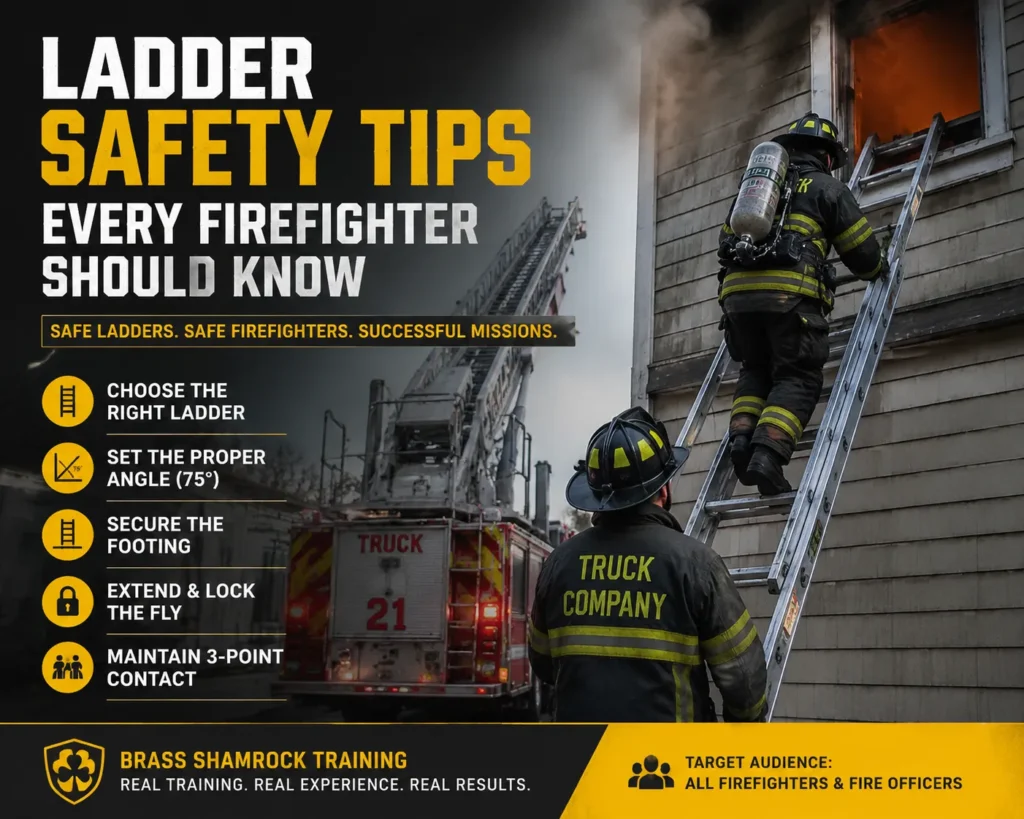
When the Ladder Fails, Everything Fails
Imagine it’s 0200 hours and it’s a residential structure fire with heavy smoke coming out of the second floor. A crew enters the building through the front door with a handline and a truck company throws a 24′ extension ladder to the Charlie side for secondary egress and possibly a victim search. The ladder climbs quickly. The firefighter on the ground does not “heel it. The fly section is not extended to its full length. At the point when the butt kicks out, the climber is 3 rungs from the sill. He falls on a concrete walking path along with the ladder!
That is not a scenario that is just a guess. This variation occurs on an annual basis throughout this country and is almost invariably due to the failure of the equipment. It’s from a lack of technique, due to complacency, inadequate training reps or just not knowing why each part of the Ladder throw is there in the first place.
Ground and aerial laddering are essential skills for truck companies, and the most common shortcuts on the fireground. Firefighters have to throw ladders in the heat, in the dark, in full fire gear, on bad ground, and under time pressure. In such circumstances, each shortcut in procedure can lead to injury or death.
Every firefighter needs to know and use these important ladder safety principles and apply them not as a “list” to memorize before a ladder drill, but rather as an ingrained fundamental that changes the way you think about every ladder throw. These observations have been formed from actual fireground experience and are consistent observations found at every practice.
Understanding What Can Go Wrong And Why It Happens
It’s important to know the common places of failure before you know what to do right. Ladder fire ground injuries are not caused by unusual and extreme situations. These are due to normal activities carried out without full concentration.
The patterns that instructors have observed over the course of training hundreds of firefighters are the same. The butt is set very close to the building and forms a very steep angle. The fly section does not get locked when climbing. The heel is clear as soon as the climber begins to climb. Firefighter 1 and 2 work together to lift and toss a ladder, but do not talk to each other about the timing. A person standing on a ladder against a gutter, not a firm surface. These are not the type of blunders that are just happening to new staff. Career firefighters do them too, as habits will wear away without repeated training sessions.
Moreover, risk increases when there is situational pressure. The level of cognitive stress on all firefighters rises when a crew is fatigued, working at night, or going to a structure that has a large amount of fire. This means that tasks that are conscious in training are more prone to be done incorrectly on the fireground. Hence, it is better to drill ladder safety into their bone structure rather than review it from time to time.
Ladder Selection: Getting the Right Tool to the Right Place
The first rule of ladder safety is to make sure that the ladder is safe before leaving the apparatus. The wrong ladder can cause hazards that can’t be fully addressed through good technique.
Height matching matters. If it is too short, the climber will have to reach over the top rung to cling on, and no way to use the ladder for a controlled bail should the conditions inside become worse. A long ladder is also more difficult to manoeuvre in confined areas, is more liable to be thrown at a dangerous angle, and puts a greater physical strain on the crew carrying it.
Typically, the height of the ladder at the top should be about 3-5 feet higher than the roof line or window sill for common height ladders. It offers the climber a safe handhold point for climbing on or off the ladder and helps to see the landing point from below the ladder.
Weight ratings are also crucial. The minimum loads for fire service ladders are specified in NFPA 1931, but it doesn’t matter as much if your fire crew knows those minimums as if they know the load rating for each ladder on their apparatus. A full structural fire scene gear and SCBA-equipped firefighter is significantly heavier than a firefighter without gear and SCBA. Include a victim rescue, and the load increases again. Do not use the rated capacity of a ladder as a general guideline.
When looking at length and capacity, also take into account access and the type of terrain. Most residential and light commercial operations use ground ladders. In multi-story buildings, buildings with many access points, operations that need water from a higher elevation, though, aerial ladders offer features beyond what can be achieved by a ground ladder. It is not an option for truck company staff to receive training on both platforms.
The Angle Is Not a Preference, It Is Physics
A fire service ground ladder should have a proper climbing angle of about 75 degrees from the horizontal or about one foot out from the building for every four feet of working height. This is not a random criterion. It is based on physical principles of load distribution, stability of the climber, and contact between the climber and the footing.
When the angle exceeds 75 degrees, the climber’s center of gravity is behind the ladder, and a backward fall becomes more likely, and the heel is less effective. The compressive force of the butt rises sharply at shallower angles below 65°. The ladder will start to kick out from the building base at this angle. Furthermore, shallower angles make for a physically more difficult climb and increase fatigue for fully equipped firefighters.
Quick Check Method: Place foot on the bottom of the ladder, with the raised portion up, and take a single arm outstretched at shoulder level with a finger on a rung of the ladder. If your arm is about parallel to the ground, the angle is about right. It isn’t a precision instrument, but a quick, 2-second fireground field check that’s reliable.
Some of the most common angle problems that coaches observe in training are crews standing too near to the building, especially when they are in a hurry. The butt is almost directly under the structure, the angle is greater than is safe, and the climber would feel the instability but not necessarily know the reason. The problem may be completely cured by adjusting the butt distance by as much as twelve to eighteen inches.
The reverse situation applies, however, in situations where the apparatus is congested, or when the apparatus must operate in an alleyway area, the optimal angle may not be available. In those cases, the crew must understand the restriction, adjust their heeling accordingly, and tell the climber about the constraint before he/she starts going up. Flexibility within known parameters is an indicator of professional truck driving.
Heeling, Tying Off, and Securing the Base
The heel is a very under-trained part of ground ladder operations. It is usually given a cursory treatment in controlled drills. It is also often left behind when a company is rushed to the fireground. Injuries start to occur in that gap.
Heeling a ladder is when a firefighter keeps sustained downward and inward pressure on the butt of the ladder during the climb. This is not just standing by the ladder or lightly holding on to a rung. The heel person needs to keep their foot in place along the base of the ladder and apply body weight to prevent the butt from moving in any direction.
Use the heel firefighter position to tie the ladder for longer climbs or when the heel firefighter needs to step off the ladder. If the ladder tie-off is properly placed and done in a manner that doesn’t require constant human interaction, the heel firefighter is not dependent on the continuous presence of a person and can perform other duties without affecting base security. With fast-moving operations, however, tying off will require extra time and is not always possible, so the role of the heel firefighter needs to be assigned and never left empty without communicating with the climber.
The surface conditions have a great impact on heel stability. The butt may shift even with a firefighter heeling a wet pavement, ice, or loose gravel or soft soil surface. In such cases, further steps can be taken to provide greater security, like the use of ladder shoes, spikes, or digging the butt into softer ground. Heel exercises on sub-optimal surfaces should be provided in the training regimen as a way to get firefighters to sense when additional work is required.
Moreover, the heel angle of the heel firefighter is important. The best resistance to the forces generated by the climbing load is provided when the load is directly behind the butt and pressed down and forward. Without feet on the ground or standing next to the rope, it is very little effective.
Contact Points, Climbing Posture, and Load Distribution
Three points of contact are a universal climbing rule, and the ladders used by the fire service are no exception. While ascending or descending, one hand and one foot or two feet and one hand must be in contact with the ladder. This is important when firefighters are climbing in full structural PPE with SCBA, as this forces their center of gravity to move towards the rear and decreases fine motor control.
The spacing of rungs on fire service ladders is standardized, while the climbing rhythm still needs to be practiced in gear. Firefighters who have ever climbed in a uniform or light station gear may not realize how different a full uniform is on a ladder from what it is on the ground. It should not be a default standard; it should be a standard. It should not be the exception; it should be the standard to train while wearing full gear.
The placement of the firefighter’s body on the ladder also has safety implications and is important for productivity. Weight should be kept in the center of the rails as opposed to being thrown to one side. The eyes should be looking forward to the destination, not down. Arms should be slightly bent and not straight so that it is easier to absorb the shock and to maintain grip if the ladder tips a little.
The pace of descent must be slow, especially when backing down from a roof or upper story. The faster a person descends, the more likely he or she is to miss a rung, particularly in smoke or when visibility is low, and it is difficult to confirm foot placement. It’s not urgency on the way up; it’s urgency on the way down, and that’s where many of the injuries with ladders happen.
Fly Section Orientation and Extension Protocol
There is one more area of technical attention to consider when working with extension ladders that some Firefighters often overlook when they are busy on the fire. The locking mechanism, direction of the fly, and the load capacity of the fly are important factors that are influenced by the fly section.
Most ground ladders should be used facing away from the building in the fly section. This orientation will ensure that the rungs of the fly section are to the outside and the climber is on the main beam when climbing, and not the fly section beam, which helps to spread the load across the structure of the ladder.
The pawl locks must be locked when a firefighter is climbing. This is a basic instruction, but in actual practice, sometimes the ladders are erected before the fly is completely extended and sometimes before the pawls have been confirmed to be in place. A fly section that is partially closed may slide under the load of a climber and, if so, may cause a climber to fall off the ladder. Develop a standard practice: Before the climber contacts the first rung, the heel firefighter or crew officer will say the word pawl and confirm the lock.
The extension height should not be arbitrary, as it should serve a clear purpose. This reaches just above the roofline or sill to provide the climber with a solid handhold at the transition level without adding undue overhang, which stresses the upper portions of the structure. If there’s too little extension, the climber will be reaching the edge. Excessive results in a lever arm that, under load, causes excessive stress to the fly section.
Aerial Ladders: Elevated Operations and Crew Discipline
Everything covered so far about ground ladders becomes more consequential when working from an aerial device. The working height is raised. The risk of mechanical failure increases. The magnitude of the personnel who can be impacted by one mistake grows. Aerial ladder safety is not just ground ladder safety but requires a disciplined approach.
The load ratings of aerial ladders apply to a specific elevation angle and to specific lengths of extension. The capacity of a device at full extension and low elevation may be quite different from that at maximum extension and maximum elevation. All crew members operating near the aerial device must be aware that all crew and equipment on the ladder at one time must not exceed the rated capacity.
Aerial operator and firefighter communication is a must! The operator should ensure that any crew members on the ladder know and understand what the adjustments to angle and elevation of the aerial are before moving it, even small ones. The rapid acceleration from the tip of the ladder to the roof has been recognized as a source of severe injury to firefighters.
Also, weather conditions can have an impact not as pronounced as on the ground with ladders. When an extended aerial is extended at height, forces must be taken into consideration by the operator due to wind loading. The hazard of icing on rungs is greater at elevated altitudes where evacuation is slower. Training should introduce crews to aerial operations in more challenging environments than a calm day in perfect weather on a perfect surface.
Instructor Insight: The most critical time of an aerial operation is not when the stick is longest or when water delivery is performed. Communication discipline fails when it’s time to reposition under operational pressure, and the crew thinks that the operator knows what he is doing.
The Fireground Context: Decisions Under Pressure
Ladders are not used in isolation. It happens amid the mad rush of firefighting operations, with several crews operating, radio communications may be limited to almost nothing, and each decision must be made in a timely fashion. To become truly competent, as opposed to technically correct on the flat, one must know the impact of operational stress on laddering selections.
A common instructor observation made during fireground simulations is crews will position ladders where they can find them, not where they are ideal. A ladder could be required to lean against a wall with an existing leak in the soffit, on a flower bed that may not be stable for standing, or in an alley that has a lot of smoke, so the angle could need some extra care. Rehearsals in realistic situations, not in a parking lot with clean pavement, prepare crews to make these decisions.
Collapse risk zones are also taken into account when making placement decisions. Having a ladder directly under a section of a wall that is unstable or under a structure where fire was burning within the walls introduces risk that must be balanced against the need to access the area. This should not be an excuse for not using ladders in certain work areas but rather an encouragement to think things through and not just automatically use ladders.
Furthermore, ladders must be used with knowledge of other companies’ locations. Water application locations may be limited by an aerial elevated for water application. If a ground ladder is not communicated and placed along a wall, it will be a hazard for advancing hoses. Ladder operations are not “stand-alone” exercises, but rather part of a bigger fireground coordination problem.
Training Frequency and Skill Decay
The skills of ladders fade quicker than one might imagine. If a firefighter throws ground ladders twice a year during yearly certification exercises, he or she does not have the same skill level as a firefighter who throws ground ladders in monthly or quarterly training sessions. The proper angle, proper heel technique, fly lock confirmation, and climbing posture should be constantly reinforced in the physical memory.
There is more to ladder training than throwing and climbing. It should have scenarios that simulate fireground complications, such as carrying ladders over other crew members in confined spaces, throwing ladders on odd surfaces, climbing in full PPE after a simulated interior assignment while fatigued, etc., and should include heel techniques on differing types of terrain, such as uneven ground and slippery ground.
More directly, truck companies that incorporate the ladder throws into other downstream activities like assignment of ventilation or boarding/recovery of victims or roof access drills create a training environment that more readily translates into actual performance. The ladder is not an end unto itself on the fireground; it’s there to facilitate something else. The training should be a reflection of that.
Officers should also be looking at near-miss data from their own departments as well as near-miss data from national databases like the annual reports on firefighter fatalities from the NFPA and the NIOSH Fire Fighter Fatality Investigation reports. Because of their frequency, there is a specific training segment devoted to ladder-related incidents, and looking back at other departments’ incidents is one of the best ways to safeguard your crew from the same.
When your department is looking for an in-depth program to build proficiency beyond the basic training you receive at the academy, consider a program such as Brass Shamrock Training that offers fireground-realistic ladder training based on the challenges real crews face. The intent is not to pass a test of skills, but rather to create firefighters who will perform well during the worst conditions.
Communication Protocols That Prevent Ladder Incidents
A lot of ladder accidents are really “communication” accidents. The climber assumed that the heel was kept. The heel firefighter presumed the fly was locked. The officer assumed that the crew understood that they were not to allow more than two persons up the ladder at any one time. All those assumptions were not voiced. None of them were confirmed.
At each transition on the ladder, the effective ladder crew will use intentional verbal confirmations. The crew checks the chosen area and contact point before throwing. The heel position is confirmed before climbing, and the fly is verbally checked prior to climbing. The climber is notified before any moving of the ladder with person(s) on it. These are not long radio conversations; they’re just 5-second confirmations, no need to assume, and that’s where most incidents are caused.
It is especially the responsibility of the company officers to set and reinforce communication routines. No confirmation steps are taken when an officer allows a ladder throw to continue given an active scene and what appears to be an effective crew movement, thus normalizing the shortcut. This normalization builds up over time. When officers are constantly pressuring for the confirmations, even in standard training throws, they create crews that automatically don’t hesitate to throw them in a real situation.
Maintenance and Pre-Use Inspection: The Step That Happens Before the Throw
A ladder that is mechanically compromised presents risks that no technique can compensate for. Pre-use inspection of ground and aerial ladders is a safety practice that is easy to defer and costly to skip.
Bent or cracked beams, damaged rungs, broken pawl mechanisms, and heat or flame damage must be considered when checking ground ladders. Ladders that have been exposed to fire, including those stored on apparatus that have passed through high radiant heat, may be damaged and not be readily observable. Ladders that are damaged in any way due to heat, warpage, or failure should be taken out of service at once and should be inspected by a competent person before any further use is made of them.
The extent of the inspections needed for aerial devices exceeds the scope of the morning apparatus inspection a crew can conduct. Fire service aerial apparatus must be regularly inspected by qualified technicians in accordance with NFPA 1911. Following the pre-use walk-around that crews should conduct before each shift, however, should involve checking the fly section for binding, checking the turntable area for any obvious mechanical problems, checking hydraulic fluid levels, and performing a basic range of motion test of the aerial before the unit leaves the bay.
When pre-use issues are discovered, the problem must be documented and reported, not quietly worked around. A crew that chooses to simply be careful with a stiffer ladder that has a stiffer pawl is not dealing with risk management. They are taking risks that are not necessary, and they are having an incident that is avoidable.
Final Thoughts: The Ladder Is Only as Safe as the Crew Throwing It
At the end of each ladder, safety elements are preparation, repetition, and communication. The ladder is an ingeniously designed tool. It is constructed according to NFPA standards. Manufacturers make fireground allowances in safety margins. However, all that engineering power does nothing to stop a butt kicking out when no one is heeling it, nor does it stop a fly section from slipping when the pawls have not been confirmed.
Fireground ladders carry firefighters to places where rescue, ventilation, and suppression can occur, such as access points and egress routes, as well as elevated locations. Ladder operation failures are more than just a rigger injury. It wreaks havoc on the whole operation, takes resources away, and may even take away the access way that another crew was using to exit or be rescued.
When a firefighter doesn’t experience a ladder incident, he or she is not lucky. They are trained. They have thrown hundreds of ladders in realistic conditions. They express themselves naturally and affirm without prompting. They examine equipment before it is required and comprehend why it is that there is a set of ladders that have evolved over the years, just as much as they know how to use it.
This is a skill that any crew can attain with the proper training and repetitions. Does not need any complex machinery or construction. It necessitates a company officer who takes truck work seriously, as well as a crew that trains on how they’re going to operate.
Build the habit. Have the correct method for throwing the ladder and do it every time in training and on the fireground. If you try to skip the technique once, then it will not be the time it all goes well. It will be the time that you wish you hadn’t.
Frequently Asked Questions
What is the correct angle for a fire service ground ladder?
The correct climbing angle is approximately 75 degrees from horizontal. A practical field check: stand at the butt of the raised ladder, extend one arm straight out, and grip a rung at shoulder height. If your arm is roughly parallel to the ground, the angle is close to correct. This angle balances climber stability with effective load transfer to the footing.
How many firefighters can safely climb a ground ladder at once?
Most fire service ground ladders are rated for one firefighter at a time under operational load conditions, particularly extension ladders. Some combination ladders are rated for greater loads, but single-occupant climbing is the standard practice for most ground ladder applications unless the ladder is specifically rated and operationally justified for multiple climbers. Always confirm the load rating for your specific ladder.
What does heeling a ladder mean?
Heeling a ladder means a firefighter maintains firm downward and inward pressure on the butt of the ladder, using their foot planted against the base and body weight applied to resist movement. The heel firefighter prevents the butt from kicking out during climbing operations and must remain in position throughout the climb unless the ladder has been properly tied off to an anchor point.
Should the fly section face toward or away from the building?
In most ground ladder applications, the fly section should face away from the building. This positions the main beam rungs closest to the structure, distributes load more effectively through the ladder’s structural design, and provides the climber with a more stable surface on the ascending side.
How often should firefighters train on ladder operations?
Ladder skills require regular reinforcement to maintain proficiency. Monthly or quarterly practical training sessions are significantly more effective than annual certification reviews. Training should include full-gear climbs, realistic surface conditions, scenario integration with downstream operational tasks, and deliberate communication practice at each step of the evolution.