
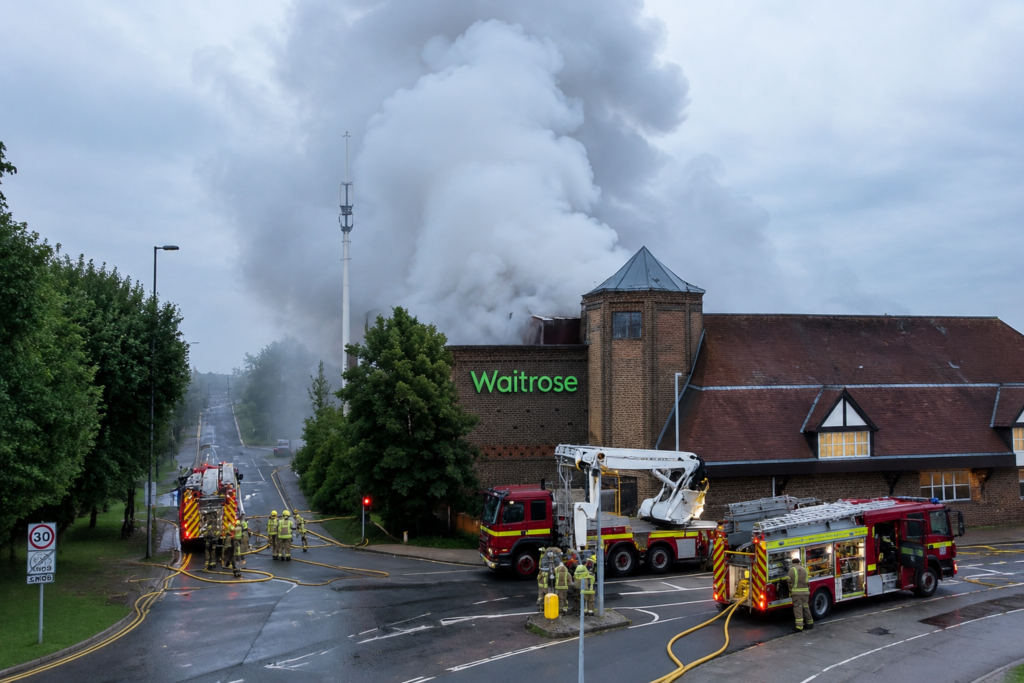

A warehouse fire at a major supermarket in Hove had no bystanders to report conditions, no staff on site, and a building already filling with smoke before the first appliance rolled.
The next seven-plus hours saw a systematic, methodical operation, utilizing two counties while shutting down a busy road during an entire morning commute.
Firefighters are tackling a large blaze at a Waitrose store with heavy smoke rising.
The Call and Initial Size-Up
ESFRS was called at 03:46 BST to Nevill Road in Hove, which is home to the Waitrose supermarket. The reported origin: a warehouse chiller, a refrigerated storage area that is in continuous operation and not subject to store opening times.
That detail matters. Fire developing in the chiller can be hard to notice and slow to appear before things go bad. Refrigeration units produce heat, consume electricity, and are likely to have combustible packaging materials around them. If the fire can start in an environment at that time, when no one is on site to raise an early alarm, then the fire can already be firmly established when crews arrive.
When the first units arrived, smoke had already started to rise from the roof of the supermarket, something that would be recorded on video and posted widely this morning.
Scale of Response
The answer came from all around the county line. Fire & Rescue colleagues from Eastbourne and West Sussex Fire & Rescue Service augmented Brighton, Hove, and Preston Circus stations. Ten fire appliances were on scene, which was a significant mobilisation for a commercial structure fire, and a reflection of the complexity of this incident and the uncertainty of a large enclosed warehouse at night.
Four jets were used to directly attack the fire by the firefighters. This is a figure representing a working perimeter hold-down on the fire, rather than a defensive perimeter hold-down, with crews actively pushing in and attempting to coordinate suppression throughout the blaze’s perimeter within the building’s fire load.
Police and ambulance services were also called to the scene, aiding in the scene management and for the purposes of readiness in case any of the personnel were injured, but there were no reports of such occurrences among the public, store staff, or firefighters at the scene.
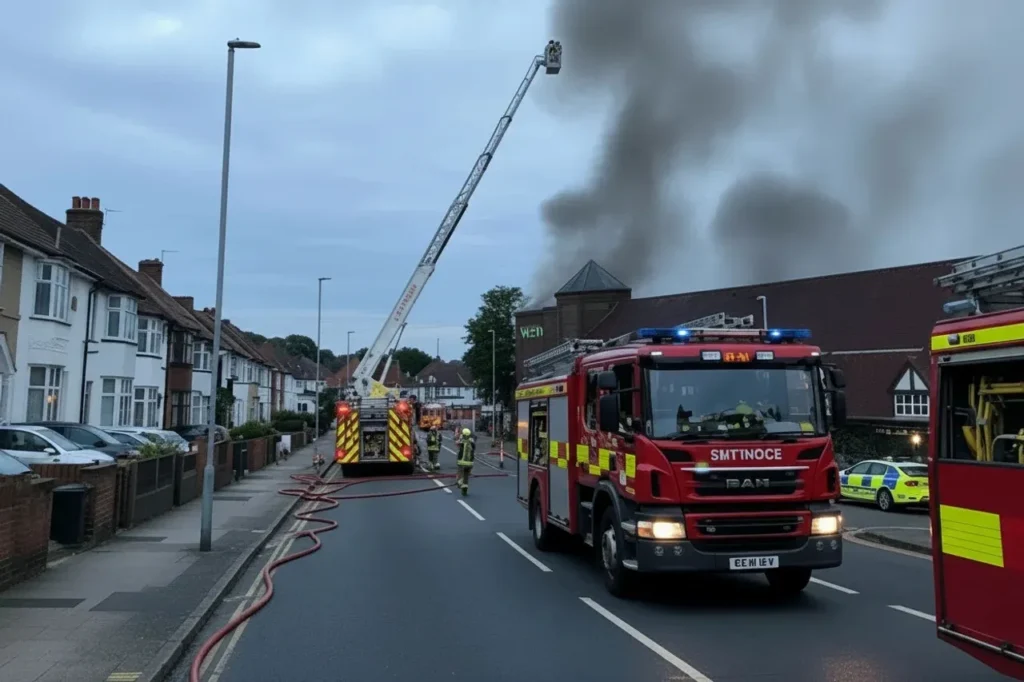
Firefighters are at the scene as thick smoke rises from a building during an active emergency response.
Why Commercial Chillers Demand a Different Playbook
When crews are not used to supermarket warehouse layouts, the challenge of getting things done is worth unpacking! These areas are not only cold storage rooms. They are sized and segmented, filled with palletized products on racking, have electrical facilities above, and refrigeration pipework above, as well as little natural ventilation. Visibility drops quickly.
Depending on the type of system, chiller fires may also include refrigerant compounds. The modern supermarket refrigerants are not as risky as the old refrigerants, but they are another factor in the ventilation/decontamination equation.
The clearing of smoke isn’t the only work ESFRS crews had to complete to cut away and ventilate the property in the morning. It is a systematic job to do, and it’s a job that can be done without much difficulty if the hidden hot spots in wall cavities, under racking (or even in insulation materials) are not addressed.
The Long Game: Damping Down
The fire was brought under control, but the operation didn’t end there. A phase of the incident that is frequently overlooked is dampening hot spots, which was the focus of the rest of the morning for crews.
Materials such as cardboard, insulation foam, and packaged items can burn to smoldering embers that can remain hot and smolder for hours after the flames have been put out in a warehouse setting. Missed or hurried on this step can lead to a second fire. ESFRS’ presence was significant throughout the morning hours, demonstrating good incident command decision-making.
By 10:25 am, Nevill Road was reopened, and the response was reduced to two fire engines (two out of three) watching the scene. The operation ended officially at 11:30, almost 8 hours after the callout
Road Closure and Public Communication
Nevill Road was closed both ways throughout the Tuesday morning peak, causing queuing traffic on the road. ESFRS released public advisories to avoid the area as a standard procedure, but the action that is required matters.
Clear and timely communication regarding road closures and air quality advisories in the vicinity of large structure fires minimizes secondary risks due to rubbernecking drivers, minimizes the potential for civilians entering the cordon, and enables road users to avoid the congestion caused by the fires and secondary risks. The road was shut down by traffic monitor INRIX and reopened once the traffic was reduced.
ESFRS publicly acknowledged the cooperation of the public in heeding that advice, a small but worthwhile recognition that community behaviour during incidents affects operational outcomes.
Aftermath and Investigation
Waitrose confirmed that it was a fire in a store chiller in its warehouse and that at the time the store was closed. The statement gave credit to the fire service and company colleagues for a quick containment and kept surrounding branches open at Brighton and Southwick.
That’s the fire cause that’s being investigated, ESFRS confirmed. Fires involving chillers and refrigeration units do not occur frequently in the commercial food industry, and the results obtained might have general lessons for the industry and the departments to which these properties are exposed.
Operational Takeaways
A few threads worth carrying forward from this incident:
Pre-incident familiarisation pays off. Large commercial properties with complex layouts, warehouse sections, refrigeration plant rooms, and roof plant benefit enormously from fire crews having prior access to familiarisation walkthroughs. Knowing the layout before the call comes in changes the speed and confidence of initial size-up.
Cross-county coordination is increasingly normal. The seamless deployment of West Sussex resources alongside ESFRS crews reflects mature mutual aid arrangements. Multi-agency responses at this scale require pre-planned protocols, shared radio channels, and clear command structures.
The damping-down phase deserves more time and attention. In a large warehouse, thermal imaging should be used thoroughly across racking, wall cavities, and structural voids before crews are released. The absence of visible fire doesn’t equal full extinguishment.
ESFRS extended thanks to partner agencies and responding crews for what was a sustained, professional effort through the night and into the following day.
Further Reading: BBC News also covered the overnight fire at the Waitrose store in Hove, including official updates from emergency services and local authorities. Read the full report here: Firefighter tackle blaze at Waitrose
