The Fire That Teaches You What You Don’t Know
Every firefighter who works long enough hits the same realization: the textbook fire and the actual fire are two different animals. On paper, the engine pulls up, water flows, the door comes, the line advances, search proceeds, ventilation lines up, and the fire goes out. But in practice, the hydrant is dry, the door has three locks, the line kinks behind the couch, the search team gets turned around in a hoarder house, and somewhere a window vents at exactly the wrong moment.
The gap between the planned fireground and the actual one is where careers are made and where firefighters get hurt. It’s also where most of the lessons in our profession have been written, often in NIOSH reports and line-of-duty death investigations. So understanding the problems that keep showing up on real firegrounds, and the solutions that have proven themselves over decades is one of the most valuable forms of professional development you can pursue.
This article walks through the most common fireground problems crews run into, why they happen, and the proven solutions experienced departments have refined into practice. The goal isn’t theory. It’s to sharpen the decisions you’ll actually make when the next box drops.
Quick Answer: What Are the Most Common Fireground Problems and Their Proven Solutions?
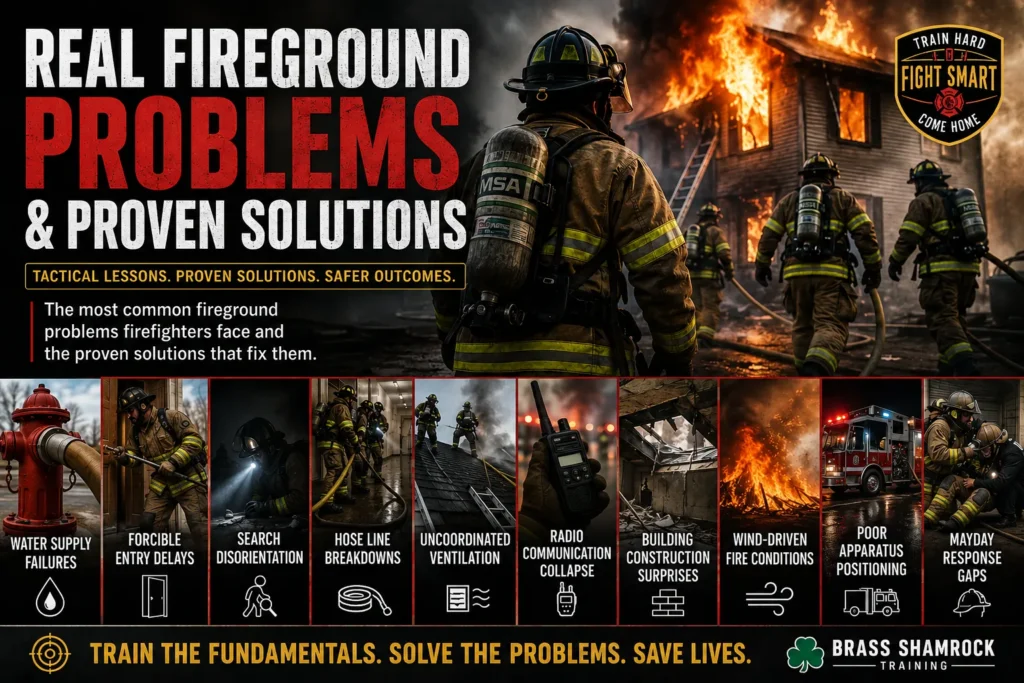
The most common fireground problems include:
- Water supply failures
- Forcible entry delays
- Search disorientation
- Hose line management breakdowns
- Uncoordinated ventilation
- Radio communication collapse
- Building construction surprises
- Wind-driven fire conditions
- Poor apparatus positioning
- Mayday response gaps
Proven solutions across all of these share a common foundation: realistic training, disciplined size-up, clear communication, and crew-level repetition of fundamentals. Tactical fixes vary by problem, but the underlying principle doesn’t. Departments that build competence in the fundamentals consistently solve fireground problems faster than departments that lean on improvisation.
What Counts as a “Fireground Problem”
A fireground problem is any tactical, operational, or communication failure that delays, disrupts, or endangers an operation. Some are small and recoverable. Others cascade into the kind of events the fire service writes reports about for years. What separates the two is rarely the problem itself. More often, it’s whether the crew has trained for it, anticipated it, and built the reflexes to solve it under stress.
In other words, problems are inevitable. Surprises are optional. The firegrounds that go well aren’t the ones without problems; they’re the ones where crews caught the problem early, called it out clearly, and applied a rehearsed solution before things got worse.
Problem 1: Water Supply Falls Apart at the Worst Moment
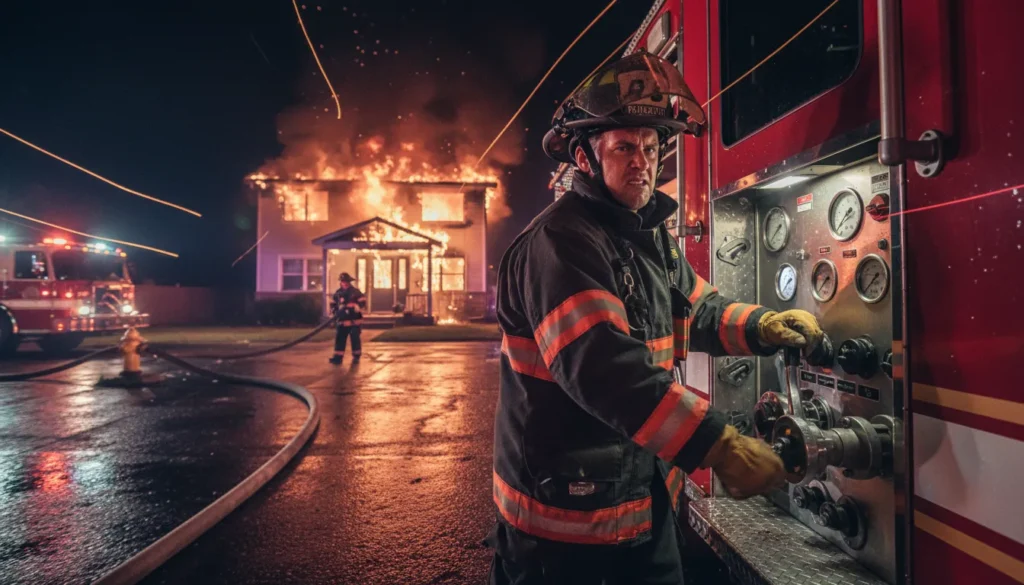
The line is flaked, the nozzle firefighter is at the door, the officer calls for water, and nothing happens. Maybe the hydrant is broken. Maybe the supply line got pinched under a wheel. Maybe the pump operator missed a step. Whatever the cause, the result is the same: a charged fire, a vulnerable crew, and no water.
Water supply problems happen for a handful of recurring reasons. Hydrants aren’t pre-planned. Drivers position too far from the supply. Crews assume the system works without testing it. Pump operators end up running unfamiliar equipment under pressure. And departments train on water delivery far less than they train on suppression itself.
The proven solution is straightforward but demanding. Pre-plan water supply for every district hydrant and rural draft site. Drill the whole sequence weekly, from arrival to flowing water at the nozzle. Time it. Then rotate engineers through unfamiliar apparatus so nobody is improvising the first time it matters. Departments that treat water supply as a core competency, rather than an assumption, get dramatically better outcomes on working fires.
Problem 2: The Door Will Not Force
The crew arrives. The line is ready. But the door has a security gate, a deadbolt, and a drop bar, and thirty seconds later, the entire operation has stalled in the foyer. While that’s happening, the fire grows, the victim’s situation worsens, and the company officer is making decisions under pressure that should have been settled before the alarm dropped.
This happens because forcible entry gets treated as a basic skill when it’s actually a specialized one. Most departments train conventional inward-swing force frequently, but they neglect through-the-lock, commercial entries, security gates, and hardened doors. So crews end up competent against the easy doors and helpless against the hard ones.
The fix is structured repetition across the full range of doors a department will see. That means through-the-lock cylinders, drop-bar simulations, padlock cutting, and outward-swing commercial entries, not just residential props. Specialized programs like Forcible Entry Training and Truck Academy through Brass Shamrock Training exist for exactly this reason. Departments that invest in this workforce open doors quickly across the full spectrum of buildings in their response area.
Problem 3: The Search Team Loses Time at the Threshold
A common pattern shows up in many search operations. The team makes an entry. Then, instead of moving aggressively along a wall or hose line into the structure, they bog down within the first ten feet. They get tangled in furniture. Disoriented in smoke. Slowed by clutter. And every additional second at the threshold is a second the victim doesn’t have.
This happens because most departments train search in clean rooms with clear pathways and good visibility. But real searches happen in cluttered, smoke-filled, unfamiliar environments where decision-making matters as much as movement. Without training that mirrors those conditions, crews freeze at exactly the moment they need to move.
The solution is realistic search training: blacked-out facepieces, cluttered rooms, time pressure, simulated radio traffic, and unfamiliar floor plans. Departments should also drill VEIS, oriented search, and large-area search separately, because each one requires different decisions. Search and RIC training that combines decision-making with movement consistently produces faster, more confident search teams.
Problem 4: The Hose Line Stalls in the Hallway
The line gets through the door, advances ten feet, and stops. The nozzle firefighter is wrestling kinks, the backup is fighting a doorway pinch, and the officer is calling for more line that isn’t coming. The fire keeps growing. Interior temperatures climb. And the operation is losing the race it absolutely has to win.
Hose line problems are almost always crew problems, not equipment problems. They happen because crews don’t drill stretching as a system. The nozzle moves, and the backup falls behind. The third firefighter doesn’t feed slack. The officer doesn’t call out the chokepoints. Each piece is competent on its own, but the line doesn’t move because nobody is managing it as a single operation.
The proven solution is to drill the stretch as a team movement, not a series of individual skills. The whole crew should practice advancing a charged line through hallways, around furniture, up stairs, and through doorways together, over and over, until communication becomes wordless. The backup firefighter’s job of feeding line and clearing kinks is the role most departments under-train, and it’s the one that most determines whether the line advances or stalls.
Problem 5: Ventilation and Suppression Aren’t Coordinated
A window vents. Fire surges. The hose team gets driven back. On the roof, a saw is running. In the rear, a door has just been forced. Somewhere in this scene is a coordinated operation, but from the inside, it looks like chaos. The fire is now controlling the operation instead of the other way around.
Uncoordinated ventilation is one of the most consistently dangerous problems on the fireground. It happens because crews operate in silos. The truck cuts the roof on its own schedule. The engine advances on its own schedule. Each is doing its job, but nobody is connecting the timing. So the result is a flow path the suppression crew never planned for and can’t survive.
The solution is command-driven ventilation coordination. In practice, that means ventilation only happens when the suppression crew is in position to make the push, the IC has authorized the action, and everyone on the radio knows it’s coming. Vertical ventilation training that emphasizes timing, communication, and flow-path awareness is essential. Departments that drill ventilation and suppression together produce coordinated operations. Departments that drill them separately produce wind-driven near-misses.
Problem 6: Radio Communication Breaks Down
The IC is calling for a status update. The interior crew is calling for more line. The roof team is reporting conditions. Two channels are being used incorrectly, one firefighter is keying down on top of another, and the most important transmission of the incident is getting stepped on by routine traffic. And just like that, command loses the picture.
Radio failure is rarely an equipment problem. It’s a discipline problem. It happens because crews don’t train on radios under load, don’t practice clear and concise transmissions, and don’t enforce radio discipline during routine incidents. By the time a working fire generates real traffic, the habits are already broken.
The fix is treating radio work as a deliberate skill. Drills should include simulated radio traffic at fireground volume, structured transmissions (unit, location, action, need), and real consequences for sloppy communication. Most importantly, officers have to enforce discipline on routine calls so the habits exist when the fire is real. Communication is a perishable skill, and it perishes faster than most.
Problem 7: Building Construction Surprises the Crew
The roof feels solid, until it doesn’t. The wall holds, until it doesn’t. The floor supports the crew until lightweight engineered components fail without warning. Building construction surprises are one of the most lethal categories of fireground problems, and they reflect a fundamental gap between what firefighters expect and what modern construction actually delivers.
This happens because departments still teach building construction as if every structure were balloon-frame or platform-frame wood with dimensional lumber. But the reality is that modern residential and commercial construction relies heavily on lightweight engineered components like I-joists, trusses, OSB, and glued connections, all of which fail dramatically when exposed to fire. Crews trained on legacy construction routinely misread modern buildings.
The solution is sustained education on modern construction realities. Training in Building Construction for Firefighters should cover lightweight framing, truss failure modes, void spaces, and the rapid collapse timelines tied to engineered components. Crews that understand what they’re operating on make fundamentally better tactical decisions about interior operations, vertical ventilation, and overhaul.
Problem 8: Wind Drives Fire Through the Crew
A door opens. A window fails. Wind catches the fire and drives it through the interior. Suddenly, the hallway the crew was advancing down has become a flame thrower. Wind-driven fires aren’t new, but they remain one of the most dangerous fireground problems because they unfold faster than most crews can react.
Wind events happen because crews fail to read wind direction before making entry. They happen when ventilation occurs on the wrong side, when crews open doors without controlling them, and when nobody on the fireground is watching how environmental conditions could change the flow path. So the fire takes the path the wind dictates, and that path may run directly through the suppression crew.
The solution is wind-aware tactics. Every size-up should include wind direction relative to the building, and every interior operation should anticipate how a failed window or opened door could create a wind-driven event. Departments should also train on wind-controlled tactics: positive pressure attack, door control, exterior knockdown of wind-side fire before entry, and the use of wind-control devices in specific occupancies.
Problem 9: Apparatus Positioning Limits the Entire Operation
The truck parks too close to the building, and now the aerial can’t reach the upper floors. Or the engine parks past the hydrant and has to back up to make the supply work. Or the rescue blocks the egress route for the medic unit that arrives five minutes later. Apparatus positioning sets the ceiling for what the entire fireground can accomplish.
Poor positioning happens because drivers get less ongoing training than firefighters. Departments rarely drill multi-company positioning until they have to do it for real. Each driver decides individually, and the collective result is a fireground where apparatus get in each other’s way.
The fix is deliberate positioning training. That means drilling, spotting, and positioning for engines, trucks, and rescues separately and together. The truck has to think first about the aerial’s reach. The engine has to think about the supply line. The rescue has to think about scene egress and patient transport. Departments that train spotting and positioning as a core skill produce firegrounds where every apparatus enhances the operation instead of constraining it.
Problem 10: A Mayday Catches the Department Unprepared
The transmission comes across the radio. Mayday, Mayday, Mayday. A firefighter is down, lost, or trapped. In that moment, the department’s training, or lack of it, determines what happens next. The gap between a successful firefighter rescue and a line-of-duty death is often measured in minutes, whether the operation was prepared for it or didn’t.
Mayday problems happen because departments treat firefighter rescue as an exceptional event rather than a planned-for one. Crews don’t drill RIC deployment under realistic conditions. Officers don’t practice the command transition that a Mayday requires. And communication procedures fall apart under the unique stress of the worst transmission a firefighter ever sends.
The proven solution is RIC training that mirrors real conditions. Crews should drill rescuing downed firefighters in full PPE, with limited air, in cluttered environments, on a clock. Officers should train on the command and accountability side of Maydays too: channel switches, PAR checks, resource ordering, and the difficult discipline of keeping the rest of the fire under control while a rescue is in progress. Search and RIC training that integrates both sides of the operation produces departments that can survive their worst day.
What All These Problems Have in Common
After working through ten very different fireground problems, a pattern shows up. The proven solutions all rest on the same foundation: realistic training, fundamental skill repetition, disciplined communication, and crew-level integration of decision-making with action. Tactical fixes are specific. But the underlying capability is general.
Departments that build that underlying capability solve fireground problems faster than departments that treat each problem as a separate event. And that’s what separates the crews that come home from the crews that almost don’t.
Closing Thoughts
Fireground problems aren’t exceptional events. They’re the normal texture of the work. Every fire produces them. Every crew faces them. So the question is never whether the problems will occur; it’s whether the crew has trained, communicated, and built the reflexes to solve them before they cascade.
The fixes outlined here aren’t new. Most of them were written in blood by firefighters who came before us. And the lessons remain available to any department willing to take them seriously. Train the fundamentals. Drill the integration. Communicate ruthlessly. Position deliberately. Build the kind of crew-level competence that turns chaos into a problem-solving exercise instead of a survival event.
For firefighters and departments committed to deepening operational capability, specialized programs through Brass Shamrock Training, including Forcible Entry, Truck Academy, Search and RIC, Vertical Ventilation, Spotting and Positioning, Building Construction, and Heavy Lift and Stabilization, provide focused, scenario-driven instruction in the disciplines where firegrounds are most often won or lost. The fireground will keep teaching lessons. The job is to learn them before the next box drops.