
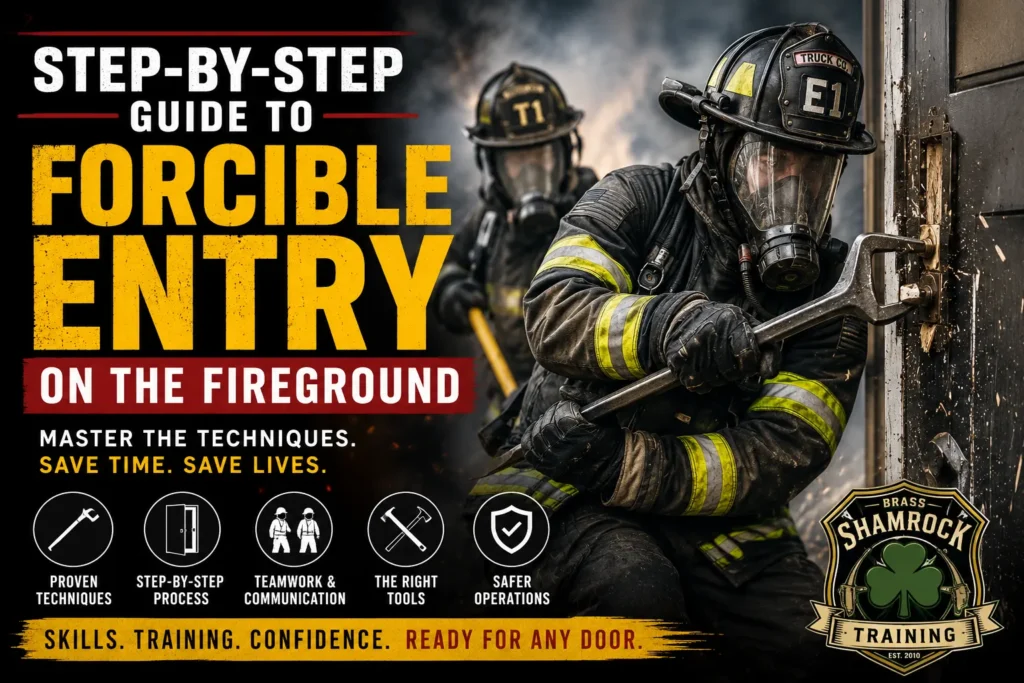
Mastering Forcible Entry Techniques for Faster, Safer Fireground Operations
In situations where time is of the essence, fire crews need to move rapidly to the scene, with as few delays as possible, and stay safe. This Step-by-Step Guide to Forcible Entry on the Fireground outlines practical techniques, proven strategies, and common pitfalls to avoid during emergency operations.
Properly training and communicating how to conduct a forcible entry can enhance the efficiency of the operation and save lives, regardless of whether you are a recruit learning how to work up to the skill or an experienced firefighter practicing the skill.
What Is Forcible Entry?
Forcible entry is the act of entering a building without the ability to enter by regular means or when regular means of entry are locked, blocked, or compromised. One of the most essential truck company operations on the fireground.
Effective forcible entry requires:
- Knowledge of building construction
- Familiarity with forcible entry tools
- Proper communication
- Team coordination
- Repetitive hands-on practice
Why Forcible Entry Matters
Fire can get worse very quickly. Any entry delays can lead to:
- Increased fire spread
- Delayed rescue operations
- Reduced victim survivability
- Greater property damage
- Increased risk to firefighters
If a well-trained crew is available, they can enter efficiently without compromising any of the structure.
Essential Forcible Entry Tools Every Firefighter Should Know
Firefighters should know the tools that they use during forcible entry before discussing the process.
Halligan Bar
The Halligan is reputed to be one of the most versatile forcible entry tools and can be utilized for:
- Prying
- Twisting
- Striking
- Pulling locks
- Breaching doors
Flathead Axe
The flathead axe can be used in conjunction with the Halligan to help:
- Drive the Halligan into gaps
- Strike with precision
- Force inward-opening doors
Hydraulic Forcible Entry Tools
They can be used on heavily reinforced doors and commercial buildings.
Rotary Saws
Useful for cutting:
- Roll-down security gates
- Metal doors
- Padlocks
- Security bars
Rabbit Tool
A hydraulic spreader designed for rapid door forcing in high-security environments.
Step-by-Step Guide to Forcible Entry on the Fireground
Step 1: Conduct a Size-Up
Before touching the door, evaluate it.
Ask yourself:
- Is there visible fire?
- Are occupants trapped?
- Is the door inward or outward opening?
- What type of lock is present?
- Is there an alternative entry point?
- Does the building construction affect tactics?
Practical Tip:
Collect some information for a few seconds. If a size-up is done correctly, it can avoid unnecessary damage and wasted effort.
Step 2: Try Before You Pry
The oldest fire-fighting rule is one of the most important.
Always:
- Check if the door is unlocked.
- Test the handle.
- Verify whether another crew has already opened it.
Common Mistake:
Some firefighters immediately force doors without checking. This wastes energy and unnecessarily damages property.
Step 3: Identify the Door Type
Different doors require different tactics.
Residential Inward Opening Doors
Most common in homes.
Best tactics include:
- Gap
- Set
- Force
Outward Opening Doors
Often found in commercial buildings.
These require:
- Removing hinge pins
- Exposing locking mechanisms
- Using outward-opening techniques
Metal Doors
Require more aggressive methods and sometimes power tools.
Security Doors
May involve multiple locking systems and reinforcement.
Practical Tip:
Recognizing door construction quickly improves success rates.
Step 4: Position the Team Correctly
Proper positioning enhances efficiency and safety.
The firefighter operating the Halligan should:
- Maintain stable footing.
- Stay balanced.
- Keep hands clear of striking zones.
The firefighter with the axe should:
- Deliver controlled strikes.
- Watch tool placement.
- Communicate before every hit.
Communication examples include:
- “Ready.”
- “Strike.”
- “Stop.”
Common Mistake:
Poor communication can result in injuries from misplaced strikes.
Step 5: Gap the Door
Creating an opening between the door and frame is the first operational step.
Methods include:
- Using the Halligan adze.
- Driving the fork into the seam.
- Targeting weak points near the lock.
The objective is to expose enough space to work effectively.
Practical Tip:
Work near the locking mechanism rather than random areas of the door.
Step 6: Set the Tool
Once a gap exists:
- Drive the Halligan deeper.
- Seat the tool securely.
- Ensure maximum leverage.
Proper tool placement significantly increases mechanical advantage.
Common Mistake:
Shallow placement reduces effectiveness and increases fatigue.
Step 7: Force the Door
Using controlled movement:
- Apply leverage.
- Rotate or pry steadily.
- Coordinate with the striking firefighter.
Listen and feel for lock failure.
Avoid excessive force when controlled pressure is sufficient.
Practical Tip:
Use the door frame as a fulcrum whenever possible.
Step 8: Control the Door
After forcing entry:
- Open the door carefully.
- Assess interior conditions.
- Coordinate with suppression crews.
- Avoid creating unnecessary flow paths.
Fireground priorities should dictate whether the door remains open or controlled.
Step 9: Maintain Situational Awareness
Once inside, conditions can change rapidly.
Monitor for:
- Heat conditions
- Smoke movement
- Structural instability
- Victim locations
- Fire extension
Communicate findings immediately to command.
Practical Tips for Successful Forcible Entry
Train Frequently
Skill deterioration occurs without repetition.
Incorporate:
- Door prop drills
- Timed evolutions
- Team coordination exercises
- Multiple door scenarios
Learn Building Construction
Understanding construction features helps predict:
- Lock locations
- Reinforcement methods
- Entry challenges
Preserve Property When Possible
The objective is access—not destruction.
Choose the least damaging option that achieves the mission.
Stay Physically Conditioned
Forcible entry demands:
- Grip strength
- Core stability
- Endurance
- Functional movement
Fatigue contributes to poor decision-making.
Review Every Incident
After-action reviews help crews identify:
- What worked well
- Areas for improvement
- Equipment limitations
- Training opportunities
Common Mistakes to Avoid During Forcible Entry
Skipping the Size-Up
Rushing into action without assessment often leads to poor tactical decisions.
Forgetting to Try the Door First
Unlocked doors are more common than many firefighters realize.
Using Incorrect Techniques
Applying residential tactics to commercial doors wastes valuable time.
Poor Tool Placement
Improper Halligan positioning reduces leverage.
Lack of Communication
Crews that fail to communicate increase injury risk.
Overusing Force
Excessive striking can:
- Damage tools
- Damage structures unnecessarily
- Increase firefighter fatigue
Ignoring Building Construction
Security upgrades and reinforced doors require adjusted tactics.
Related Skills That Improve Forcible Entry Performance
Firefighters should also train in related disciplines, including:
- Truck company operations
- Search and rescue techniques
- Vertical ventilation
- Fireground communication
- Rapid intervention procedures
Developing these complementary skills improves overall operational effectiveness.
The Importance of Realistic Forcible Entry Training
Classroom instruction alone is not enough.
Realistic training should simulate:
- Residential structures
- Commercial occupancies
- Security doors
- Time-pressure scenarios
- Low-visibility conditions
Doing it over and over gets the muscle memory and confidence going that can come in handy during emergencies.
Final Thoughts
Forcible entry is more than “breaking doors down”. It is an organized skill of the fireground that incorporates knowledge, teamwork, communication, and technical skills.
Following this step-by-step procedure will increase firefighter speed, minimize property damage, improve firefighter safety, and increase the chances of a successful rescue and suppression.
The key to the difference between average performance and exceptional fireground execution is practice, realistic training, and a dedication to mastering the basics.
Ready to Take Your Forcible Entry Skills to the Next Level?
If you’re serious about improving your fireground performance, invest in professional hands-on training designed to prepare firefighters for real-world emergencies. Join experienced instructors, sharpen your techniques, and build the confidence needed to perform when lives are on the line. Contact our team today to learn more about advanced forcible entry training programs and take the next step in your firefighting career.