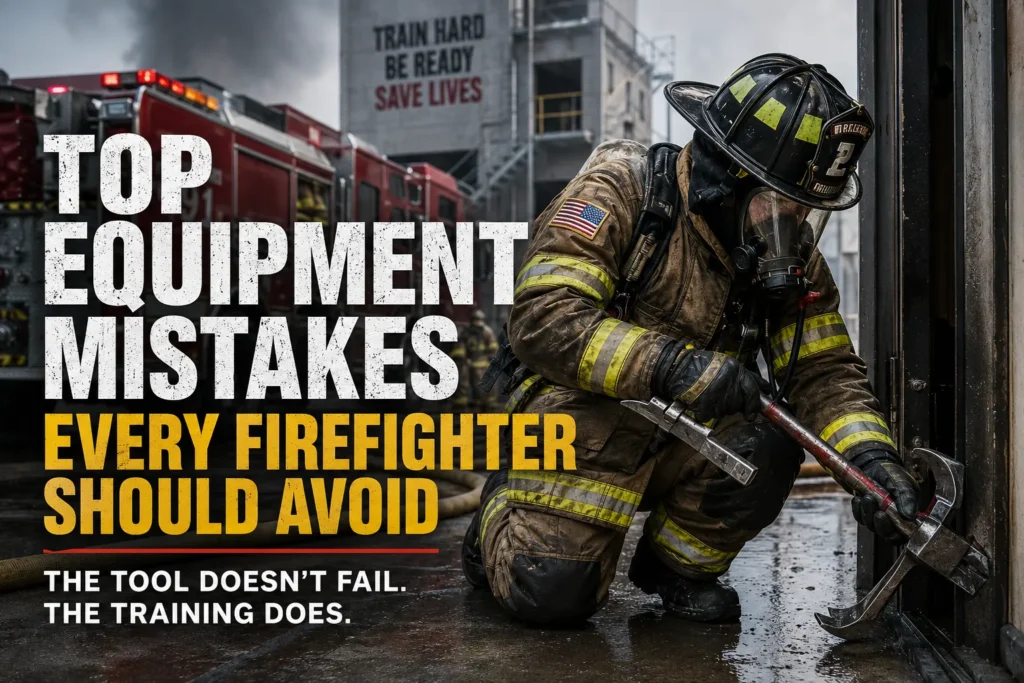
A tool doesn’t fail on its own. I’ve sat through enough honest debriefs to know how these stories actually go. The irons didn’t break. The saw didn’t quit. Somebody set the tool wrong, swung it wrong, or reached for it a half second too late. Every equipment failure on a real fireground traces back to a hand that was never trained hard enough to use it under pressure.
So no, this isn’t a list of manufacturer defects. These are mistakes made by trained hands. They get repeated across departments because the training culture decided familiarity was good enough. Every single one has shown up in real incidents and real near misses, usually followed by someone admitting the truth out loud. The tool didn’t fail them. They failed the tool.
How many of these has your department quietly normalized? Be honest. The equipment in your hands only performs as well as the training behind it.
Quick Answer
The top five fireground equipment errors are the following: bad Halligan placement the first time, hesitation to use the saw on unstable roofs, misusing hydraulic and lifting tools, misreading the thermal imaging camera in stressful situations, and search rope/rigging (RIC) equipment that isn’t in muscle memory. All of them are training errors, first and foremost, before they’re equipment errors.
1) Misjudging Halligan and Irons Placement
If you watch long enough for forcible entry and watch it go sideways. The crew sets up the Halligan on the wrong side the first time, and takes precious time to correct it during the operation. Why did it always happen to him? Most of the members were trained on doors that popped after one showed them the technique. They learned a list by heart. They have never been able to really develop problem-solving skills against a door that comes back.
If a door has a security bar, or multiple lock points or a swollen frame, it will require a different read and set. The member who never faced that type of resistance uses the incorrect technique when pressure comes. HERE, competency trumps courage, every time. A good swing with the incorrect swing is simply giving fire more time to play against the crew inside.
2) Hesitating With the Saw on an Unstable Roof
This is the effect of flat-ground saw training. Members who feel confident in the tool and are completely unready for the surface. The first time they will be able to use footing and saw at the same time (on a real roof over a real fire). It’s at that moment that the hesitation emerges. The cut appears slow, or it doesn’t appear at all.
This is a clear place where simulation simply doesn’t work. My experience is that no one can learn anything about sag and sound from a saw when it’s on the ground before they put weight on it. Violence of execution is on par. A hesitant cut is an operation that does not have time to do it and has all members of that roof exposed longer than necessary.
3) Misapplying Hydraulic and Lifting Tools
Struts, rams and airbags can only function when the operator has the understanding of how the load is actually distributed. Most members took them to a light training tool. That’s how they use them; not how real weight would be used. If the member has only worked on a scaled-down version of the product, they have no experience with seeing a poorly supported load before it moves.
The trouble with this one is that it doesn’t look dangerous at the time. To an untrained eye, it seems like a good setup. It only fails when the actual load causes the calibration to be incorrect. By that time the failure is occurring live, and there’s a trapped victim or one of your members trapped under it.
4) Misreading the Thermal Imaging Camera Under Stress
A thermal camera is only as useful as the member reading it. That member is usually disoriented, in zero visibility, juggling search technique and radio traffic all at once. Too many crews treat the camera like an answer machine instead of a tool that demands trained interpretation. The result is false confidence in a reading that was actually ambiguous.
Think about where these members practiced. Calm room. Good lighting. No stress. That kind of exposure builds nothing for the moment when the screen becomes the only reliable information source in a smoke-filled room. A misread camera doesn’t just waste time. It can send an entire search in the wrong direction while conditions fall apart around the crew.
5) Search Rope and RIC Equipment Without True Muscle Memory
The worst case scenario of this error is easy to imagine. A member must think through the deployment of the rope or operation of the RIC tool at the precise moment it is needed. Disoriented. Under physical stress. Lack of fine control due to fear/stress. That conscious thought process takes seconds a firefighter who is down doesn’t have.
Hesitation is the combination of fear and a lack of skill. In a RIC operation that hesitation puts the member who is already on the ground in direct danger. If the equipment is not set to automatic execution, it will not work when most needed. The steps of the explanation, whether in class or not, aren’t important. There is no such thing as a fireground that grades on explanation.
The Root Cause Behind Every Mistake on This List
Now look back through all 5 and you will see the same failure below. Training that ended at familiarity rather than at mastery, under the realistic resistance, time pressure and under real physical load. Don’t mistake the ability to pronounce every tool on the rig to mean an operator is skilled at using each one during the fireground when the fireground doesn’t cooperate.
So stop assuming that everyone is adept at operating equipment quickly and efficiently under stress; know who is. It’s not about keeping every skill level the same during evolutions, it’s about setting the example to those heavy lifters. There is not an equal distribution of mastery on a roster. Training that is supposed to be otherwise is a misuse of the department’s best asset.
Why This List Matters More Than a Gear Inventory
Safety without capability is false security. A department can issue the best equipment on the market and still watch members make every mistake on this list, because the training never demanded real resistance or real consequences for failure. The tool in a firefighter’s hands is never the variable that decides the outcome. The training behind those hands is. Every single time.
Frequently Asked Questions
What is the most common forcible entry mistake firefighters make?
Setting the Halligan wrong on the first attempt. It usually traces back to training on doors that opened easily, which builds a memorized sequence instead of problem-solving skill against a door that genuinely resists.
Why does saw hesitation happen on roof operations?
It happens when members train only on flat ground. They never built the balance and positioning skill needed on an unstable roof, where footing and tool control have to happen at the same time.
Can hydraulic and lifting tools fail even when set up correctly?
A setup can look correct and still fail. If the operator only trained against lightweight props, their load calibration simply doesn’t transfer to real field conditions.
Why do thermal imaging cameras get misread on real calls?
Because most members only practiced in calm, well-lit rooms. They never built the interpretive skill to read the camera while disoriented in real smoke.
How dangerous is poor muscle memory with RIC and search rope equipment?
It’s one of the most dangerous gaps on this list. A member who has to consciously think through deployment during a rescue loses seconds a downed firefighter doesn’t have.
Are these equipment mistakes a tool problem or a training problem?
A training problem, every single time. The tool fails because the hands using it were never pushed past basic familiarity into real mastery under resistance and pressure.
