Introduction
Nobody on the fireground cares whether you’re ready. I’ve seen plenty of crews learn that lesson the hard way, usually because forcible entry was covered once in recruit school and then never revisited. New firefighters spend years building the kind of muscle memory that turns a chaotic scene into a controlled one, and that doesn’t happen by accident. Volunteer departments deal with a different problem: limited training hours and gear on the rig that doesn’t always match what was used on the prop. Career firefighters fall into their own trap too, assuming that years on the job somehow substitute for staying sharp on the fundamentals. None of these gaps are theoretical. A botched forcible entry technique slows down the search team behind you. A sloppy ladder throw sets ventilation back. A weak RIC deployment costs precious time on a downed firefighter rescue.
This guide walks through the core skills every firefighter needs to have locked in, why they actually matter on a real incident, and the mistakes I’ve watched quietly chip away at readiness in departments of every size.
Quick Answer
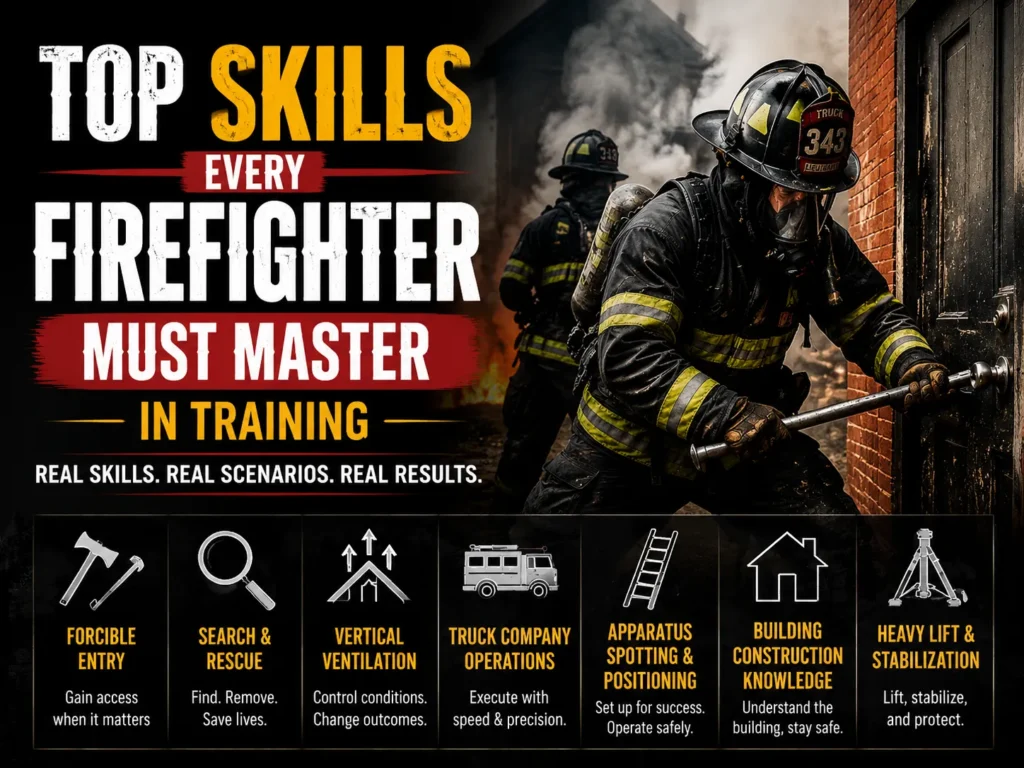
If I had to rank the skills that matter most, they’d be forcible entry, search and rescue with RIC procedures, vertical ventilation, truck company operations, apparatus spotting and positioning, building construction knowledge, and heavy lift and stabilization. These are the backbone of interior firefighting and rescue work. Departments that keep training on them consistently show up to calls faster and perform more safely, and that’s no coincidence.
What Is Forcible Entry and Why Does It Matter?
Forcible entry is exactly what it sounds like: entering a structure, vehicle, or barrier when the normal entry point is locked or blocked. That covers door breaching, window entry, lock manipulation, and through-the-lock work. The goal is simple on paper and brutal in practice: get your crew inside fast, without tearing up the path the search team needs right behind you.
Here’s the thing about doors. They don’t fail the same way twice. Commercial buildings throw security gates and roll-down doors at you. Residential structures are increasingly showing up with reinforced doors and security screens bolted on. If you’ve only ever trained on a standard residential door, you’re going to hesitate the first time you hit something different, and hesitation is a luxury nobody has on that fireground.
Why This Skill Matters
Every second you spend fighting a door is a second your victim spends breathing smoke. Modern fuel loads burn hotter and faster than the furniture our grandfathers dealt with, so a slow entry can be the difference between pulling someone out alive and not pulling them out at all. Crews that can’t force their way in quickly end up exposed longer to collapsing conditions outside, and RIC teams in particular live and die by clean, fast entry skill, since a downed firefighter’s survival window is measured in minutes, not hours.
There’s also the property side. A crew that knows the right tool for the right lock does far less collateral damage than a crew swinging a sledgehammer at a door that only needed ten seconds of proper technique. I’ve seen both, and the difference is night and day.
How It Works
- Size up the entry point. Check the door swing, lock type, and construction before you commit a tool.
- Try before you pry. Always attempt the simplest method first.
- Select the correct technique. Match your tool and method to the actual door in front of you.
- Apply controlled force. This comes from body mechanics, not just arm strength.
- Maintain the opening. Chock and control the door to keep it safe for crews moving through it.
- Communicate completion. Let command and interior crews know the path is clear.
Essential Equipment and Tools
Equipment | Purpose | When Used |
Flathead Axe | Striking and prying tool | Conventional doors |
Halligan Bar | Prying, punching, through-the-lock work | Doors with visible locks |
Set of Irons | Combined leverage and strike force | Most forcing operations |
Rabbit Tool | Hydraulic spreading | Inward-swinging, jammed doors |
K-Tool | Lock cylinder removal | High-security locks |
Bolt Cutters | Cutting padlocks and chains | Roll-down gates, fencing |
Battering Ram | Heavy impact force | Reinforced, barricaded doors |
Thermal Imaging Camera | Conditions assessment | Before and during entry |
Step-by-Step Guide
Step 1: Approach and Assess. Walk the door, check the swing and hardware. The common error here is skipping size-up entirely and just forcing the first door you see.
Step 2: Attempt Conventional Entry. Try the handle before you assume it’s locked. I can’t tell you how many times I’ve watched someone force a door that was never even locked.
Step 3: Select and Position Tools. Match the tool to the door type and keep your hands clear of pinch points. Get the angle wrong, and you’ll waste strikes you didn’t need to waste.
Step 4: Apply Force. Strike using leg and hip drive, not just your arms. Rushing this step without resetting your tool placement is how strikes get wasted.
Step 5: Control the Opening. Chock the door and confirm there’s enough clearance for SCBA-equipped crews. Leaving the door uncontrolled creates a hazard for everyone moving through it.
Step 6: Communicate and Transition. Report your tool placement and conditions to command. Failing to relay that information to search teams leaves them walking in blind.
Best Practices
- Always size up before committing a tool.
- Try before you pry, every single time.
- Train with every tool in the cache, not just your favorite.
- Communicate strike progress to your partner.
- Maintain a charged line during interior operations.
- Control the door once it’s forced.
- Rotate crew members through entry drills so the skill spreads.
- Debrief every evolution, live or training.
- Keep your tools sharp and maintained.
- Train on non-standard doors and security gates, not just the easy residential ones.
Common Mistakes
- Skipping size-up. This usually happens when crews rush under pressure, wasting time by forcing the wrong point. Build size-up into every repetition until it’s automatic.
- Forcing an unlocked door. This comes from assumption instead of verification. Always try the handle first.
- Wrong tool for the door. Crews default to whatever tool they’re comfortable with. Cross-train on the whole cache to fix this.
- Poor body mechanics. Fatigue and low repetition cause this. Regular stance drills solve it.
- No communication. Stress narrows focus fast. Build verbal callouts into training from day one.
- Uncontrolled entry point. Crews move on too quickly after forcing the door. Chock every forced opening, no exceptions.
- Neglected tool maintenance. This slips due to low priority during busy shifts. Routine inspection fixes it.
- Overcommitting force. Habit from heavier commercial doors carries over to lighter hardware. Train on a variety of door types.
- Ignoring secondary security. Crews focus only on the primary lock and miss hidden hardware. A full door inspection prevents that.
- Skipping the debrief. Departments treat it as a checkbox instead of a learning opportunity. A structured after-action review changes that.
Safety Considerations
Every evolution should start with a quick risk assessment of fire conditions and structural integrity. Full PPE and SCBA are non-negotiable before any interior operation, live or training. Crew accountability matters just as much, since command needs to know exactly which crew is working which entry point at all times. Keep radio traffic direct and simple, and stay alert to secondary hazards like overhead debris and deteriorating structural members. Every crew member should know the Mayday and RIC activation procedure cold, before they step inside, not after something’s already gone wrong.
Training Drills Firefighters Can Practice
Multi-Door Circuit. Rotate crews through conventional, through-the-lock, and security door props. The benchmark is a reduced average entry time while maintaining proper technique.
Blind Forcible Entry. Force a known door prop in low-light or blacked-out conditions. Success means entry within a set time with controlled strikes.
Team Communication Drill. Pair firefighters on one door with an officer observing. The goal is zero missed verbal callouts during the evolution.
How Fire Departments Can Improve Performance
Training has to happen on a recurring monthly schedule, not as a one-time recruit school topic that gets checked off and forgotten. Timed evolutions and officer checklists give you a real way to track performance over time. Combining forcible entry with search, RIC, and ventilation drills puts the skill in a realistic context rather than isolating it. At the end of the day, repetition under stress is what builds the memory that holds up on a real call, and when officers train alongside their crews, the standard rises for everyone on the roster.
Expert Tips from the Fireground
- Train on the worst door in your district, not the easiest one in the tower.
- If you haven’t forced a security gate in training, you’re not ready to force one on a call.
- Clean, controlled strikes beat frantic, powerful ones every time.
- Inspect your irons every shift, no shortcuts.
- Speed comes from technique, not from swinging harder.
- Communicate like your crew can’t see what you see, because they can’t.
- Train new firefighters on every tool early, before bad habits take root.
- An uncontrolled forced door is a hazard you created for your own crew.
- Debrief every drill as if it were a real call, because the lessons are the same.
- Readiness gets built one repetition at a time; there’s no shortcut around it.
Conclusion
Mastering forcible entry, alongside search and RIC operations, vertical ventilation, and truck company fundamentals, isn’t optional for anyone expecting to perform under real fireground conditions. Readiness doesn’t get built during the call. It gets built in the months of deliberate, repeated training that come before it. Keep training, keep sharpening the basics, and keep your crew ready for the door you haven’t forced yet. That’s the standard Brass Shamrock Training exists to help departments reach.
Frequently Asked Questions
What is the most important skill for a new firefighter to master?
Forcible entry and basic search procedures, since nearly every interior operation depends on getting in safely and fast.
How often should firefighters train on forcible entry?
At least monthly, and more often for truck company and rescue assignments specifically.
What tools are essential for forcible entry training?
A standard set of irons, backed up by rabbit tools, K-tools, and bolt cutters for the specialized entries you’ll eventually run into.
Why do firefighters struggle with this skill under pressure?
Stress narrows focus and reduces fine motor control, which is exactly why repetitive, realistic training matters so much.
What's the difference between conventional and through-the-lock entry?
Conventional entry forces the door itself, while through-the-lock targets the cylinder directly to minimize damage.
How does this connect to RIC operations?
RIC teams often need fast entry to reach a downed firefighter, so this skill is directly tied to rescue readiness.
What's the biggest safety risk during forcible entry?
Uncontrolled entry points, poor body mechanics, and a breakdown in communication.
Should volunteer departments train differently than career departments?
No. Technique and safety standards shouldn’t change based on staffing model, full stop.
How can departments measure training success?
Timed evolutions, officer evaluations, and after-action reviews.
Can this be trained without live fire?
Yes. Technique, tool selection, and body mechanics all train well on static props alone.
