Most departments don’t have a training problem because they lack hours. The real problem is that the hours they log don’t produce the skill they think they do. A department can drill every single week and still send members onto a fireground who hesitate at the exact moment hesitation costs the most. Volume isn’t the variable here. Standard is.
We see this everywhere we teach, from fire departments across the Pacific Northwest to agencies we work with nationwide. And the pattern keeps repeating. Individual skills matter, sure, but no amount of correct technique survives a culture that tolerates low-resistance training or looks the other way on instructor quality. Training culture gets built top down or it doesn’t get built at all.
How many departments have you watched run the same training calendar for ten straight years while wondering why performance never moves? That’s fireground reality in Washington State and everywhere else we go. The fix isn’t more training. It’s better strategy behind the training you already run.
Quick Answer
The strategies that actually improve fire department training are:
- Shifting from demonstration-based drills to resistance-based evolutions
- Vetting instructors on operational fireground background, not certifications alone
- Building role-specific curriculum for engine and truck company members
- Deliberately identifying and developing high-performing members
- Treating skill retention as an ongoing program instead of an annual event
Adopt all five and the difference in fireground readiness shows up fast.
Strategy One: Replace Demonstration With Resistance
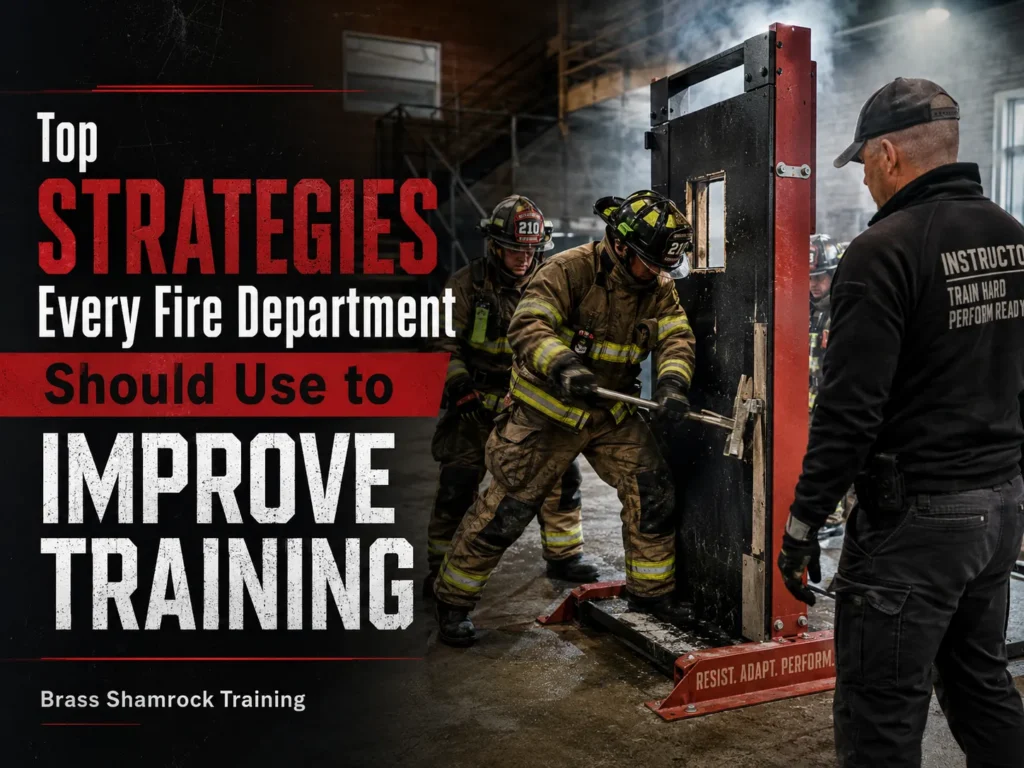
If a department changes only one thing, make it this. Shift training time away from demonstration and toward genuine resistance. A member who watches a technique once and then tries it on a cooperative training door hasn’t built any real problem-solving skill. Put that same member on a forcible entry prop that fights back, under a clock, and you start building the automatic technique adjustment that actually holds up on a call.
This applies across every discipline, and it’s the standard we hold in our own hands-on firefighter training courses:
- Forcible entry needs real resistance doors and props that fight back
- Vertical ventilation needs acquired structures with actual roof behavior
- Search and RIC need genuine disorientation and time compression
- Heavy lift and stabilization need real weight, not scaled-down props
Fear plus lack of skill produces hesitation. The only proven way to break that equation is repetition against conditions that actually resist the trainee.
Departments that make this one shift see a measurable change in how members perform under pressure within a few months. No new budget required.
Strategy Two: Vet Instructors on Operational Background, Not Just Certification
A department’s training quality is a direct reflection of who’s running it. Far too many training officers and outside instructors get picked on certification level or seniority, and neither one guarantees the operational fireground experience it takes to teach real skill under pressure.
So before booking any outside training provider, whether in the Seattle area or anywhere else in the country, ask a direct question. What operational time does that instructor have on the specific skill being taught? Has the person teaching truck company operations actually run a roof division on a working structure fire? Has the person teaching RIC ever located and removed a downed firefighter? Certification proves someone passed a course. It doesn’t prove they can operate under chaos, and a department that confuses the two is building its whole program on a weak foundation.
Strategy Three: Build Curriculum Around Roles, Not a Generic Firefighter
Engine company members and truck company members need fundamentally different training emphasis. Running identical curriculum for both wastes hours that should go toward role-specific repetition. Roof division work, spotting and positioning aerial apparatus, and heavy lift and stabilization all demand a different physical and tactical skill set than interior search and fire attack does.
Map your roster against actual fireground roles and build training blocks that match. That doesn’t mean throwing out cross-training entirely. It means ending the habit of treating every member as an interchangeable generalist when the fireground itself never works that way.
Strategy Four: Deliberately Identify and Develop Heavy Lifters
Every department already has members who move faster, solve problems with less hesitation, and absorb correction quicker than the rest. And most departments do nothing with that information beyond a nod of informal recognition. That’s a strategic failure.
Build a deliberate process instead. Identify these high performers during resistance-based evolutions, then hand them increased responsibility and more advanced repetition rather than holding the whole group to the pace of the slowest learner. These are the members who become the operational backbone of a crew, the ones an officer trusts to move first when speed decides the outcome. A department that won’t develop its heavy lifters is leaving its best asset sitting on the shelf.
Strategy Five: Treat Skill Retention as a Program, Not an Event
Skill is perishable. Forcible entry technique, search patterns, and heavy lift procedures all degrade within months without continued repetition. A department that trains hard once a year and assumes the skill holds is gambling with its response capability.
The fix is building retention directly into the calendar:
- Schedule recurring resistance-based drills between major training events
- Track which perishable skills are decaying fastest across the roster
- Adjust the calendar based on actual performance data, not habit
A program with no retention strategy produces a temporary spike in capability that quietly disappears a few months later.
Why Strategy Matters More Than Schedule
Safety without capability is false security. A department can document every single training hour correctly and still lose a member, because the underlying skill was never built through real resistance, never taught by a credible instructor, or never maintained after the course ended. Capability has to come first. And capability is the direct output of strategy, not volume.
The departments improving fastest, in the Pacific Northwest and across the country, aren’t the ones stacking more hours onto the calendar. They’re the ones asking harder questions about what those hours actually build, who’s teaching them, and whether the skill survives past the training day itself.
Frequently Asked Questions
What is the most effective single change a department can make to improve training?
Shifting from demonstration-based drills to resistance-based evolutions produces the fastest measurable improvement, because it forces members to build real problem-solving skill instead of memorizing one cooperative technique.
How should a department evaluate training officers or outside instructors?
Ask directly about operational fireground background on the specific skill being taught, not just certification level. Certification proves a course was completed. It does not prove the person can operate under chaos.
Are hands-on firefighter training courses available in the Seattle area?
Yes. Brass Shamrock Training is based in the Seattle, Washington area and delivers resistance-based truck company operations training for departments across the Pacific Northwest and nationwide.
How does a department identify its high-performing members?
Watch how members respond during resistance-based evolutions. The ones who solve problems faster and hesitate less are the heavy lifters worth developing with increased responsibility and repetition.
Why does skill decay even after a strong training course?
Skills like forcible entry technique and search patterns are perishable. Without scheduled follow-up repetition built into the calendar, the gains from a single course fade within months.
