
Introduction
Ventilation in contemporary firefighting is much more than merely clearing smoke out of a burning building. It is a life-saving tactical choice that directly influences the behavior of fire, survivability of occupants, safety of firefighters and the effectiveness of suppressive efforts. Using the wrong ventilation system at the wrong time can increase a fire in a matter of seconds, whereas the right ventilation system can increase visibility, reduce heat, and provide safer conditions to rescue and extinguish the fire.
Whether to employ vertical ventilation or horizontal ventilation when structural fires occur is one of the most crucial decisions that incident commanders and firefighting crews will have to make. These two techniques are both critical to coordinated fire attack efforts, but each approach has different goals depending upon building construction, fire location, wind conditions, staffing, and operational priorities.
With the ever-changing dynamics of fire due to the lightweight construction materials, synthetic furnishings, and tight building envelopes, it has become important to every firefighter, officer, and fire department to understand when it is appropriate to use vertical or horizontal ventilation.
This guide will discuss the differences between these two ventilation strategies, when either strategy should be employed, some pitfalls to avoid, and the tactical aspects that can enhance operational success and reduce risks.
Understanding Fire Ventilation
Fire ventilation is the deliberate extraction of heat, smoke, gases, and toxic products of combustion out of a structure. Adequate ventilation is beneficial to the firefighters as:
- Improving interior visibility
- Reducing extreme temperatures
- Limiting flashover potential
- Enhancing rescue conditions
- Increasing survivability for trapped occupants
- Supporting coordinated fire suppression efforts
Ventilation is also a contributor of oxygen to the fire conditions. When not properly organized, it may quickly escalate the growth of the fire.
What Is Vertical Ventilation?
Vertical ventilation is a method of providing openings in the roof of a structure to enable heat, smoke, and gases to escape naturally upwards.
Due to the increase in the amount of heat, the convection uses vertical ventilation to direct the harmful gases out of the building through the top.
Common Vertical Ventilation Methods
- Roof cuts
- Trench ventilation
- Existing skylight openings
- Mechanical roof exhaust systems
Primary Goal
The overall goal is to evacuate superheated gases before the flashover event and to enhance the interior conditions of firefighters and occupants.
What Is Horizontal Ventilation?
Horizontal ventilation is the removal of smoke, heat, and gases through doors, windows or wall openings on the same level as the fire.
Such a method can be natural or mechanical with the help of fans and positive pressure ventilation systems.
Common Horizontal Ventilation Methods
- Opening windows
- Door control techniques
- Positive pressure fans
- Hydraulic ventilation
- Mechanical exhaust fans
Primary Goal
Horizontal ventilation aims to clear the smoke, enhance visibility, and provide safer routes during the suppression and rescue processes.
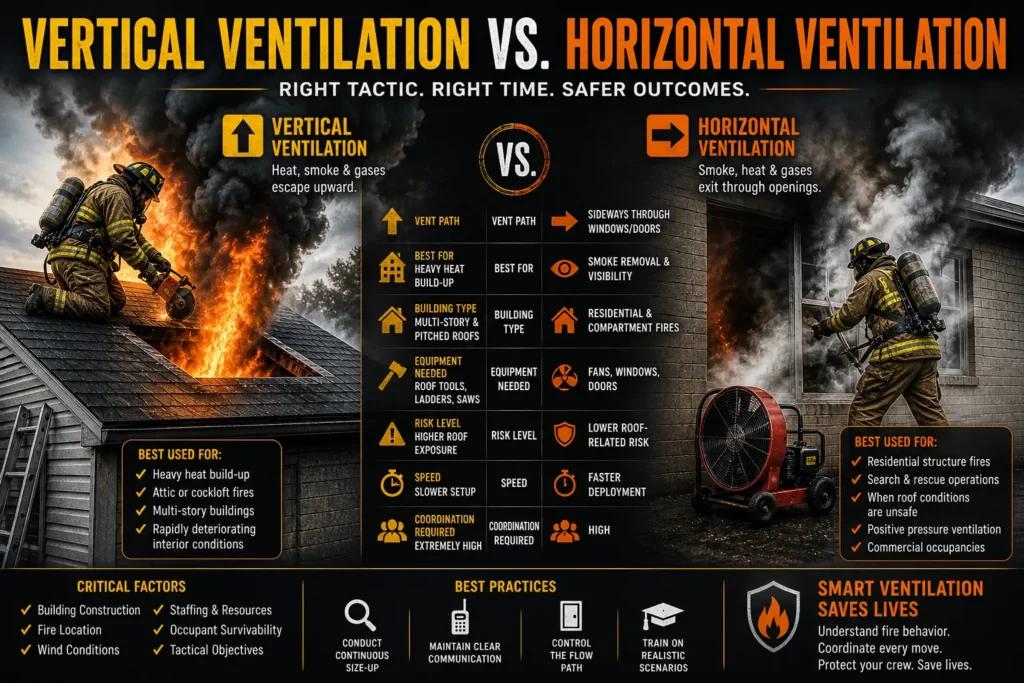
Vertical vs. Horizontal Ventilation
Feature | Vertical Ventilation | Horizontal Ventilation |
Vent Path | Upward through the roof | Sideways through windows/doors |
Best For | Heavy heat buildup | Smoke removal and visibility |
Building Type | Multi-story and pitched roofs | Residential and compartment fires |
Equipment Needed | Roof tools, ladders, saws | Fans, windows, doors |
Risk Level | Higher firefighter exposure | Lower roof-related risk |
Speed | Slower setup | Faster deployment |
Coordination Required | Extremely high | High |
Understanding these distinctions helps firefighters select the safest and most effective approach during evolving fire conditions.
When to Use Vertical Ventilation in Fires
Vertical ventilation is best used in certain fire conditions, where the buildup of heat and smoke endangers interior crews or trapped occupants.
- During Heavy Heat Build-Up
Vertical ventilation enables gases to move away quickly when they accumulate in close proximity to ceilings. This greatly reduces the interior temperatures and minimizes the flashover possibilities.
Firefighters often choose vertical ventilation when:
- Interior temperatures are dangerously high
- Smoke banking is severe
- Fire is located below the attic spaces
- Upper floors are heavily charged with heat
- In Multi-Story Structures
High-rise and multi-story buildings often trap heat vertically through stairwells, shafts, and concealed spaces.
Vertical ventilation becomes valuable because it:
- Channels heat upward
- Prevents smoke spread between floors
- Supports stairwell tenability
- Assists rescue operations
- During Attic or Cockloft Fires
Attic fires may propagate quickly, due to hidden cavities. Horizontal ventilation by itself might not be effective enough to eliminate heat that is trapped around roof assemblies.
Vertical ventilation is commonly used when:
- Fire spreads through attic voids
- Roof spaces are heavily involved
- Cockloft extension threatens neighboring units
- Quick roof access can slow horizontal fire extension and improve suppression effectiveness.
- When Interior Conditions Are Deteriorating Rapidly
When internal crews report that visibility is growing worse, rollover conditions are getting worse, or increasing heat levels despite the hose streams, vertical ventilation can alleviate dangerous thermal accumulation.
This tactic becomes critical in preventing:
- Flashover
- Backdraft conditions
- Thermal layering collapse
- During Coordinated Offensive Fire Attacks
Vertical ventilation is most effective when it is closely coordinated with the fire attack teams.
Timing is essential.
When roof openings arise prior to the application of water, oxygen can cause the fire to burn out of proportion. But when the efforts are coordinated, it may enhance the speed and survivability of suppression efforts.
When to Use Horizontal Ventilation in Fires
Horizontal ventilation tends to be quicker, secure, and more convenient for numerous residential and compartment fires.
- During Residential Structure Fires
Single-family houses are often well-suited to horizontal ventilation since the crews can clear the smoke quickly, using the windows and doors.
This improves:
- Victim visibility
- Search efficiency
- Firefighter orientation
- Hose advancement
Modern residential tactics increasingly prioritize controlled horizontal ventilation combined with door control strategies.
- During Search and Rescue Operations
Smoke removal is essential for locating trapped occupants quickly.
Horizontal ventilation helps create survivable spaces by:
- Clearing escape paths
- Reducing smoke inhalation hazards
- Improving search speed
For this reason, horizontal ventilation is commonly coordinated during primary search operations.
- When Roof Conditions Are Unsafe
Lightweight roof construction has increased collapse risks significantly.
Firefighters may avoid vertical ventilation when roofs show signs of:
- Structural instability
- Fire compromise
- Sagging
- Heavy fire involvement
In these situations, horizontal ventilation offers a safer alternative.
- During Positive Pressure Ventilation (PPV)
Positive pressure ventilation uses fans to force smoke out through designated exhaust openings.
PPV is highly effective when:
- Fire location is known
- Exhaust openings are controlled
- Crews coordinate suppression timing
- Buildings have manageable compartment layouts
PPV has become increasingly popular because it rapidly improves interior visibility.
- During Commercial Occupancy Operations
Large commercial buildings often require extensive horizontal ventilation due to complex layouts and large interior spaces.
Examples include:
- Warehouses
- Retail stores
- Schools
- Office buildings
Mechanical ventilation systems are frequently integrated into these operations.
Critical Factors That Determine Ventilation Choice
Firefighters must evaluate several variables before selecting a ventilation strategy.
Building Construction
Modern lightweight construction burns and collapses faster than legacy materials.
Vertical ventilation may be dangerous on:
- Engineered truss roofs
- Lightweight wood assemblies
- Fire-damaged roofing systems
Construction type strongly influences tactical decisions.
Fire Location
Ventilation should align with fire location and flow path control.
For example:
- Basement fires may worsen with improper horizontal ventilation
- Attic fires often benefit from vertical release
- Compartment fires may require controlled horizontal openings
Wind Conditions
Wind-driven fires can become extremely dangerous when ventilation openings align with airflow.
Research from fire dynamics studies has shown that wind can rapidly intensify interior fire conditions and increase firefighter risk.
Incident commanders must carefully evaluate wind direction before opening structures.
Staffing and Resources
Vertical ventilation requires trained roof crews, tools, ladders, and coordination.
Departments with limited staffing may favor horizontal tactics because they:
- Deploy faster
- Require fewer personnel
- Reduce roof exposure risks
Occupant Survivability
Ventilation decisions should always prioritize life safety.
If victims are trapped, ventilation must improve survivable conditions without worsening fire spread.
This requires disciplined coordination between suppression and ventilation crews.
Common Ventilation Mistakes Firefighters Must Avoid
Ventilating Too Early
Premature ventilation can feed oxygen to the fire before suppression lines are ready.
This mistake can rapidly intensify fire behavior.
Failing to Coordinate With Attack Crews
Ventilation and suppression must function together.
Uncoordinated ventilation can create dangerous flow paths that spread heat toward firefighters or trapped occupants.
Ignoring Building Construction
Roof operations on unstable lightweight structures have contributed to numerous firefighter fatalities.
Construction awareness is non-negotiable.
Creating Improper Exhaust Openings
Incorrect exhaust placement during positive pressure ventilation may push smoke deeper into uninvolved areas.
Ventilation openings must support tactical objectives.
The Role of Modern Fire Dynamics
Modern fires burn differently from fires decades ago.
Synthetic materials now generate:
- Faster heat release rates
- Higher toxic gas concentrations
- Quicker flashover development
Research indicates that some modern rooms can reach flashover in under five minutes.
Because of this, ventilation decisions today require greater precision than ever before.
Modern firefighting increasingly emphasizes:
- Flow path control
- Door control
- Coordinated ventilation
- Air management
- Tactical patience
Departments that understand fire dynamics achieve safer and more effective outcomes.
Frequently Asked Questions
Which ventilation method is safer?
Horizontal ventilation is generally safer because it avoids roof operations. However, the safest method depends on fire conditions, building construction, and tactical coordination.
Is vertical ventilation always better for heat removal?
Vertical ventilation is highly effective for removing heat because heat naturally rises. However, it may not always be practical or safe, depending on roof conditions.
Can both ventilation methods be used together?
Yes. Many fire operations combine vertical and horizontal ventilation to improve smoke removal and fire control.
Coordination is critical to prevent unintended fire growth.
What is the biggest risk of improper ventilation?
The greatest danger is rapid fire intensification caused by introducing oxygen into a ventilation-limited fire.
This can lead to:
- Flashover
- Backdraft
- Fire spread
- Firefighter entrapment
Why is ventilation timing important?
Proper timing ensures suppression crews are ready to control fire growth once oxygen enters the structure.
Poor timing can worsen conditions dramatically.
Best Practices for Successful Fire Ventilation
Conduct Continuous Size-Up
Conditions change rapidly during structural fires.
Command officers must constantly reassess:
- Smoke behavior
- Structural stability
- Wind conditions
- Fire spread
- Occupant survivability
Coordinate Communication
Ventilation teams and suppression crews must maintain clear communication at all times.
Radio discipline improves operational timing and firefighter safety.
Prioritize Flow Path Control
Modern tactics emphasize controlling air movement through structures.
This includes:
- Door control
- Controlled ventilation openings
- Coordinated fan placement
- Flow path awareness saves lives.
Train on Realistic Scenarios
Firefighters should regularly train on:
- Roof operations
- PPV coordination
- Search and ventilation integration
- Wind-driven fire tactics
- Fire dynamics behavior
Realistic training improves decision-making under pressure.
Understand Local Building Types
Every jurisdiction has unique construction characteristics.
Departments should study:
- Roof systems
- Legacy buildings
- Lightweight construction
- Commercial occupancy layouts
Local knowledge strengthens tactical effectiveness.
Conclusion
The choice of vertical or horizontal ventilation is one of the most crucial tactical decisions made by the firefighters during the process of structural firefighting operations. The two approaches offer very important advantages, but each approach has special dangers and operational implications.
Vertical ventilation is highly effective to get rid of heat and interior conditions during attic fires, multi-story fires, and severe thermal build-up. Yet, it puts firefighters at risk of roof hazards and necessitates a lot of coordination.
Horizontal ventilation provides a quicker deployment, reduced risk operations, and efficient smoke management during residential and compartment fires. Nevertheless, the inappropriate timing or uncontrolled flow of air may quickly worsen the conditions of the fire.
The success of ventilation relies on the awareness of fire behavior, the construction of buildings, the ability of the occupant to survive, and the coordination of suppression strategy. Firefighters who learn to master both vertical and horizontal ventilation methods can enhance the results of rescue operations, the efficiency of operations, and reduce the risks on the fireground significantly.