Why On-Site Firefighter Training Is More Effective
A volunteer crew once drilled forcible entry into a shined-up steel prop for an entire weekend at a regional academy. Each rep was a clean rep. Two weeks later, the same crew looked at a residential door with an inward-swinging deadbolt and drop bar and set fire to it; this was something the prop never did, and it took four minutes for them to get in, too! Four minutes, when someone is locked on the other side, is an eternity.
Perhaps one of the most underrated dangers of the fire service could be the difference between where the firefighter trains and where they encounter fire. Skills are not as easily transferable as we might think. A door isn’t a door! A building is more than a building. Sure, a controlled academy environment, which is good for the basics, is often not the same as the cacophony, geometry, and randomness found in a response district.
This article examines why the on-site training in your buildings with your apparatus and your crew is always the superior fireground training experience compared to generic off-site training. You’ll discover how the training environment affects skill retention, the importance of local building stock, which departments are weak, and how to construct a program that truly reflects calls that you run.
Quick Answer
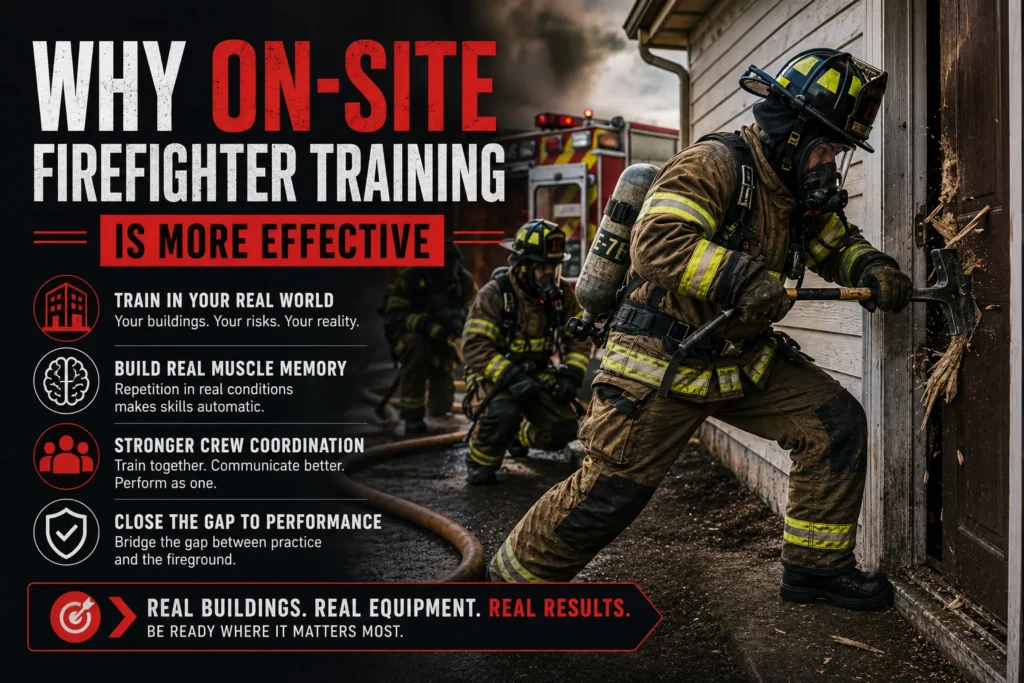
On-site training by a firefighter is effective as it allows for the development of skills in the same environment that a firefighter will encounter during an emergency call. On-the-fire training with real apparatus and crew in your own response area on local building types develops accurate muscle memory, provides exposure to real-world obstacles, enhances team coordination, and narrows the dangerous gap between practice and on-the-fire performance.
The Problem With Training Away From the Job
The basic skills are taught in most cases in a relatively safe and controlled environment. Academy props are designed for repetition, and that’s exactly what makes them effective in teaching the basics. But it’s precisely this predictability that’s their downside. Real structures resist like props do not.
Think of buildings, architectural structures alone. A house built in the 1920s with a balloon frame structure is not like a modern lightweight-truss home or a concrete commercial block. Each one breaks differently, vents in a different way, and calls for different tactics. If crews only have one standardized prop for which they do drills, they tend to make assumptions about all firegrounds responding in the same fashion. That’s why people get hurt when they make the assumption.
After all, off-site training tends to further isolate firefighters from their fire gear and rigs. Bring in a truckie who throws ground ladders at a truckie academy and then take him to a department with varying lengths of ladders, mounting brackets, and apparatus set-up. That’s a firefighter who needs to re-learn the muscle memory in the heat of the situation. The transfer is not finished, and an unfinished transfer comes at the wrong time.
Why Environment Shapes Skill Retention
The research on skill acquisition highlights the fact that there’s something that has been known in fire instruction for decades: context-dependent learning. In other words, recalling and performing a skill is most effective in a context similar to where the skill was learned. The closer the training conditions are to the operational conditions, the more reliable the skill will be in operational conditions.
This is significant on the fireground because stress constricts thinking, impairs fine motor control, and tempts firefighters to return to their deeply ingrained habits. Those habits formed in an environment mismatched to reality show up just when people are not able to adapt.
On-site training fills in that gap. If practice is conducted in the types of layouts the search team might find, such as split-level homes, garden apartments, or the commercial occupancies in their district, they aren’t only learning to search; they are learning to search in practice. They are learning to look for things here, where bedrooms are found, where stairs are found, where dead-end hallways trap the unwary.
What Local Building Stock Teaches You
There is no identical district in the nation that could be called a “response district. A coastal department must deal with the problems of high piling and the rusting of hardware due to saline moisture. In the meantime, a Rust Belt city faces a decline in masonry and uncertain renovations. Lightweight construction subdivisions are rapidly falling apart in a suburb district. Training on-site forces crews to confront these specifics head-on.
Take forcible entry. Which techniques you will use depends on the doors, frames, locks, and security provided in your first due area. Hands-on training with representative doors, instead of generic props, provides firefighters with the opportunity to get accustomed to reading a door, determine the approach, and predict the resistance they will encounter. Similarly, vertical vent (roof type) classes in your district provide instruction in sounding, cut placement, and escape awareness specific to the type of roof you’re going to climb.
It is also here that building-construction knowledge turns from theory to action. By taking a crew to a real building and showing them the truss system, the void spaces, and the structural change that was hidden from view by a renovation, a classroom concept becomes a recognition skill. It is at times like this, when things go wrong, that recognition saves firefighters.
Crew Coordination: The Hidden Multiplier
While individual competence is an important attribute, fires are battled in teams, and teams are best when they have trained together. It’s one of the most frequently neglected benefits of using on-site training. You are drilling with your own people, using your own rigs, so you are developing your wordless coordination, which is what sets efficient companies apart from slow ones.
Consider spotting and positioning. The location of the apparatus at an incident may be the deciding factor whether or not the aerial can get on the roof, whether or not the engine can create a water supply and whether or not there is space for the rescue company to operate. These decisions are based on a knowledge of your apparatus size, your operator’s habits, and the streets you operate on. Once the driver sees the rig outside the district’s buildings, he or she gains judgment that a cone course at the other location cannot provide.
The same holds for search and RIC operations. A Rapid Intervention Crew must operate in a hurry and under the extreme conditions of stress to find and extract a downed firefighter. The ability to do that develops over and over again with the same crew, packs, radio, and methods of removal until the response becomes automatic. To know this is no luxury – it’s the difference between a rescue and a line-of-duty death.
Where Departments Lose Effectiveness
Even motivated departments fall into predictable traps. Recognizing them is the first step toward fixing them.
- Training to the prop, not the problem. Crews master a specific training device and mistake that mastery for readiness. The prop becomes the goal instead of the skill it was meant to teach.
- Skipping the unglamorous reps. Heavy lift and stabilization, cribbing, and methodical search lack the excitement of a live burn, so they get neglected until a vehicle entrapment or a collapse suddenly demands them.
- Training in isolation. Companies drill separately and then struggle to integrate at multi-company incidents because they’ve never coordinated as a fireground team.
- Ignoring mutual-aid realities. Departments that will operate together on real calls rarely train together, so command structures and tactics clash at exactly the wrong moment.
Each of these problems shrinks when training moves on-site and becomes realistic, integrated, and tied to the actual operational environment.
Building a Realistic On-Site Training Program
You don’t need a lot of money to provide a productive training on-site. It needs a will. The aim is to make the practice as realistic as is safe.
A district inventory should be done first. Recognise the major building types, problem occupancies, and buildings that are most likely to cause a serious incident. These are your training priorities. Use acquired structures wherever possible. A house destined for destruction provides unparalleled conditions for building-construction studies, forced entry, search, and ventilation under realistic conditions.
Train with your assigned apparatus and crew, not borrowed apparatus and crew. The reps don’t really matter if they don’t develop the muscle memory you’ll need. In the meantime, do different skills that are not always used, such as stabilization, RIC deployment, and ladder work, to keep the entire toolbox sharp, not just the exciting bits.
Finally, debrief honestly. The training surfaces are realistic, and the mistakes are gifts. It’s a lesson learned in practice, not paid in blood: A door that took too long, a search pattern that missed a room, a spot that blocked the truck.
This is where the structured, scenario-based training is worth its while. The type of hands-on, focused training that Brass Shamrock Training emphasizes in its courses allows programs to bridge the gap between the academy and the street without leaving the department’s jurisdiction area.
Instructor Insight: Train the Decision, Not Just the Task
The toughest part of the firefighter’s job isn’t learning a skill; it’s knowing which skill, when, and why. A through-the-lock operation can be faster than the conventional forcible entry, and the firefighter might have failed the job even though he or she performed the entry perfectly.
What can be developed in scenario-based training is judgment that cannot be developed by isolated skill drills on-site. Real decision in a realistic environment – size up this real building, read these real conditions, choose the real tactic, train the real thought that drives the real doing. That’s when the fireground heads sideways, and cognitive readiness is what holds the pieces together.
Frequently Asked Questions
Is on-site training meant to replace academy or classroom instruction?
No. Foundational academy training teaches essential fundamentals safely and systematically. On-site training builds on that foundation by applying those skills in realistic, district-specific conditions. The two work together.
Does realistic on-site training increase the risk to firefighters?
If it is well organized and monitored, no. The objective is realistic and not reckless. Hazardous conditions are controlled, instructors are qualified, and have clear objectives to keep crews training hard.
How often should departments conduct on-site training?
The intensity is not as important as the consistency. More, narrower, focused repetitions of relevant skills are more effective than the occasional big event. Just a few minutes of regular practice in realistic conditions keeps the “muscle memory” intact that dissipates without proper practice.
What skills benefit most from on-site training?
The skills most effectively acquired by hands-on operational activities include forcible entry, search and RIC, ventilation, apparatus positioning and stabilization. The method and equipment used to do their work is critical.