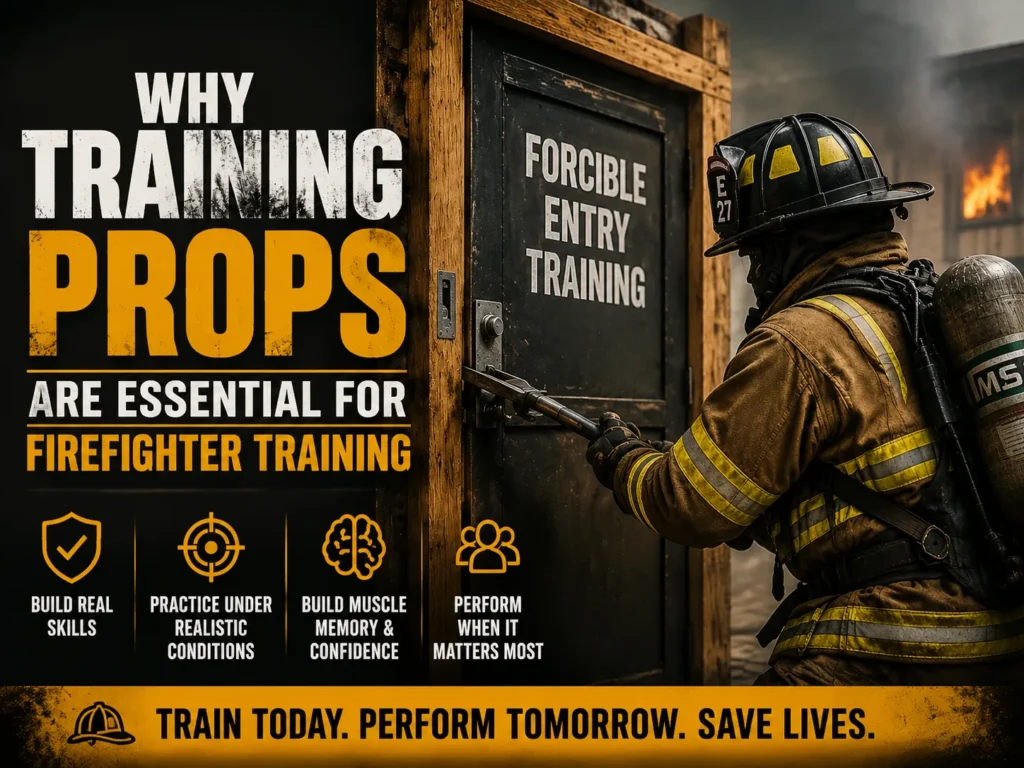
A firefighter can ace a written test on forcible entry technique and still freeze the first time a real door fights back. Knowing the steps and performing them under resistance are not the same skill, and the gap between them is exactly where training props live.
Too many departments treat props as optional gear, something to buy if the budget allows it after the trucks and turnout gear are squared away. That thinking has it backward. A whiteboard lecture on K-tool placement teaches a firefighter what a K-tool is for. It does nothing to teach how a door actually feels when the tool bites wrong, when the jamb is harder than expected, or when the lock setup throws a curveball nobody mentioned in class. Only a prop teaches that, and no amount of talking replaces it.
Fireground performance lives in the hands, not in the notes. Forcible entry, search, ventilation, RIC, every one of these disciplines depends on repetition against resistance that behaves like the real thing. Strip that resistance out of training, and you are left with theory wearing a uniform. Firefighters show up to a real door, a real wall, a real victim, and discover the gap between what they understood and what they could actually do, usually at the worst possible time to find out.
This article breaks down why props matter this much, what separates a prop that builds skill from one that just sits in the bay collecting dust, and how departments of any size can run a prop-based program without needing a six-figure budget.
Quick Answer
Training props matter because they force firefighters to practice physical skills under the most realistic resistance possible, building the muscle memory and trained reflexes that lectures and videos cannot create. A firefighter who has only watched a technique demonstrated has not learned it. They have only watched someone else learn it.
Knowledge Is Not the Same as Skill, and Pretending Otherwise Gets Firefighters Hurt
Here is a hard truth that a lot of training officers avoid saying out loud. A firefighter who explains forcible entry perfectly on a written test can still fail at the actual door. Explaining a technique and performing it under pressure are two different competencies entirely, and only one of them keeps a crew moving when the building is not cooperating.
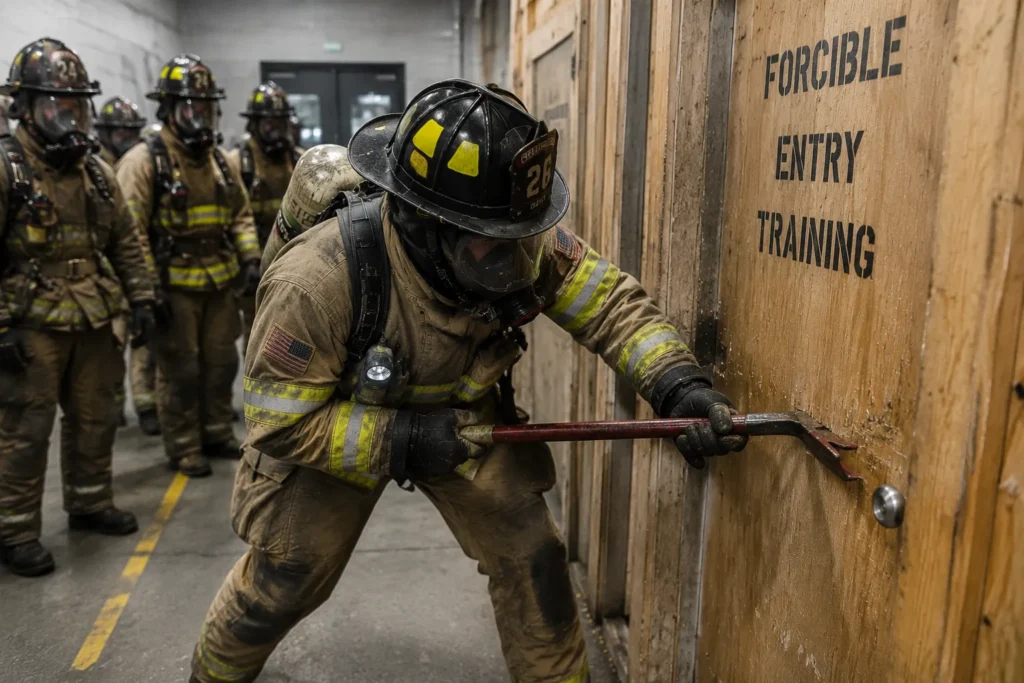
Props close that gap, and nothing else does it as well. A door prop forces a firefighter to feel exactly where the tool needs to go, how much force the irons actually demand, and what it feels like when a strike lands wrong. None of that transfers through a slideshow. The brain encodes physical skill differently from verbal knowledge. Repetition against a resistant surface builds procedural memory, the kind that fires automatically under stress. A lecture only builds declarative memory, the kind that requires conscious recall, a firefighter does not have time for at 2 AM in a smoke-filled hallway.
That difference matters most exactly when conditions are worst. A firefighter with SCBA, in zero visibility, with a crew waiting on the other side of a door, does not have a spare second to recall a fact from a PowerPoint. They need a trained reflex. Props are the only thing that builds it.
What Happens When Departments Skip Realistic Props
Departments that lean on classroom instruction and skip hands-on prop work often do not notice the gap until a real incident exposes it in front of everyone. A firefighter who has only seen forcible entry demonstrated, not performed it, dozens of times against real resistance, hesitates at the door. That hesitation costs seconds. Seconds matter when there is fire on the other side or a victim inside who is running out of time.
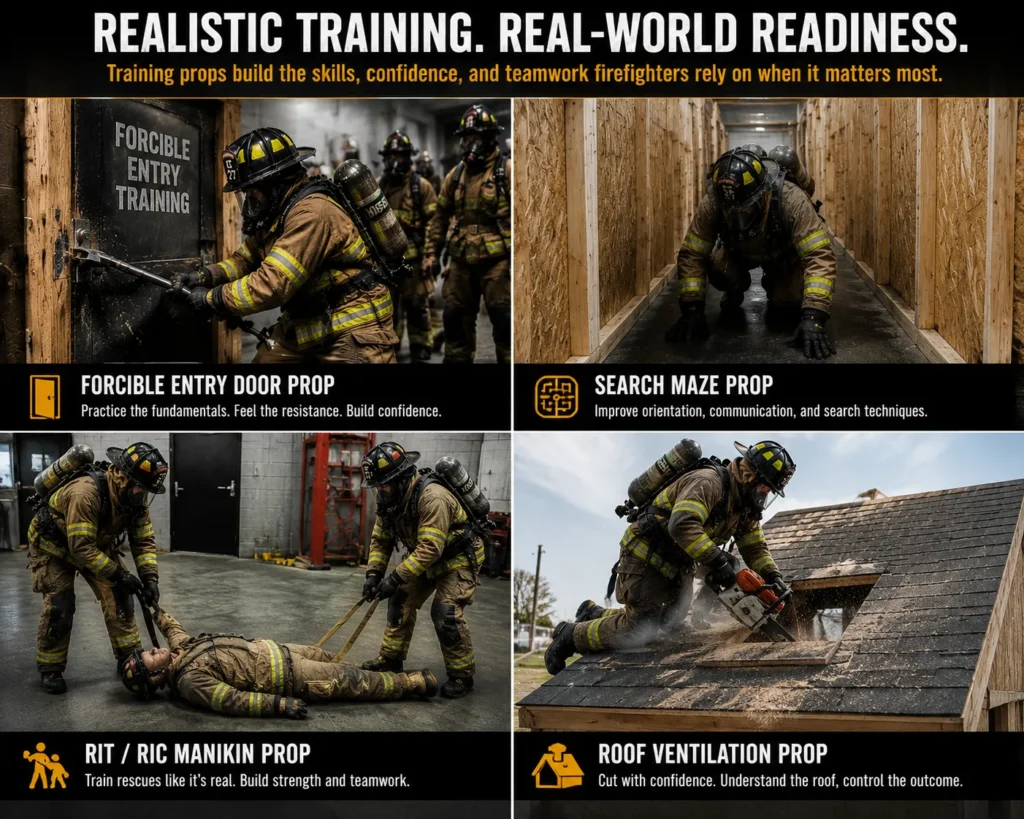
This same failure shows up across nearly every discipline in the fire service. Search training without a maze prop produces firefighters who move too fast or lose orientation the moment real smoke fills the room. RIC training without a weighted manikin produces crews who badly underestimate how physically brutal it is to drag a downed firefighter out of a structure. Vertical ventilation without a roof prop produces firefighters who have never actually felt how a roof responds to a saw cut, and that is not a small gap to discover live.
In every case, the failure is not a knowledge failure. It is a skill failure. And skill failures only get fixed with repetition against something real, not another video.
What Makes a Training Prop Actually Worth Having
Not every prop earns its place in a training bay. Plenty of departments own props that look impressive and teach almost nothing, because the people who bought them never asked what actually makes a prop effective.
A good prop offers resistance that mimics reality. A door prop with a flimsy lock mechanism teaches bad habits just as fast as a good prop teaches good ones, and bad habits learned on a soft prop will show up at the worst possible moment on a real door. The resistance has to be close enough to the real thing that the technique actually transfers.
A good prop also resets fast. A prop that breaks after five uses or needs major rebuild time between evolutions kills training momentum before the reps can stack up. Adjustability matters too. Firefighters progress at different speeds, and a prop that can scale difficulty, tighter tolerances, added complications, and multiple lock types keeps experienced members challenged while still serving newer firefighters learning the basics.
Above all, safety has to be built in. Realism should never come at the cost of avoidable injury. The best props let firefighters train hard, fail safely, and reset without the prop itself becoming a hazard.
Acquired structures deserve a specific mention here because nothing built on purpose fully replaces them. There is no substitute for training in a real building slated for demolition. Departments lucky enough to get access should prioritize forcible entry, search, and ventilation evolutions in these structures whenever possible, since nothing else replicates true construction variability the same way.
Matching the Prop to the Skill, Not the Other Way Around
Different skills demand different props, and matching them correctly is where a lot of training programs lose value fast. A generic, one-size-fits-all setup wastes training time on skills that actually need specific, targeted resistance to develop properly.
Forcible entry demands door props with interchangeable lock setups, varying jamb materials, and adjustable resistance, because real doors on real calls never behave identically twice. Search training needs maze props that reconfigure for different floor plans, low visibility conditions, and entanglement hazards. RIC training needs a weighted, realistically proportioned manikin, because dragging one hundred and seventy pounds of dead weight through a doorway teaches something a fifteen-pound dummy never will. Vertical ventilation needs roof props built with realistic decking and rafter spacing, ideally able to simulate different construction types crews actually respond to in their district.
How many departments do you think are running RIC drills on a manikin that weighs less than a fully loaded SCBA bottle? That gap matters, and it shows up the day a real RIC operation demands more from a crew than their training ever prepared them for.
Training Methods That Get the Most Out of a Prop
Owning a great prop and using it well are two completely different things. A prop sitting unused in the corner of the apparatus bay teaches nothing, no matter how much it cost. The method built around the prop determines whether that investment actually pays off on the fireground.
High-value prop training builds in progressive difficulty. Start with the basic technique under low pressure, then add a time standard, then add full PPE and SCBA, then add darkness or simulated smoke. Each layer closes the distance between training and the real environment a little further.
Scenario integration multiplies the value even more. Running a forcible entry prop in isolation teaches mechanics. Running that same prop as the entry point into a search evolution that flows into a simulated fire attack teaches the mechanics inside real fireground context, with a truck company forcing entry while an engine company stretches behind them and command is tracking both. That context is exactly what separates a trained reflex from an isolated party trick that only works in a quiet training bay.
Building a Prop Program Without a Massive Budget
Smaller and volunteer departments often assume realistic prop training requires money they simply do not have. That assumption holds plenty of capable departments back from training the way their firefighters deserve. In reality, plenty of effective props get built from salvaged materials, donated doors, and basic carpentry skills already sitting in most firehouses.
A functional door prop can be built from a salvaged door frame, used or acquired lock cylinders, and adjustable hardware. A search maze can be built from reclaimed lumber, pallets and tarps inside an existing bay. Neither solution requires the polish of a commercial training facility to deliver real training value. What matters is realistic resistance, not a high price tag, and departments that wait for budget approval before training hard are making excuses, not decisions.
For departments that want a faster path or access to props beyond what they can build internally, dedicated training facilities and instructor-led courses fill that gap efficiently. Brass Shamrock Training builds prop-based evolutions directly into Truck Academy and Forcible Entry courses specifically because hands-on repetition against real resistance is where skill actually gets built, not in a classroom seat watching a slideshow.
Leadership Decides Whether Props Get Used or Just Displayed
Officers decide whether prop training becomes a habit or stays a once-a-year photo opportunity. When leadership schedules regular reps on the props already sitting in the bay, crews notice and follow that lead without being told twice. When props collect dust because nobody prioritizes the time, firefighters notice that too, and the standard drops right along with it.
The best officers treat prop maintenance with the same seriousness as apparatus checks. A door prop with a broken mechanism or a roof prop with rotted decking sends the same message as a hose line nobody bothers to test before it is needed. Departments serious about readiness build prop upkeep and scheduled reps directly into the training calendar instead of leaving it to chance, or worse, to whoever happens to feel motivated that week.
Final Thoughts
Props are not an accessory to firefighter training. They are the mechanism that turns understanding into ability. A department that talks about technique without ever putting hands on resistant material is building firefighters who know the theory and freeze at the door when it counts.
Invest in props that resist realistically, reset fast, and scale with experience, then build the training cycle around using them consistently. That combination, not the size of the budget, decides whether a department’s training actually shows up on the fireground when everything is on the line.
Frequently Asked Questions
Why are training props important for firefighters?
Training props let firefighters practice physical skills against realistic resistance, building the muscle memory and trained reflexes that lectures and videos cannot create on their own.
What makes a good firefighter training prop?
A good prop offers realistic resistance, resets quickly for repeated use, scales in difficulty, and includes built-in safety features so firefighters can train hard without unnecessary injury risk.
Can small or volunteer departments build effective training props?
Yes. Many effective props come from salvaged doors, basic hardware, and simple carpentry, proving that realistic resistance matters far more than an expensive build.
How often should firefighters train on props?
Perishable skills like forcible entry and search demand frequent, recurring reps rather than occasional sessions, since physical skill decays fast without reinforcement.
