
Introduction
Modern fire departments face challenges that are far more complex than traditional firefighting operations. Today’s emergency responders must manage high-rise rescues, hazardous-material incidents, vehicle extrications, technical rescues, and rapidly evolving urban emergencies, often under extreme pressure and within seconds of arrival. In this demanding environment, truck company training has become one of the most critical investments for modern fire departments.
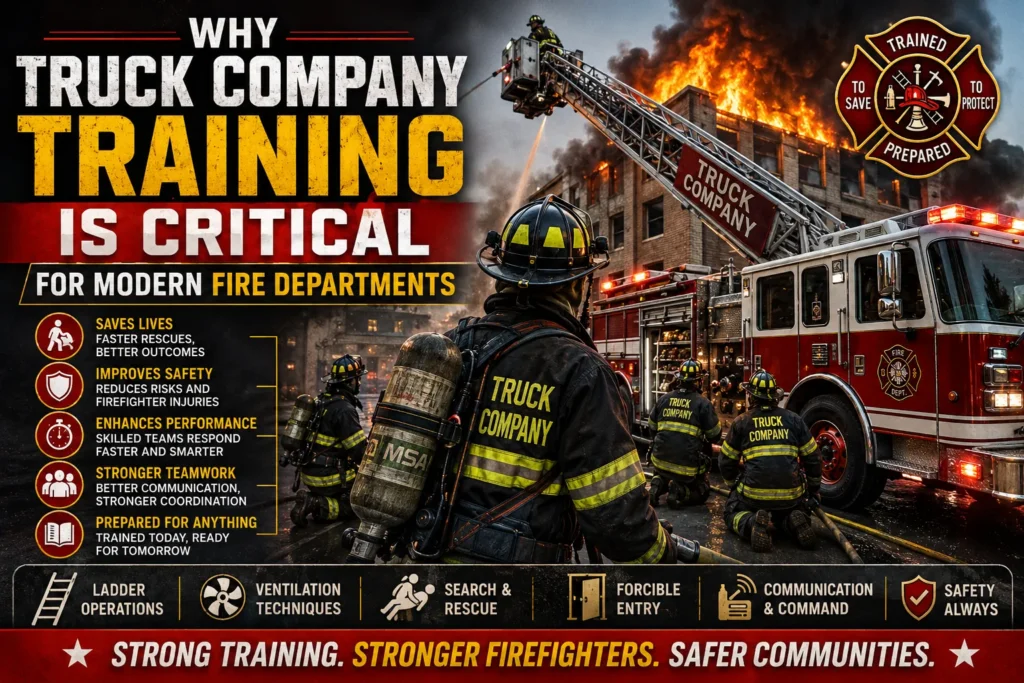
Truck companies have a specific role to play during a fire. Truck companies include the functions of ventilation, forcible entry, search and rescue, ladder operations, utility control, overhaul, and scene stabilization, while engine companies are primarily concerned with water supply and fire suppression. The duties involve being precise, coordinated, skilled, and constantly trained.
If a fire department doesn’t receive adequate training from the truck company, they may experience delayed response, higher firefighter injury rates, ineffective communication, and potentially deadly scenarios during an emergency. But departments that make advanced training for their truck companies a priority see their operational times, firefighter safety, and community trust all improve.
This comprehensive book delves into the importance of truck company training in contemporary fire service, how it enhances emergency response, and the approaches that departments can take to ensure they remain prepared in the current high-risk emergency environment.
What Is Truck Company Training?
Truck company training is the education, drills, simulations, and operational training that is specific to the operator of the ladder truck and rescue company.
This training focuses on critical emergency functions such as:
- Ladder placement and operation
- Ventilation techniques
- Search and rescue procedures
- Forcible entry methods
- Roof operations
- Technical rescue coordination
- Fireground communication
- Victim removal strategies
- Building construction awareness
- Rapid intervention tactics
At emergency scenes, crews from truck companies are frequently called upon to perform the most difficult, physically exhausting, and technically challenging duties. Hence, it is essential for continuous training to stay prepared and minimise operational risks.
Why Modern Fire Departments Depend on Truck Company Training
Fire departments no longer respond slowly to structure fires. Emergency services now include medical calls, industrial accidents, active disaster zones, and complex rescue incidents.
Firefighters need to learn to adapt to: In dense urban areas, as buildings become more sophisticated:
- Taller structures
- Modern lightweight construction
- Hazardous materials
- Renewable energy systems
- Smart building technologies
- Increased traffic incidents
- Climate-related emergencies
Through training from the truck companies, firefighters learn the knowledge and skills needed to work safely and effectively in these changing circumstances.
- Truck Company Training Improves Firefighter Safety
Firefighter safety is one of the primary reasons for the need for truck company training for contemporary fire departments.
Poorly trained crews face greater risks during:
- Roof ventilation operations
- Structural collapses
- Smoke-filled rescues
- Electrical hazards
- High-angle rescues
- Ladder operations
Provided a comprehensive training so firefighters can quickly identify danger and make safer decisions under pressure.
Key Benefit
Departments with structured training programs often report lower injury rates and stronger operational confidence among firefighters.
- Faster Search and Rescue Operations Save Lives
Time is the most important commodity in structure fires. Primary searches and victim rescues are usually performed by truck companies.
Proper training improves:
- Victim search speed
- Room orientation skills
- Fireground navigation
- Thermal imaging usage
- Communication efficiency
- Team coordination
Why It Matters
Research has consistently demonstrated that exposure to smoke for a few minutes significantly reduces the chances of survival.
Highly trained truck crews increase the likelihood of successful rescues.
- Advanced Ventilation Techniques Reduce Fire Spread
Ventilation is one of the most dangerous and misunderstood aspects of firefighting.
Incorrect ventilation can:
- Intensify fires
- Create flashover conditions
- Endanger trapped occupants
- Harm interior crews
Truck company training teaches firefighters how to coordinate ventilation with suppression operations safely.
Essential Training Areas
- Vertical ventilation
- Horizontal ventilation
- Positive pressure ventilation
- Hydraulic ventilation
- Smoke management tactics
Modern ventilation training is especially important because newer building materials burn hotter and faster than older construction methods.
- Ladder Operations Require Constant Practice
Ladder truck operations involve precision, timing, and teamwork.
Firefighters must know how to:
- Deploy aerial ladders quickly
- Position the apparatus effectively
- Rescue victims from elevated areas
- Operate in tight urban spaces
- Avoid power line hazards
Even experienced firefighters require repetitive ladder drills to maintain proficiency.
Important Insight
Minor mistakes in deployment can prove life-threatening for firefighters and civilians alike.
- Building Construction Knowledge Prevents Tragedies
The fire behavior of modern buildings is different from that of older buildings.
Lightweight materials can begin to fail quickly when exposed to heat, which can lead to collapses.
Truck company training includes education on:
- Structural integrity
- Roof systems
- Fire behavior
- Collapse indicators
- Occupancy types
- Hidden fire spread
Why This Training Is Critical
Understanding building construction allows firefighters to anticipate hazards before catastrophic failures occur.
- Technical Rescue Incidents Are Increasing
Modern truck companies frequently respond to:
- Vehicle extrications
- Confined space rescues
- Trench collapses
- Rope rescues
- Industrial accidents
- Machinery entrapments
These incidents require specialized skills and advanced equipment knowledge.
Operational Advantage
Departments with highly trained truck companies can stabilize scenes faster and improve victim survival outcomes.
- Strong Communication Training Enhances Coordination
Fireground communication failures are a major contributor to operational confusion and injuries.
Truck company training strengthens:
- Radio discipline
- Command coordination
- Tactical reporting
- Accountability systems
- Emergency evacuation communication
Critical Outcome
Clear communication ensures all crews understand assignments, hazards, and changing fire conditions.
- Realistic Scenario-Based Drills Build Confidence
Classroom learning alone is not enough for emergency response readiness.
Modern fire departments use realistic simulations to replicate:
- High-rise fires
- Nighttime rescues
- Multi-casualty incidents
- Structural collapses
- Hazardous material emergencies
Scenario-based training prepares firefighters to make effective decisions under stress.
Why It Works
Muscle memory and repetitive exposure improve reaction speed during real emergencies.
- Truck Company Training Reduces Liability Risks
Fire departments face increasing legal scrutiny following major incidents.
Poor training can lead to:
- Operational negligence claims
- Increased injury lawsuits
- Insurance complications
- Public criticism
Documented training programs demonstrate a department’s commitment to safety and professionalism.
Business Perspective
Investing in training often reduces long-term financial and legal exposure.
- Modern Equipment Requires Specialized Knowledge
Today’s fire trucks contain advanced technologies such as:
- Thermal imaging systems
- Hydraulic rescue tools
- Drone integration
- Digital communication systems
- Electric vehicle response equipment
Truck company training ensures firefighters can operate these systems effectively during emergencies.
Growing Challenge
Technology evolves rapidly, making continuous education essential.
- Teamwork Improves Through Consistent Training
Truck operations depend heavily on coordination and trust.
Well-trained crews develop:
- Faster decision-making
- Better situational awareness
- Improved accountability
- Stronger leadership
- Efficient task delegation
Key Observation
High-performing truck companies function as synchronized teams rather than individual firefighters working independently.
- Mental Preparedness Is Just as Important as Physical Skills
Emergency scenes create intense emotional and psychological pressure.
Truck company training increasingly includes:
- Stress management
- Decision-making under pressure
- Mental resilience
- Critical incident preparation
Why This Matters
Mental preparedness helps firefighters remain focused during life-threatening situations.
- Continuous Training Creates a Stronger Safety Culture
Departments that focus on the training of truck companies build cultures around professionalism, discipline, and accountability.
This culture encourages firefighters to:
- Follow procedures
- Share operational knowledge
- Report safety concerns
- Improve continuously
Long-Term Impact
A strong safety culture improves morale, operational efficiency, and public confidence.
Common Challenges Facing Modern Fire Departments
Despite the importance of truck company training, many departments face obstacles such as:
- Budget limitations
- Staffing shortages
- Aging equipment
- Limited training facilities
- Time constraints
- Increased call volumes
However, departments that overcome these challenges through strategic planning often achieve stronger operational outcomes.
Best Practices for Effective Truck Company Training
Use Hands-On Drills
Practical exercises build confidence and improve skill retention.
Incorporate Realistic Scenarios
Simulated emergencies prepare crews for real-world conditions.
Train Across Multiple Disciplines
Cross-training improves adaptability during large incidents.
Evaluate Performance Regularly
Routine assessments identify weaknesses before emergencies occur.
Prioritize Leadership Development
Strong officers improve crew coordination and decision-making.
The Future of Truck Company Training
The future of fire service training will likely include:
- Virtual reality simulations
- AI-assisted scenario planning
- Drone-supported operations
- Smart building integration
- Data-driven performance tracking
Departments that embrace innovation will remain better prepared for increasingly complex emergencies.
Conclusion
For today’s fire departments, truck company training is not a luxury; it’s a necessity. Some of the most hazardous and critical duties of a truck company are search and rescue, ventilation, technical rescues, and laddering.
A well-trained truck crew can help save lives, prevent injuries to firefighters, enhance the effectiveness of operations, and build confidence in the community. However, as challenges on the fireground keep changing, departments investing in the advanced training of their truck company will continue to be able to protect firefighters and civilians.
The contemporary fire service requires swiftness, accuracy, flexibility, and leadership. By training fire departments continuously and as part of a truck company, the fire department can do so with confidence and professionalism.
In today’s emergency high-risk environment, preparation is not just an advantage; it’s a matter of life and death.
Frequently Asked Questions
What does a truck company do in the fire service?
Truck companies handle specialized firefighting tasks such as ventilation, search and rescue, ladder operations, forcible entry, and scene stabilization.
Why is truck company training important?
Truck company training improves firefighter safety, rescue efficiency, communication, and operational performance during complex emergencies.
How often should truck company training occur?
What are the biggest risks truck companies face?
Major risks include structural collapse, smoke exposure, falls, electrical hazards, flashovers, and communication failures.