
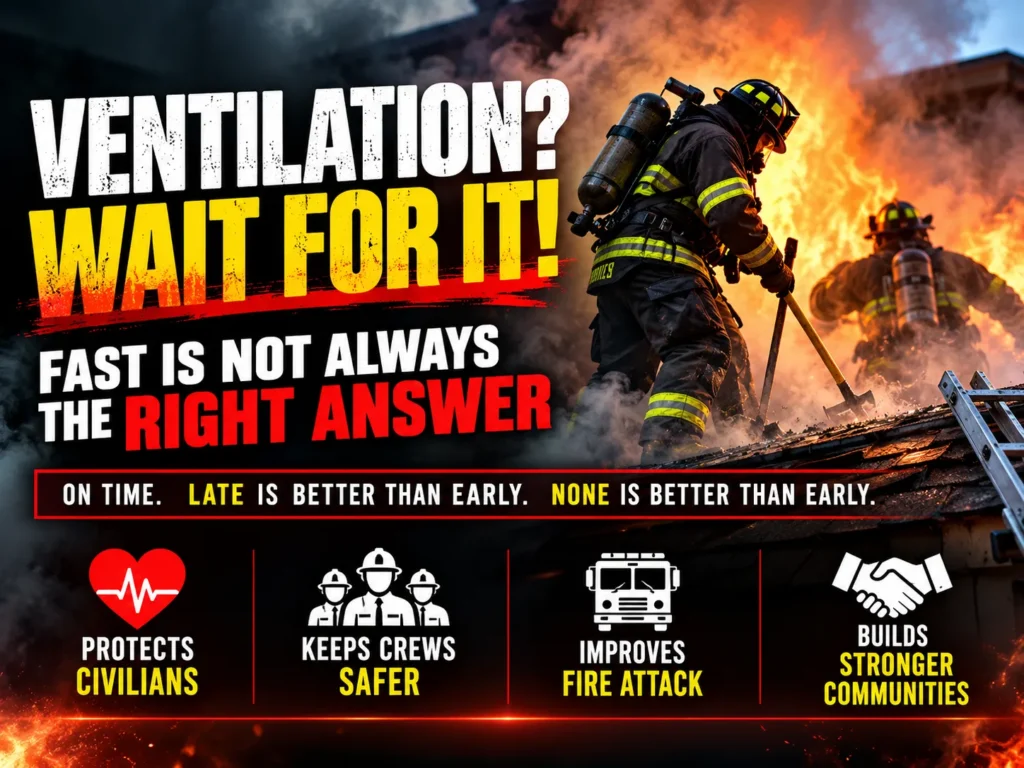

Fast is not always the right answer
Truck companies should be built for speed. Truckies should be built likewise. Speed saves lives. Water saves lives. Vent saves lives. A good plan, trained regularly, implemented with speed and purpose. Action proceeds from decision and Truck decisions should be deliberate, though never delayed.
Ventilation needs timing and action. Timing is the key. Ventilation action, when it is warranted, must be quick and decisive. When the time is right, vent. Don’t be early. Late is better than early. No ventilation is better than early ventilation.
Default is on time. Late is better than early. None is better than early.
On time has a definition. Nick Papa sets it in Coordinating Ventilation (2nd ed.): no opening before suppression until at least a charged handline is moving in, able to flow water and reach the seat of the fire. FSRI’s work, as Nick summarizes it, found that venting in step with water, just before it or at the same moment, improved conditions along the crew’s path without pushing heat beyond the fire room.
That is what on time buys. Anything ahead of it buys the opposite. An opening made before water hands air to the fire. Fire uses that air to grow. Fire growth is bad for everyone but is particularly harmful to civilians. FDNY Chief Edward McAniff said it in 1974: “Once ventilation has been started, the time for effective extinguishment is limited.”
That is why late ranks above early, and why no vent at all ranks above early.
Why early is the worst answer
The hierarchy turns on one question: which mistake can you take back?
A broken window can’t be fixed. Neither can a hole in the roof. A door can be closed but that is typically an isolating rather than venting maneuver. Once the glass is out or the roof is open, the air is committed, and nothing the truck does afterward takes it back.
Late costs the engine crew. They work longer in heat and poor visibility, and the job takes more time. They will flow water, cool the space, cause gas contraction, but there is no doubt in my mind that the engine will have a more difficult time without a vent than with it. Success may be delayed but will rarely be denied without additional venting. That cost is real for the engine crew, but limiting additional ventilation is unlikely to make things worse for the civilian inside.
If early ventilation costs, it costs the civilian and the engine crew. The fire gets the air before the water does, grows, and spreads. Temperatures rise, oxygen falls, survivability suffers.
Ventilation should help the crew, but only if it does no harm to the civilian.
None of this means early is bad on the fireground writ large. Often, early is the right answer. Calling the next alarm early is the safe error, because over-calling costs some staging and under-calling can’t be undone. Getting in position to vent as early as possible is the same kind of right. It is the speed side of truck work. Being in position early is good. Making the opening early is not.
The pushback
We vent for life. We have a failure to disagree that life is one of the purposes of vent. Going back to Nick Papa, (P. 68) “The only potential exceptions are when the affected area is or can be promptly isolated from the fire, or the opening is being created to effect the rescue of a known victim.” A known victim rescue is a deliberate decision to accept the risk for a specific person.
“Withholding vent kills people too.” It can. But the hierarchy governs the window before water. Once water is on the fire, vent hard. “None is better than early” does not mean none.
“Late isn’t free.” Correct. Late costs the crew, and I’m not pretending otherwise. Late is better than early. It isn’t good. The target is on time.
Getting there
Communicate, communicate, communicate. Is the vent ready? Easy enough for a window, tougher for a roof. Ready by the window means in position to take it. Ready on the roof means the same with the added measure of cutting 4 sides of the hole and leaving the roofing, and ceiling, in place. Ready to vent. Standing by to vent. In position to vent. Use whatever terminology you want but indicate you are ready.
The word you wait for
Nobody gets credit for a window they didn’t take or the roof they did not open. Nobody is (or should be) looking for credit in the first place. We pursue excellence and craftsmanship because that is what the oath requires. Credit is ego and there is no room for it on the fireground. If the engine asks you to vent, vent. If you must wait, wait. If you can see or hear the engine smashing the fire, vent. When in doubt, wait. Not sure, wait. Unclear transmission, wait. On time is best. Late is next. None is next. Early is unprofessional.
Reference: Nicholas Papa, Coordinating Ventilation, 2nd Edition.